


Quick Summary
Astronomers have made a groundbreaking detection: an incredibly powerful, laser-like signal originating from a galaxy a staggering eight billion light-years away. This cosmic beacon is not believed to be a sign of alien life, but rather a rare natural phenomenon.
What Happened
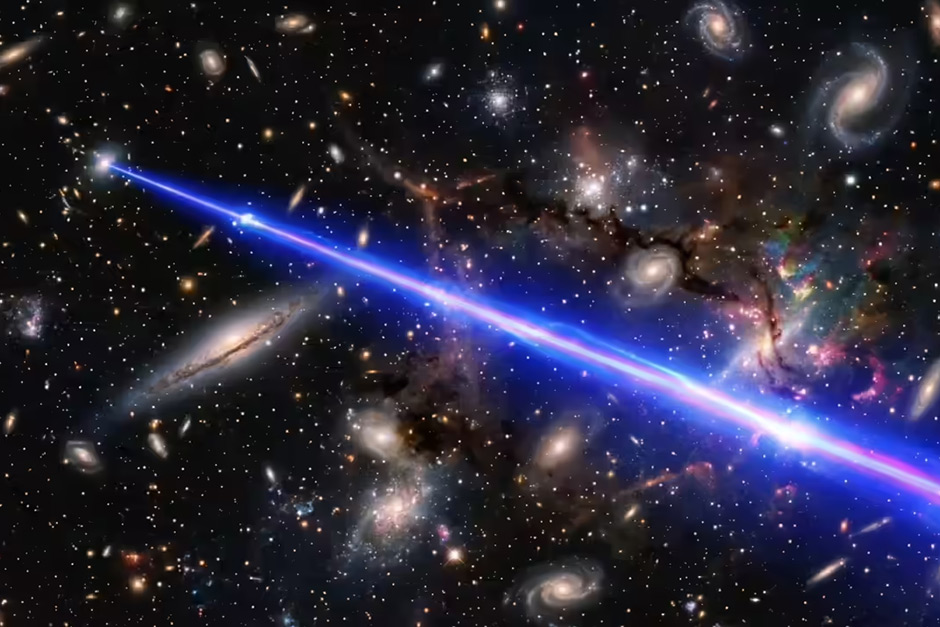
Using the European Southern Observatory’s Very Large Telescope (VLT) in Chile, researchers identified an extraordinarily bright and narrow beam of light. This ‘mega-laser’ signal, technically known as a maser (microwave amplification by stimulated emission of radiation), is the most distant and powerful of its kind ever observed.
The signal traces back to a galaxy so far away that the light we’re seeing began its journey when the universe was less than half its current age. Its intensity is baffling scientists.
Why It Matters
This unprecedented discovery significantly challenges our current understanding of celestial mechanics and the most energetic events in the cosmos. While the prospect of extraterrestrial intelligence often sparks excitement, scientists believe this is a natural, albeit extreme, astrophysical event.
It provides invaluable new insights into galaxy evolution and high-energy physics in the early universe. As one astronomer reportedly stated, “This is truly unprecedented, a signal of immense power that pushes the boundaries of our current models for cosmic phenomena.”
Bottom Line
The detection of this ‘mega-laser’ offers a rare and powerful glimpse into the universe’s most extreme processes, opening new avenues for research into the vast and mysterious cosmos.

