


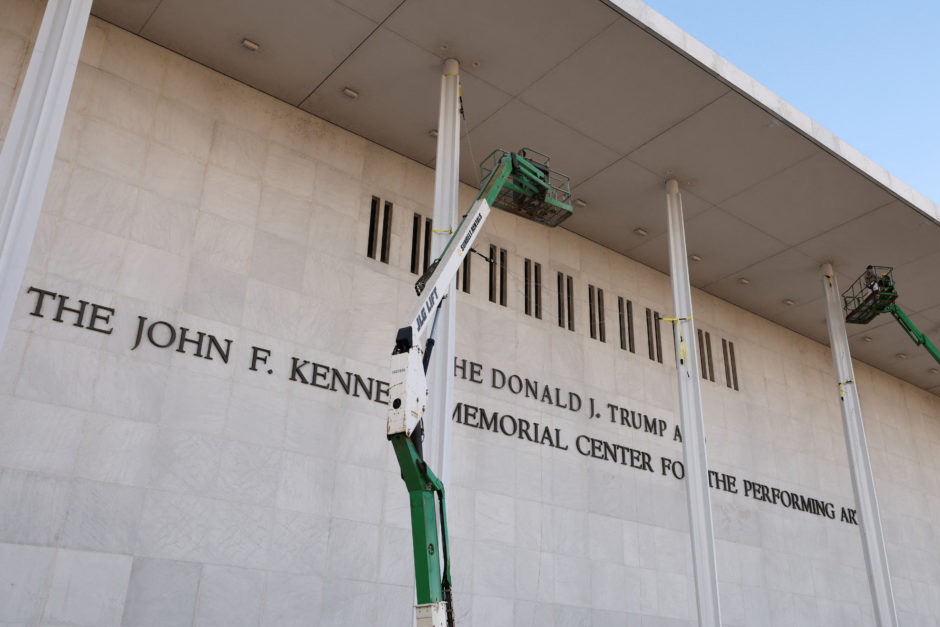
In a significant legal development drawing attention across the globe, including in India where US political narratives often spark considerable interest, a federal judge in Washington D.C. has issued a landmark ruling concerning the John F. Kennedy Center for the Performing Arts. U.S. District Court Judge Royce Lamberth has ordered the removal of Donald Trump’s name from a plaza at the revered national cultural institution and, crucially, blocked a contentious plan to close two of its vital performance venues. This decision underscores the sanctity of donor agreements, the autonomy of cultural institutions, and the enduring power of judicial oversight, even against the backdrop of high-profile political figures.
Upholding Donor Intent: The Naming Controversy
The saga surrounding Donald Trump’s name at the Kennedy Center began with a substantial federal allocation. In 2017, Congress approved $100 million for the Kennedy Center’s “REACH” expansion project, a significant undertaking designed to add classrooms, studios, and new public spaces. Following this, the Kennedy Center’s board decided to name a public space the “Donald J. Trump Presidential Plaza”, a move that sparked considerable debate and controversy among patrons, artists, and the wider public. The naming was ostensibly in recognition of Trump’s role in securing these federal funds.
However, Judge Lamberth’s recent ruling found that the Kennedy Center had violated the terms of its own agreements when it permitted the affixing of the then-president’s name to a public space within the institution. The judge’s decision hinges on the principle of donor intent and the specific conditions tied to federal funding. The original agreements, it was argued, stipulated how such funds could be acknowledged and that the naming violated these pre-existing contractual obligations. For many, this judicial intervention reinforces the idea that cultural institutions, even those reliant on public funding, must adhere strictly to foundational agreements and resist pressures that could compromise their independence or original mission.
This aspect of the ruling resonates in India, where the naming of public infrastructure and institutions after political figures is a common practice, often leading to debates about legacy, appropriateness, and historical revisionism. The US court’s emphasis on legal agreements and institutional integrity offers a parallel lesson in governance and the protection of public spaces from overt political appropriation.
Preserving Performance Spaces: Blocking the Closure Plan
Beyond the naming dispute, Judge Lamberth’s ruling also delivered another critical blow to a separate, but related, administrative plan. The judge explicitly blocked the closure of two significant performance venues within the Kennedy Center: the Eisenhower Theater and the Terrace Theater. These theatres are central to the Kennedy Center’s mission, hosting a diverse array of theatrical productions, concerts, and cultural events that draw audiences from across the nation and beyond.
The plan to close these theatres was proposed by the General Services Administration (GSA), the federal agency responsible for managing government property, as part of the broader REACH expansion. The GSA argued that the closures were necessary for the comprehensive renovation and expansion. However, the Kennedy Center itself, acting as the plaintiff in this part of the lawsuit, contended that such closures were neither necessary nor mandated by the original agreements surrounding the federal funding and the expansion project. The court sided with the Kennedy Center, affirming that the GSA could not compel the institution to close these vital spaces.
This aspect of the ruling is a victory for cultural preservation and artistic continuity. It highlights the judiciary’s role in safeguarding cultural infrastructure from administrative dictates that could disrupt public access to the arts. As Judge Lamberth stated in his opinion, emphasising accountability: “The [Kennedy Center] cannot use the prospect of future litigation or the costs of complying with the agreements as an excuse for violating its own prior commitments.” This sentiment echoes the global importance of protecting artistic venues, which are often the lifeblood of a nation’s cultural identity and a critical platform for creative expression.
Broader Implications for Governance and Culture
This twin ruling from Judge Lamberth carries significant implications, both domestically for the US and as a case study for democracies worldwide. It reaffirms the principle of checks and balances, demonstrating how the judiciary can act as an impartial arbiter to uphold agreements and protect institutional autonomy against executive or administrative overreach. For cultural institutions, it provides a crucial precedent regarding the enforceability of donor contracts and the importance of safeguarding their core missions against external pressures.
For an Indian audience, the judgment offers a fascinating glimpse into the complexities of governance in a mature democracy. It showcases how legal battles, even those concerning cultural spaces, can reflect deeper struggles over power, influence, and the protection of public goods. The Kennedy Center ruling serves as a powerful reminder that the integrity of cultural institutions and the rule of law are cornerstones that must be vigilantly protected, irrespective of the political currents flowing through society.
The removal of a former president’s name under judicial order and the protection of performance venues signal a powerful message: even in a highly politicised environment, certain principles—like contractual integrity and the preservation of cultural heritage—can and must prevail. This decision will undoubtedly shape future interactions between government funding, institutional autonomy, and public perception of cultural landmarks.

