


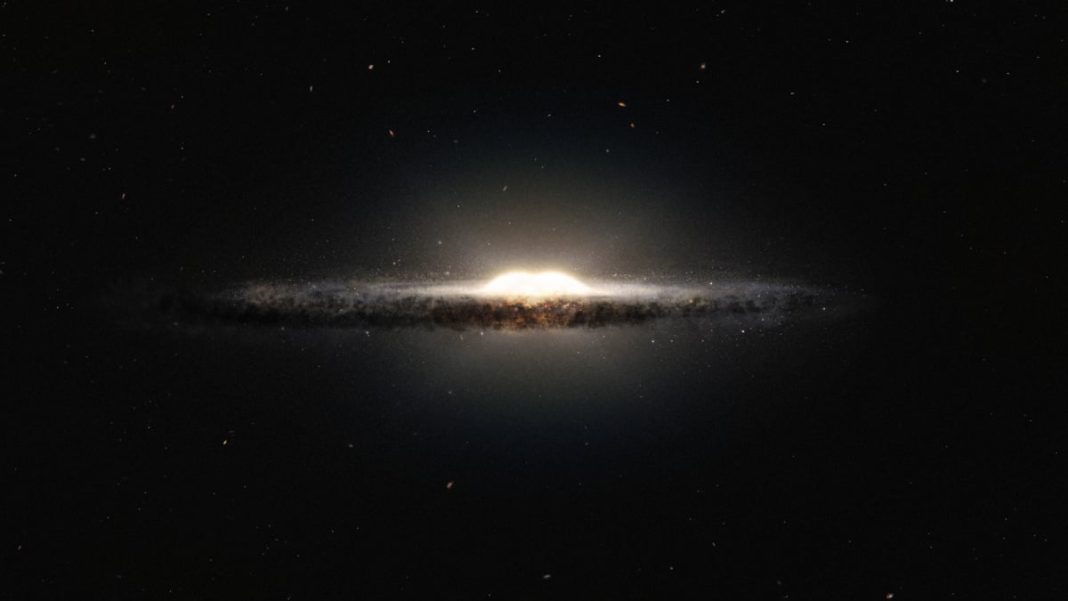
Imagine standing in the middle of a bustling metropolis, where countless stories unfold simultaneously across vast timescales. That’s a bit like our galaxy’s core, a region of incredible density, activity, and mystery. For years, its true nature remained largely obscured by dense clouds of dust and gas, making it one of the most challenging regions for astronomers to study. Fortunately, a certain venerable space telescope has been meticulously charting its hidden depths, helping us piece together the dramatic history of this cosmic heartland.
The Hubble Space Telescope, a collaboration between NASA and ESA, has been instrumental in providing unparalleled views into the heart of the Milky Way. Its unique capabilities allow scientists to peer through some of the cosmic veil, offering insights that are revolutionizing our understanding of how our galaxy formed and evolved.
Peering Through the Cosmic Dust
One of the biggest hurdles in observing the galactic center is the sheer amount of intervening dust. This dust effectively blocks most visible light, turning what would otherwise be a spectacular view into a blurry, indistinct haze from Earth-based telescopes using only visible light. Hubble, however, possesses advanced instruments capable of observing across a broader spectrum, including near-infrared light. While not a dedicated infrared telescope, its ability to capture these longer wavelengths, combined with its unmatched resolution, allows it to pierce through some of the obscuring material.
This capability has enabled astronomers to resolve individual stars and stellar clusters that would otherwise be invisible. By meticulously mapping these stars, scientists can begin to understand the distribution of matter and the forces at play in this extreme environment. It’s like clearing away a thick fog to finally see the distinct buildings and streets of that imagined metropolis, revealing its intricate architecture for the first time.
Charting Stellar Generations and Dynamics
With its sharp vision, Hubble has allowed astronomers to distinguish between different populations of stars in the galactic core. This distinction is crucial, as the age and type of stars tell us a great deal about the region’s history. We can identify ancient, metal-poor stars – relics from the early universe – alongside younger, more massive stars that have formed much more recently. The distribution of these stellar generations provides clues about past star formation events, potential mergers with smaller galaxies, and even periods of intense activity or quiescence in the galactic core.
Furthermore, Hubble’s long operational life has provided an invaluable advantage: the ability to conduct long-term observations. By repeatedly imaging the same regions over many years, scientists can track the subtle movements of stars. These stellar dynamics offer profound insights into the gravitational forces dominating the core, including the profound influence of Sagittarius A*, our galaxy’s supermassive black hole. The precision with which Hubble measures these movements allows for more accurate calculations of the black hole’s mass and its gravitational ‘sphere of influence,’ confirming its immense power.
Dr. Elara Vance, an astrophysicist studying galactic nuclei, remarked, “The sheer clarity and consistent long-term observations from Hubble have been indispensable. It’s like having a perfect time-lapse camera for a region that changes on timescales far beyond a human lifetime, allowing us to see echoes of ancient galactic processes with unprecedented detail.”
Untangling a Cosmic Tapestry
The journey to understand our galaxy’s core is an ongoing saga, with each Hubble image adding another thread to a complex cosmic tapestry. From revealing star-forming regions hidden within dense gas clouds to tracking the subtle dance of stars around a supermassive black hole, Hubble has been an unparalleled detective. It has helped us move beyond hazy theories to concrete observations, painting an ever-clearer picture of the violent, dynamic, and ultimately captivating history unfolding at the heart of our home galaxy. As we continue to gaze into the cosmos, Hubble remains a cornerstone of our quest to untangle these profound mysteries, bringing us closer to understanding our place in the universe.

