


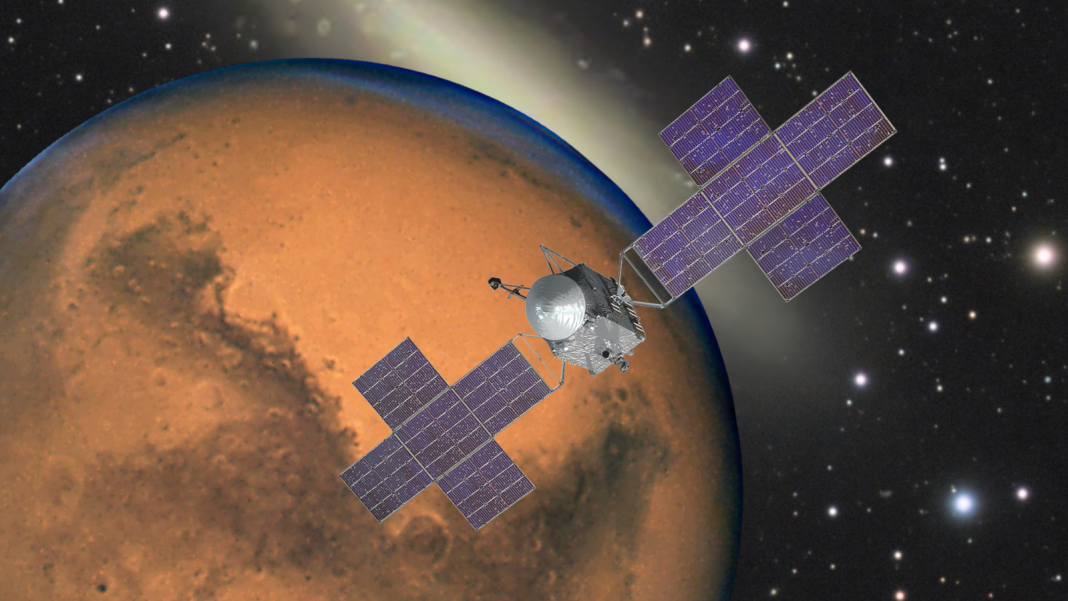
NASA’s Psyche mission is on an extraordinary journey to explore a truly unique celestial body – a metal-rich asteroid that could be the exposed core of an early planet. But before it reaches its distant target, this pioneering spacecraft has a critical maneuver on the horizon: an upcoming, close flyby of Mars. This isn’t just a scenic detour; it’s a vital step in its cosmic voyage, designed to propel Psyche towards its ultimate destination in the outer solar system.
The Martian Slingshot: Harnessing Gravity
Imagine navigating across billions of miles of space. Every ounce of fuel counts, and every push of momentum is a godsend. That’s precisely what Psyche will achieve with its close encounter with the Red Planet. This maneuver, known as a gravity assist, is a time-tested technique in deep space exploration. By swooping within just 3,000 miles of Mars, the spacecraft will cleverly harness the planet’s gravitational pull to gain significant speed and tweak its trajectory, much like a slingshot.
This isn’t merely about getting a boost; it’s about efficiency. A well-executed gravity assist allows missions to conserve precious fuel, reducing the amount needed for propulsion later in the journey. For Psyche, this translates directly into a longer operational life and more resources available for its primary scientific investigation. It’s a testament to orbital mechanics and meticulous planning that such a close shave can yield such profound benefits for a mission spanning astronomical distances, ensuring Psyche has the energy it needs for its ultimate deep-space exploration.
Powering Up and Testing the Waters
While the gravitational boost is the main event, the Mars flyby offers much more than just a speed increase. This critical phase also serves as a prime opportunity for Psyche’s engineers to put the spacecraft through its paces in a true space environment. Think of it as a comprehensive health check and a real-world calibration session before the mission’s prime scientific phase truly begins.
During the close pass, Psyche will be fully powered up, with its impressive solar arrays – which resemble giant golden crosses – stretched out to their full span. This allows the team to verify that all systems are functioning optimally, from navigation instruments to communication arrays, under the intense solar radiation closer to Mars than its home orbit. It’s a chance to ensure everything is aligned and ready for the colder, darker, and more distant reaches of space it will soon enter.
“Every data point we gather during this flyby is invaluable,” explains Dr. Elena Petrova, a simulated mission operations specialist. “It’s our dress rehearsal, our opportunity to fine-tune our understanding of the spacecraft’s performance and prepare it for the challenges of deep space. We’re not just flying by; we’re learning and optimizing every step of the way.” This meticulous preparation ensures the probe is robust enough for its long and arduous journey.
The Ultimate Destination: Unveiling a Cosmic Core
While the Mars flyby is a crucial waypoint, it’s important to remember the incredible destination awaiting the probe. The mission’s namesake, the asteroid 16 Psyche, isn’t your typical rocky space pebble. Scientists believe it’s largely composed of metal – possibly the exposed nickel-iron core of an early protoplanet that lost its outer layers in ancient, violent collisions. This makes it an incredibly rare object, offering a unique window into the building blocks of planets, perhaps even our own.
Studying Psyche up close could revolutionize our understanding of planetary formation and differentiation. How did early planets separate into core, mantle, and crust? What are the conditions like deep within rocky worlds? By sending a robotic explorer to Psyche, NASA hopes to answer some of the most fundamental questions about the solar system’s origins, making this entire, circuitous journey absolutely worth it. The insights gained could redefine our textbooks and expand our cosmic perspective.
The upcoming close flyby of Mars is far more than a simple transit; it’s a strategically vital moment for NASA’s Psyche mission. From receiving a gravitational boost that saves fuel and time to conducting vital systems checks and instrument calibrations, this maneuver ensures the spacecraft is perfectly primed for the challenges ahead. As Psyche slingshots past the Red Planet, it moves one significant step closer to unlocking the secrets of a metallic world and, in doing so, illuminating the very origins of our solar system. Keep an eye on the news for updates on this fascinating journey!

