


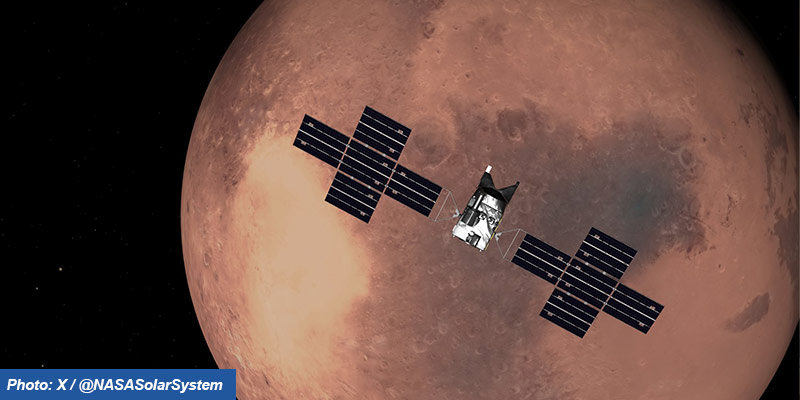
In a significant stride for deep-space exploration, NASA’s Psyche spacecraft recently received a crucial gravity assist from Mars, effectively propelling it further on its arduous journey to a unique, metal-rich asteroid of the same name. This celestial ‘slingshot’ maneuver, a marvel of precision engineering and orbital mechanics, not only saved precious fuel but also significantly accelerated the spacecraft, bringing it closer to unlocking secrets about the early solar system.
The successful flyby, which occurred on May 24, 2023, saw the Psyche spacecraft pass within approximately 3,780 miles (6,083 kilometers) of the Martian surface. This critical gravitational push marks a pivotal moment in the mission, setting the stage for its arrival at asteroid Psyche in 2029. For India, a nation rapidly expanding its footprint in space, missions like Psyche offer invaluable insights and inspiration, fostering a global scientific exchange that benefits all.
The Mars Sling-shot: A Masterclass in Celestial Mechanics
A gravity assist, often referred to as a “slingshot” maneuver, is a fundamental technique in interplanetary travel. It involves a spacecraft flying close to a planet or other celestial body, using its gravitational pull to gain speed or change direction without expending the spacecraft’s own fuel. For the Psyche mission, Mars served as this cosmic booster.
The spacecraft, launched aboard a SpaceX Falcon Heavy rocket on October 13, 2023, from NASA’s Kennedy Space Center, was initially aimed on a trajectory that would intercept Mars. As it approached the Red Planet, Mars’s immense gravitational field exerted a powerful pull, bending Psyche’s path and increasing its velocity relative to the Sun. This maneuver was meticulously planned and executed by a team of navigation experts, ensuring the spacecraft was on the precise course to leverage Mars’s gravity optimally.
Henry Stone, Psyche project manager at NASA’s Jet Propulsion Laboratory (JPL), aptly articulated the significance: “The spacecraft is healthy and on its way. We’re more than halfway to Psyche by distance, and in terms of getting all the gravity assists, we’re done. The team is excited.” This successful acceleration means Psyche is now hurtling towards its distant target with renewed momentum, conserving the onboard propellant that will be essential for finely tuning its orbit once it reaches the asteroid.
Journey to a Metal World: Unlocking Planetary Secrets
The ultimate destination of NASA’s Psyche mission is the asteroid 16 Psyche, a truly enigmatic object located in the main asteroid belt between Mars and Jupiter. Unlike most asteroids, which are rocky or icy, 16 Psyche is believed to be largely composed of metal—primarily iron and nickel. This unique composition makes it a scientific treasure trove.
Scientists hypothesize that 16 Psyche could be the exposed core of a protoplanet, an early planetary building block that lost its outer rocky layers due to violent collisions billions of years ago. By studying 16 Psyche up close, researchers hope to gain unprecedented insights into the formation of rocky planets, including Earth. Our own planet’s core is inaccessible, buried deep beneath its mantle and crust, making Psyche a natural laboratory for understanding planetary interiors.
Upon its arrival in 2029, the Psyche spacecraft will spend approximately 26 months orbiting the asteroid, using its suite of instruments—a multispectral imager, a gamma-ray and neutron spectrometer, and a magnetometer—to map its surface, study its composition, look for signs of a remnant magnetic field, and measure its gravity. The data collected could fundamentally change our understanding of planetary differentiation and the origins of metallic cores.
India’s Vision in the Cosmic Tapestry
For India, a nation with its own ambitious space program led by the Indian Space Research Organisation (ISRO), missions like Psyche resonate deeply. India has already demonstrated its prowess in interplanetary exploration with the successful Mangalyaan (Mars Orbiter Mission) and its ongoing lunar endeavors, including the recent Chandrayaan-3 moon landing. The success of Psyche’s gravity assist serves as a powerful reminder of the intricate engineering and collaborative spirit required for such missions.
While ISRO currently focuses on Mars, the Moon, and developing human spaceflight capabilities with Gaganyaan, the scientific objectives of missions like Psyche inspire a generation of Indian scientists and engineers. They highlight the global pursuit of knowledge and the interconnectedness of scientific exploration. The technological advancements derived from these missions, whether in propulsion, navigation, or instrument development, often have ripple effects, stimulating innovation and capacity-building across the world, including in India’s burgeoning space sector.
As humanity continues its quest to understand the universe, international missions like Psyche underscore a shared human endeavor. They foster a spirit of inquiry and collaboration that transcends national boundaries, encouraging countries like India to contribute their unique perspectives and capabilities to the grand tapestry of cosmic exploration.
The successful Mars gravity assist is more than just a navigational triumph; it’s a testament to human ingenuity and our unyielding desire to explore the unknown. As Psyche continues its solitary voyage through the void, the anticipation builds for the groundbreaking discoveries it promises to bring, potentially redefining our understanding of how planets, including our own, came to be.

