


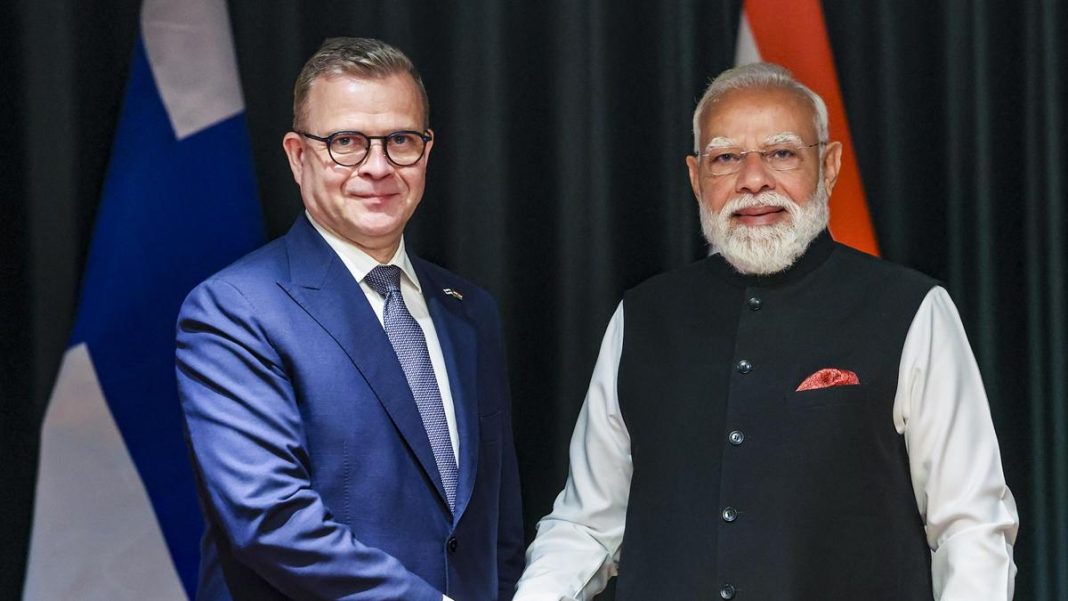
Finnish Prime Minister Sanna Marin’s recent remarks have underscored a dual aspiration from Europe towards India: a swift conclusion to the long-pending Free Trade Agreement (FTA) with the European Union, and a hopeful appeal for India to leverage its diplomatic influence in bringing an end to the ongoing conflict in Ukraine. These statements, delivered against a backdrop of complex global geopolitics and shifting economic alliances, highlight India’s growing strategic importance on the world stage, not just as an economic powerhouse but also as a potential peacebroker.
Deepening Economic Ties: The India-EU FTA Push
The pursuit of a comprehensive Free Trade Agreement between India and the European Union has been a significant point of discussion for over a decade. Negotiations, which began in 2007, were paused in 2013 due to various divergences, only to be formally resumed in June 2022. The renewed vigour in these talks reflects a mutual recognition of the immense economic potential that a robust trade pact could unlock for both sides.
For India, an FTA with the EU, its third-largest trading partner, promises greater market access for its goods and services, particularly in sectors like textiles, pharmaceuticals, and agriculture. It could also attract significant European investment and facilitate technology transfer, crucial for India’s manufacturing and digital ambitions. Conversely, the EU views India as a vast and growing market for its high-value products, machinery, and services. A successful FTA would diversify European supply chains, reduce reliance on other major economies, and strengthen strategic economic resilience.
Prime Minister Marin’s expressed wish to sign the FTA “soon” resonates with the broader European sentiment. Many EU member states, including Finland, recognise India’s burgeoning economy and its democratic values as critical in an increasingly uncertain global landscape. Strengthening economic ties with India is seen not just as a commercial opportunity but also as a strategic imperative to build a more balanced and resilient global economic order.
India’s Diplomatic Balancing Act and the Ukraine Conflict
The second, and perhaps more nuanced, part of Marin’s statement pertains to India’s role in the Ukraine conflict. Since the invasion began, India has maintained a carefully crafted diplomatic stance, advocating for dialogue and diplomacy while refraining from directly condemning Russia, its long-standing strategic partner for defence and energy needs. This position, often described as ‘strategic autonomy’, has been a hallmark of India’s foreign policy.
However, as the conflict prolongs, there is a growing global expectation for influential nations to contribute actively to peace efforts. India, as a significant emerging power, a member of the G20, and a nation with historical ties to both sides, is increasingly being looked upon to play such a role. European leaders, including Finland’s Prime Minister, see India’s unique position as potentially pivotal.
“We wish to sign the India-EU Free Trade Agreement soon, and we also hope that India plays a role in ending the Ukraine conflict,” Marin stated, encapsulating the dual agenda. This highlights a desire for India to align more closely with Western perspectives on geopolitical stability, even while acknowledging India’s unique constraints and relationships. India’s recent diplomatic engagements, including Prime Minister Narendra Modi’s conversations with both Russian President Vladimir Putin and Ukrainian President Volodymyr Zelenskyy, suggest that India is indeed exploring avenues for de-escalation, even if it hasn’t publicly taken on an overt mediation role.
Finland’s Perspective and India’s Global Stature
Finland’s perspective on the Ukraine conflict is particularly acute given its shared border with Russia and its recent decision to join NATO, reversing decades of military non-alignment. For a nation like Finland, the security implications of the war are immediate and profound. Therefore, their appeal for any nation to contribute to ending the conflict carries significant weight.
The fact that Finland’s Prime Minister specifically highlights India underscores its growing stature. India is no longer merely a regional power but a significant player whose actions and stances have global repercussions. Its demographic dividend, robust economic growth, and commitment to democratic principles make it an attractive and influential partner for many nations. The EU and its members recognise that engaging with India, both economically and diplomatically, is crucial for addressing contemporary global challenges, from climate change to geopolitical instability.
The call for India to act on Ukraine, alongside the push for the FTA, signifies a broader European strategy to integrate India more deeply into the Western-aligned global order, or at least encourage it to use its influence to support principles of sovereignty and territorial integrity that the West champions. India’s ability to navigate these complex expectations while safeguarding its own national interests will define its diplomatic trajectory in the coming years.
Prime Minister Marin’s statements serve as a clear indicator of India’s evolving global relevance. As negotiations for the India-EU FTA continue, and as the world watches for any diplomatic breakthroughs in Ukraine, India finds itself at a crucial juncture, balancing economic aspirations with geopolitical responsibilities. The nation’s responses to these intertwined challenges will undoubtedly shape its future role in the emerging world order.

