


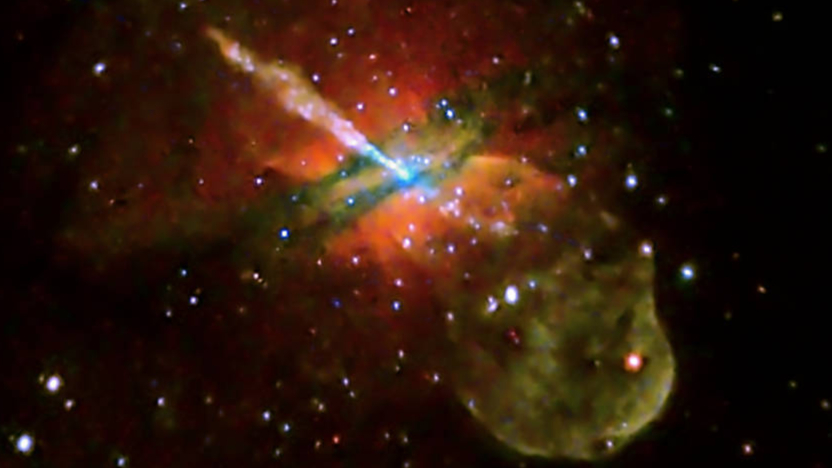
In the vast, dynamic theatre of the cosmos, few phenomena are as awe-inspiring and profoundly impactful as supermassive black holes. These colossal gravitational behemoths, dwelling at the heart of nearly every galaxy, are not merely cosmic vacuum cleaners; they are also the engines behind some of the universe’s most powerful displays: highly energetic cosmic jets. These spectacular outflows, traveling at near light-speed, are not just a spectacle; they are fundamental architects, shaping galaxies and regulating the very evolution of the universe itself, a subject of intense global scientific inquiry that India’s astronomical community keenly follows and contributes to.
The Heart of Darkness: Supermassive Black Holes as Cosmic Engines
At the core of this cosmic drama lie supermassive black holes (SMBHs), entities whose masses range from millions to billions of times that of our Sun. Our own Milky Way harbours Sagittarius A*, an SMBH approximately four million times the Sun’s mass. These titanic objects, while often perceived as passive absorbers, are incredibly active. Their immense gravity pulls in vast amounts of gas and dust from their surroundings, forming a swirling, superheated accretion disk. Within this disk, matter spirals inward, generating colossal friction and releasing extraordinary amounts of radiation across the electromagnetic spectrum before finally crossing the event horizon.
It is from the innermost regions of this turbulent accretion disk that the cosmic jets are born. While the exact mechanism is still a subject of active research, it is understood that powerful magnetic fields play a pivotal role. These fields, twisted and amplified by the black hole’s immense gravity and the rapid rotation of the accretion disk, act like a cosmic slingshot. They channel and accelerate plasma—a superheated gas of ionized particles—away from the black hole’s poles, launching it into intergalactic space.
Unleashing Unfathomable Power: The Cosmic Jets Explained
What makes these cosmic jets truly extraordinary is their sheer power and scale. They are highly collimated beams of matter and energy that can extend for hundreds of thousands, sometimes even millions, of light-years. Traveling at speeds approaching the speed of light, these jets are energetic enough to punch through entire galaxies and influence gas far beyond their galactic hosts. Their luminosity in radio waves, X-rays, and even gamma rays makes them detectable across immense cosmic distances, offering astronomers a window into the universe’s most extreme environments.
Observations by powerful radio telescopes, including India’s own Giant Metrewave Radio Telescope (GMRT) near Pune, contribute significantly to our understanding of these jets. GMRT, with its unparalleled sensitivity to low-frequency radio waves, is instrumental in mapping the diffuse emission from these jets as they interact with the intergalactic medium. Indian astrophysicists, often collaborating with international teams, use such data to model the dynamics, energy transport, and long-term effects of these cosmic phenomena.
These jets are not merely a byproduct of black hole activity; they are crucial regulators of galaxy evolution. They can inject immense amounts of energy into the gas reservoirs of galaxies, heating it up and preventing it from cooling down and forming new stars. This process, known as “feedback”, is a fundamental mechanism by which supermassive black holes can halt star formation, shaping the size and star-forming activity of their host galaxies over cosmic timescales.
As Dr. Kavita Rao, a leading astrophysicist at the Raman Research Institute in Bengaluru, often emphasizes, “These jets are not just cosmic fireworks; they are fundamental architects of galactic evolution, shaping the very structure of the universe around us. Understanding their launch and propagation is key to unlocking the secrets of galaxy formation.”
The Future of Cosmic Jet Research
The study of supermassive black hole jets remains at the forefront of astrophysics. Upcoming observatories and next-generation radio telescopes, such as the Square Kilometre Array (SKA), in which India is a participating member, promise to provide unprecedented details. These advanced instruments will allow scientists to probe the magnetic fields near black holes with higher precision, observe the jets’ interaction with their surroundings in greater detail, and potentially witness the very moment of their launch. Such insights will refine our models of black hole accretion, particle acceleration, and galactic feedback, pushing the boundaries of our cosmic understanding.
The powerful jets launched by supermassive black holes serve as a compelling reminder of the universe’s profound complexity and interconnectedness. From the smallest particles spiraling into a black hole to the grandest structures of galaxies spanning millions of light-years, these cosmic fountains of energy are pivotal players in the grand cosmic narrative. As Indian scientists continue to contribute to this global quest, humanity inches closer to fully comprehending the immense power and intricate mechanisms that govern our universe.

