


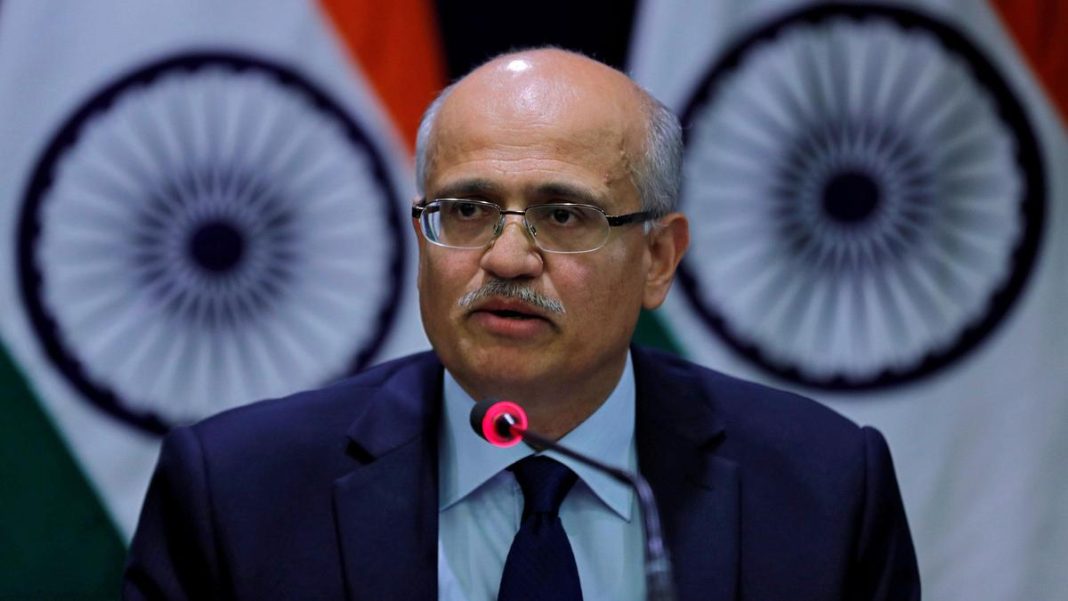
India’s relationship with China, spanning centuries of cultural exchange and recent decades of complex geopolitical maneuvering, stands at a critical juncture. The ongoing standoff along the Line of Actual Control (LAC) is a stark reminder of the underlying friction. In this intricate tapestry of diplomacy and occasional confrontation, a crucial insight offered by former Foreign Secretary Vijay Gokhale cuts to the core of the problem: “India sees relations with China in a bilateral context, Beijing has never seen it that way.” This statement highlights a fundamental divergence in perspective that profoundly impacts how both nations engage with each other and navigate their shared, often contentious, future.
The Bilateral Lens vs. The Geopolitical Chessboard
India’s foreign policy approach towards China has historically been rooted in a bilateral framework. This means New Delhi tends to view issues such as border disputes, trade imbalances, and consular matters as direct points of discussion between the two countries. The emphasis is on resolving these specific challenges through direct diplomatic channels, in isolation from broader global dynamics. India seeks a stable, predictable relationship, believing that addressing core bilateral concerns can lead to overall improvement.
However, Gokhale’s observation underscores that Beijing’s approach is often far more expansive. For China, its relationship with India is frequently integrated into a grander geopolitical strategy. This can involve its rivalry with the United States, its ambitions in the Indo-Pacific region, the vast scope of the Belt and Road Initiative (BRI), or its enduring strategic alignment with Pakistan. China may leverage its engagement with India to send signals to other global powers, assert regional dominance, or test the resolve of its neighbors within a wider strategic calculus. This inherent asymmetry in perception makes sincere, outcome-oriented negotiations exceptionally challenging, as India expects a direct resolution to a specific issue, while China might be playing a multi-layered game on a much larger chessboard.
Decades of Differing Perspectives: A Historical Context
The divergent approaches highlighted by Gokhale are not new; they have permeated the India-China relationship for decades. From the idealism of Panchsheel in the 1950s to the disillusionment following the 1962 war, and through various phases of attempts at normalization, India has consistently sought to stabilize relations through bilateral engagement. Even as trade flourished and people-to-people contacts grew, fundamental differences, particularly regarding the unresolved border, persisted.
The Doklam standoff in 2017 and the Galwan clashes in 2020 served as potent reminders of this perceptual gap. While India sought to de-escalate and resolve these specific border incursions, China’s actions often seemed to be part of a larger pattern of asserting its territorial claims and projecting power across the region. The difficulty in arriving at mutually agreeable solutions stems, in part, from India’s focus on the immediate issue versus China’s tendency to view the same issue as a data point in its broader strategic playbook. As former Foreign Secretary Vijay Gokhale has acutely observed, “India has consistently viewed its relationship with China through a bilateral prism, focusing on direct engagement on issues like trade and border management. However, Beijing’s approach has always been inherently more expansive, often integrating India into its grander strategic calculations involving regional hegemony and global power dynamics.” This means that while India aims to ‘fix’ the border, China might be using the border as a lever in a game of regional influence.
Navigating the Complexities: Implications for India
Understanding this fundamental asymmetry is crucial for India as it formulates its foreign policy. The implications are profound: it suggests that purely bilateral overtures, while necessary, may not always yield the desired results if China’s motivations are rooted in a broader geopolitical agenda. This necessitates a multi-faceted approach from India. While continuing to engage bilaterally on pressing issues, India must also strengthen its strategic partnerships with like-minded countries, enhance its indigenous defense capabilities, and bolster its economic resilience to counter potential coercion.
India’s active participation in forums like the Quad (Quadrilateral Security Dialogue) and its deepening ties with Southeast Asian nations, Europe, and the United States can be seen as a strategic adaptation to China’s expansive view. By diversifying its foreign policy and building a network of alliances, India aims to create a more balanced regional power dynamic, ensuring that its concerns are not easily sidelined within China’s larger strategic narrative. The path forward for India involves both steadfast bilateral engagement and a robust geopolitical awareness, acknowledging that for Beijing, relations with New Delhi are rarely just about New Delhi.
The challenge for India, therefore, lies in meticulously understanding China’s multi-dimensional approach and crafting a response that is both assertive in defending its interests and adaptive to the complex realities of regional and global power dynamics. Gokhale’s observation serves as a vital reminder that for any progress to be made, India must continue to articulate its bilateral concerns clearly, while simultaneously preparing for a rival that views the world, and its place in it, through a significantly different, and often more ambitious, lens.

