


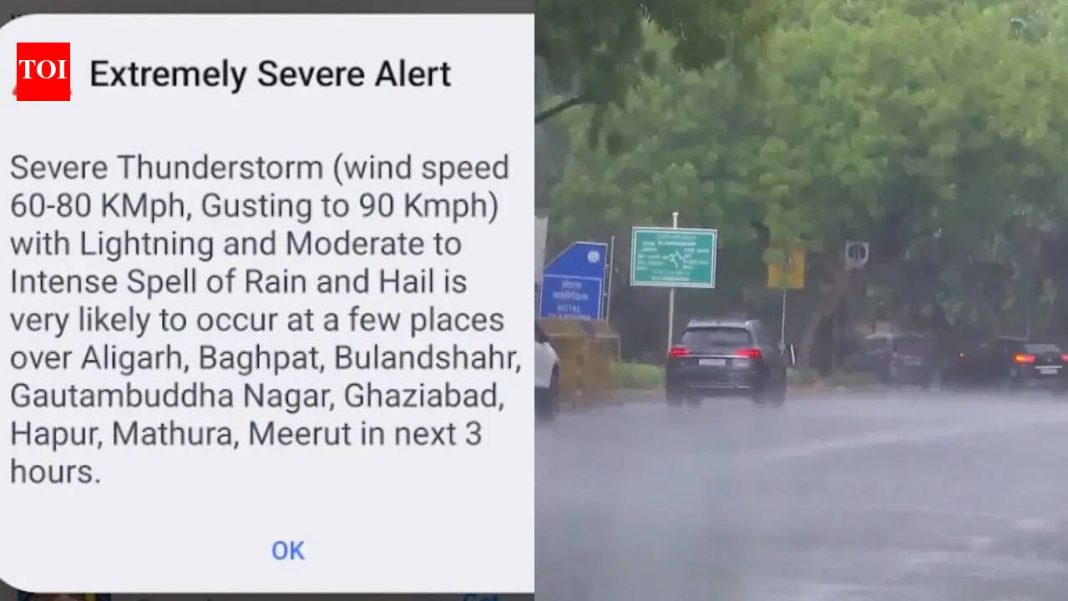
In an unprecedented event that momentarily gripped residents across Uttar Pradesh, mobile phone users recently received an ‘Extremely Severe Alert’ accompanied by a jarring siren, triggering widespread confusion and concern. While the alert, issued by the National Disaster Management Authority (NDMA) in collaboration with the Department of Telecommunications (DoT), was later clarified as a test of the Cell Broadcast Alert System (CBAS), it arrived amidst a genuine and serious weather warning from the India Meteorological Department (IMD) for rain, thunderstorms, and gusty winds across the state. This unique convergence of a system test with a live weather threat has underscored the critical need for robust public awareness campaigns regarding emergency communication protocols, even as it highlighted the potential of such systems to save lives.
Understanding the ‘Extremely Severe’ Alert
The ‘Extremely Severe Alert’ notification, which flashed across millions of Android and iOS devices, was an alarming experience for many. The message, displayed in both English and Hindi, explicitly stated: “This is a SAMPLE TESTING MESSAGE sent through Cell Broadcast Alert System by National Disaster Management Authority, Government of India. Please ignore this message as no action is required from your end. This message has been sent to TEST the Cell Broadcast Alert System implemented by National Disaster Management Authority. This system has been implemented to enhance public safety and provide timely alerts during emergencies.” Despite the clear declaration of it being a test, the sheer intensity of the alert – the loud siren, the stark red banner, and the “Extremely Severe” classification – caused immediate panic among recipients.
This initiative by the NDMA and DoT aims to establish a comprehensive emergency alert system, similar to those found in other countries, to disseminate critical information rapidly during disasters such as earthquakes, floods, tsunamis, or other severe weather events. The Cell Broadcast Alert System (CBAS) allows authorities to send location-specific messages to all mobile devices within a targeted geographical area, even if network congestion is high. Such tests are crucial for evaluating the system’s efficiency, reach, and technical glitches before it is deployed for real emergencies. However, the timing of this particular test, coinciding with actual inclement weather warnings, created a unique scenario that blended a simulated threat with a looming real one.
IMD’s Forecast and Real-World Implications
Parallel to the test alert creating a stir, the India Meteorological Department (IMD) had issued its own set of warnings for Uttar Pradesh. The forecast indicated a period of significant weather activity, including moderate to heavy rainfall, thunderstorms accompanied by lightning, and strong gusty winds at speeds ranging from 30 to 40 kmph. This weather pattern was predicted to affect various districts across the state, particularly eastern and parts of central Uttar Pradesh, for several days.
The implications of such weather conditions are substantial for a predominantly agricultural state like Uttar Pradesh. Farmers, already grappling with unpredictable weather patterns, face the risk of crop damage due to strong winds and hailstorms. Beyond agriculture, heavy rains can lead to waterlogging in urban areas, disrupting traffic and daily life. Lightning strikes pose a significant threat to life and property, especially in rural areas where open spaces and fewer robust structures make people more vulnerable. Power outages are also a common consequence of severe thunderstorms, impacting essential services and communication.
A resident from Lucknow, Mr. Alok Sharma, shared his initial reaction to the alert: “My phone suddenly blared with this extremely loud sound, and the message popped up. For a moment, my heart stopped. I immediately thought of an earthquake or some major disaster. When I read it was a test, I felt a mix of relief and confusion. It’s good that they are testing these systems, but perhaps clearer communication about such tests, especially when real warnings are also out, would reduce the initial shock.” His sentiment reflects the broader public experience – an acknowledgment of the system’s potential utility tempered by the unexpected and alarming delivery of the test message.
Preparedness and Future Outlook
The dual nature of the recent events – a system test alongside a genuine weather threat – has brought to the forefront the challenges and opportunities in disaster preparedness and public communication in India. While the CBAS test proved the technical capability of reaching a vast population instantaneously, it also highlighted the need for more nuanced messaging and public education about such alerts. Residents need to be informed about the different types of alerts, what they signify, and how to differentiate between a test and an actual emergency. This clarity is crucial to ensure that genuine warnings are taken seriously and that ‘alert fatigue’ does not set in.
Authorities, including the IMD and NDMA, consistently advise residents to take precautionary measures during periods of adverse weather. These typically include staying indoors, avoiding vulnerable structures, unplugging electronic appliances, seeking safe shelter away from trees and hoardings, and closely monitoring local news and official advisories. The ongoing efforts to enhance India’s early warning systems are commendable, representing a significant step towards mitigating the impact of natural disasters. As climate change continues to make weather patterns more erratic and severe, the ability to deliver timely and effective alerts will be paramount in safeguarding lives and livelihoods across the nation.
The incident in Uttar Pradesh serves as a vital learning experience, underscoring the delicate balance between robust system testing and clear public communication. As India progresses in its disaster management capabilities, fine-tuning these elements will be key to harnessing the full potential of advanced warning systems.

