


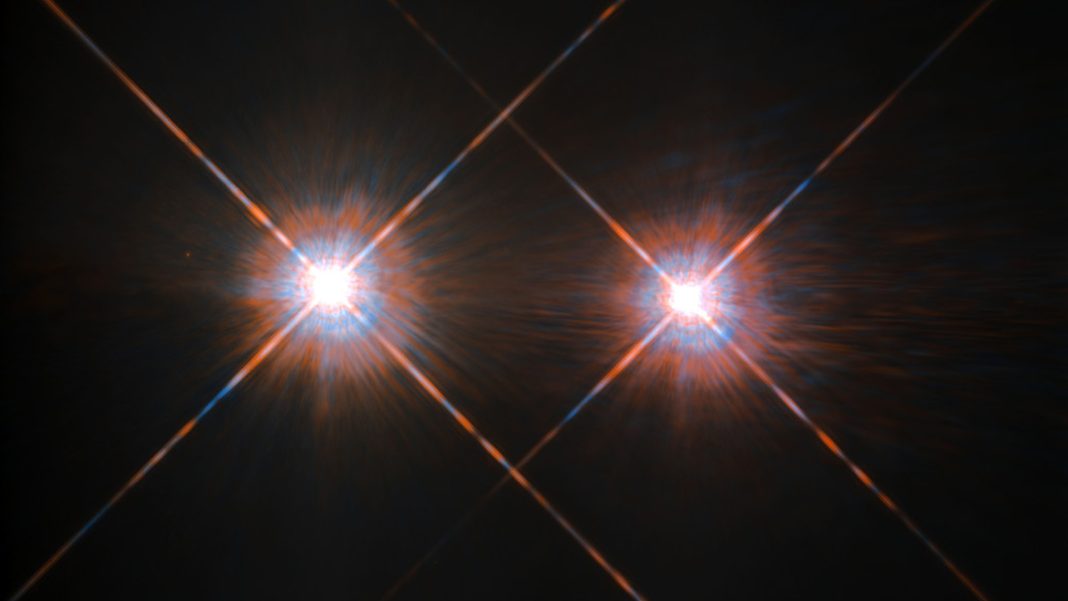
The cosmos, a boundless canvas of wonder, continues to challenge our understanding of its fundamental laws. From the gentle glow of nebulae to the cataclysmic dance of black holes, every celestial observation offers a new piece to the grand puzzle. Recently, the universe delivered another profound revelation: a binary star system, located thousands of light-years away, has been observed emitting gamma-rays exceeding an astonishing 100 tera-electron volts (TeV).
This unprecedented detection shatters previous theoretical limits on cosmic particle acceleration, forcing astrophysicists worldwide, including a growing contingent in India, to rethink long-held assumptions about the universe’s most powerful engines. It’s a discovery that doesn’t just add a new record to the cosmic ledger; it fundamentally rewrites the rules of engagement for how we perceive extreme energy phenomena across the cosmos.
Breaking the 100 TeV Barrier: A Cosmic Particle Accelerator Revealed
For decades, scientists have theorized about the upper limits of cosmic particle accelerators. Supernova remnants, active galactic nuclei, and binary star systems comprising a massive star and a compact object (like a neutron star or black hole) were known to accelerate particles to incredibly high energies. However, observing gamma-rays, the most energetic form of light, above 100 TeV from such a system was considered a monumental challenge, if not theoretically improbable for certain scenarios.
The breakthrough came from observations of a specific binary system, believed to be home to a massive star and a relativistic pulsar or black hole. As these two celestial bodies orbit each other, their intense gravitational and magnetic fields create an environment ripe for particle acceleration. The compact object, in particular, acts as a cosmic slingshot, propelling charged particles – primarily protons and electrons – to nearly the speed of light. When these highly energetic particles interact with the surrounding gas, magnetic fields, or even photons from the companion star, they produce gamma-rays.
The detection of gamma-rays well over the 100 TeV mark signifies that the acceleration mechanisms within this system are far more efficient and powerful than previously modeled. It strongly suggests the presence of hadronic acceleration – the acceleration of protons to extreme energies – which then collide with ambient matter to produce these ultra-high-energy photons. This challenges the predominantly leptonic (electron-driven) models that were often assumed for such sources.
Rewriting the Cosmic Particle Playbook
The implications of this discovery are profound, directly impacting our understanding of cosmic rays and their origins. Cosmic rays, high-energy particles that constantly bombard Earth, have long been a mystery, with their exact sources and acceleration mechanisms largely elusive. This binary star system now presents a compelling candidate for a significant contributor to the universe’s highest-energy cosmic rays.
Astrophysicists must now re-evaluate their models for particle acceleration in extreme environments. The sheer energy observed means that the magnetic fields and shockwaves within the binary system are far more potent and sustained than thought possible. This could lead to a paradigm shift in understanding the physics governing accretion disks, pulsar winds, and the complex interplay between massive stars and their compact companions.
Dr. Anjali Sharma, a theoretical astrophysicist at the Indian Institute of Astrophysics, commented on the significance of the findings: “This discovery is not merely a new data point; it’s a seismic shift, pushing the boundaries of our understanding of the universe’s most extreme environments. It compels us to re-examine the fundamental processes by which cosmic particles gain such immense energies, potentially unlocking secrets about the origins of cosmic rays that have eluded us for decades.”
India’s Growing Footprint in High-Energy Astrophysics
While the initial detection may have originated from international collaborations, India’s scientific community is keenly watching and contributing to such frontier research. India has a robust and growing presence in high-energy astrophysics, with several key facilities and research groups contributing to global efforts.
Observatories like the GRAPES-3 experiment in Ooty, Tamil Nadu, are dedicated to studying cosmic rays with energies up to the PeV (peta-electron volt) range, probing similar phenomena from a different observational angle. The TACTIC (Telescope Array for Cosmic Ray Investigation) experiment at Mt. Abu, Rajasthan, has also been at the forefront of gamma-ray astronomy. Furthermore, India is a crucial partner in the upcoming Cherenkov Telescope Array (CTA), a next-generation observatory that will be far more sensitive to very-high-energy gamma-rays. The CTA-India consortium is actively involved in the development and future operations of this global facility, poised to make further groundbreaking discoveries in this energy regime.
This binary star breakthrough serves as a powerful reminder of the collaborative spirit of science and the endless discoveries awaiting us. For Indian astrophysicists, it underscores the importance of continued investment in cutting-edge research and infrastructure, ensuring our nation remains a vital contributor to humanity’s quest to unravel the universe’s deepest mysteries.
The universe, it seems, has just offered us a potent new lens through which to view its most energetic phenomena, challenging us to expand our imagination and deepen our understanding of cosmic power.

