


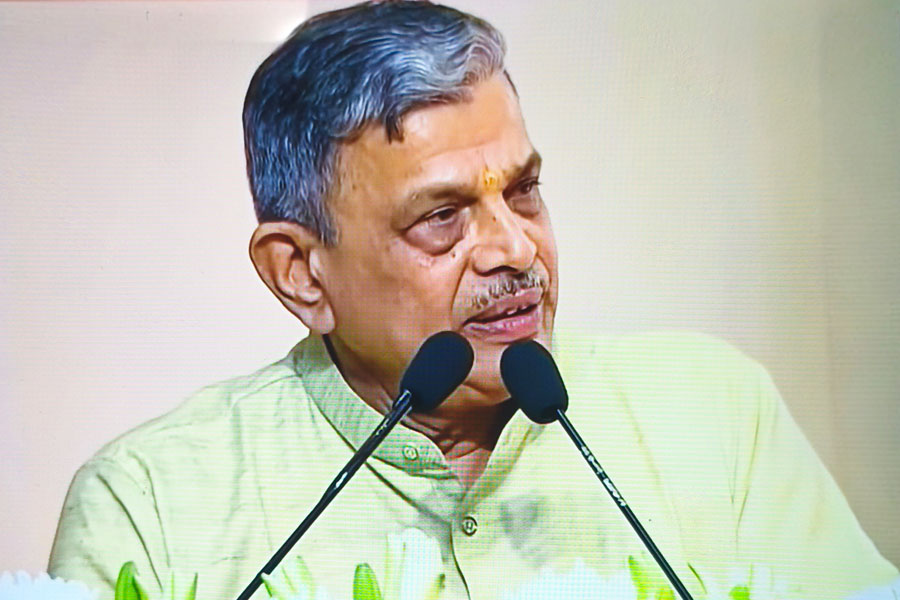
In a powerful statement that reverberated across continents, Rashtriya Swayamsevak Sangh (RSS) General Secretary Dattatreya Hosabale, speaking at a prominent event in Washington D.C., categorically rejected comparisons between the Hindu nationalist organization and the American white supremacist group, the Ku Klux Klan (KKK). His assertion, “We are not the Indian version of Ku Klux Klan,” aimed to dismantle a persistent and often inflammatory characterization that has long plagued the organization in international discourse.
A Resounding Denial in the U.S. Capital
Addressing an audience largely composed of the Indian diaspora and academics, Hosabale’s comments came amidst a broader discussion on India’s evolving identity, democracy, and global role. The comparison to the KKK – a notorious organization infamous for its history of racial violence, hate, and anti-minority sentiments – is a severe accusation. By directly confronting it, the RSS leader sought to articulate the organization’s self-perception and challenge prevalent Western narratives.
The event in Washington D.C., often a hub for international policy debates and cultural exchanges, provided a significant platform for the RSS to engage directly with critical perspectives. Hosabale’s remarks underscored the organization’s efforts to shape its image abroad, particularly in countries where the KKK’s legacy is a stark reminder of historical bigotry and systemic discrimination. He emphasized the RSS’s commitment to India’s constitutional values and its vision for a harmonious society.
Understanding the RSS: Identity and Allegations
The Rashtriya Swayamsevak Sangh, founded in 1925, is often described as the ideological fount of India’s ruling Bharatiya Janata Party (BJP). It defines itself primarily as a cultural organization dedicated to national regeneration through the revitalization of Hindu values and traditions. Its vast network of volunteers (swayamsevaks) is involved in numerous social service activities, disaster relief, education, and character-building initiatives across India.
However, the organization has consistently faced scrutiny and strong criticism, particularly from liberal commentators, minority groups, and international observers, who accuse it of promoting a majoritarian Hindu nationalist agenda. Critics often point to its concept of Hindutva – a term the RSS defines as cultural nationalism encompassing all those who consider India their motherland – as exclusionary and detrimental to India’s secular fabric. Allegations of inciting communal tensions, particularly concerning religious minorities, and its historical stance on cultural homogenization, are frequently leveled against it.
In response to these allegations, Hosabale and other RSS leaders reiterate that their philosophy is rooted in universal values, selfless service (seva), and the unity of all Indians, irrespective of religion. They contend that the RSS aims to strengthen the nation through cultural pride and social cohesion, not through discrimination or violence. They often cite their extensive work in tribal areas and among marginalized communities as evidence of their inclusive approach.
Navigating Perceptions in a Globalized World
The necessity for an RSS leader to explicitly refute a comparison to a hate group like the KKK highlights the ongoing struggle the organization faces in controlling its narrative, especially outside India. The comparison, while vehemently denied by the RSS, persists in certain circles, fueled by historical incidents and the rhetoric of some affiliated groups.
In a globalized world, where information spreads rapidly and perceptions are often shaped by snippets and historical precedents, the RSS’s international outreach efforts have become increasingly important. These platforms allow the organization to directly address its critics and present its own interpretation of its mission and activities. The challenge for the RSS lies in convincing a diverse global audience that its cultural nationalism is distinct from ethnic or religious supremacism and that its vision of India is genuinely inclusive of all its citizens.
Dattatreya Hosabale’s statement in Washington D.C. is more than just a denial; it is a critical attempt to redefine the RSS’s image on the international stage. It signals a proactive engagement with Western perceptions and a clear articulation of its identity, seeking to draw a stark contrast with the insidious history of groups like the Ku Klux Klan. As India’s geopolitical influence grows, understanding the various actors shaping its internal discourse, including the RSS, becomes ever more crucial for global observers.
The debate surrounding the RSS’s nature and intentions is complex and deeply rooted in India’s social and political landscape. Hosabale’s strong rebuttal underscores the organization’s determination to challenge what it perceives as mischaracterizations and to present its vision for India directly to a global audience, inviting a re-evaluation of its role and identity.

