


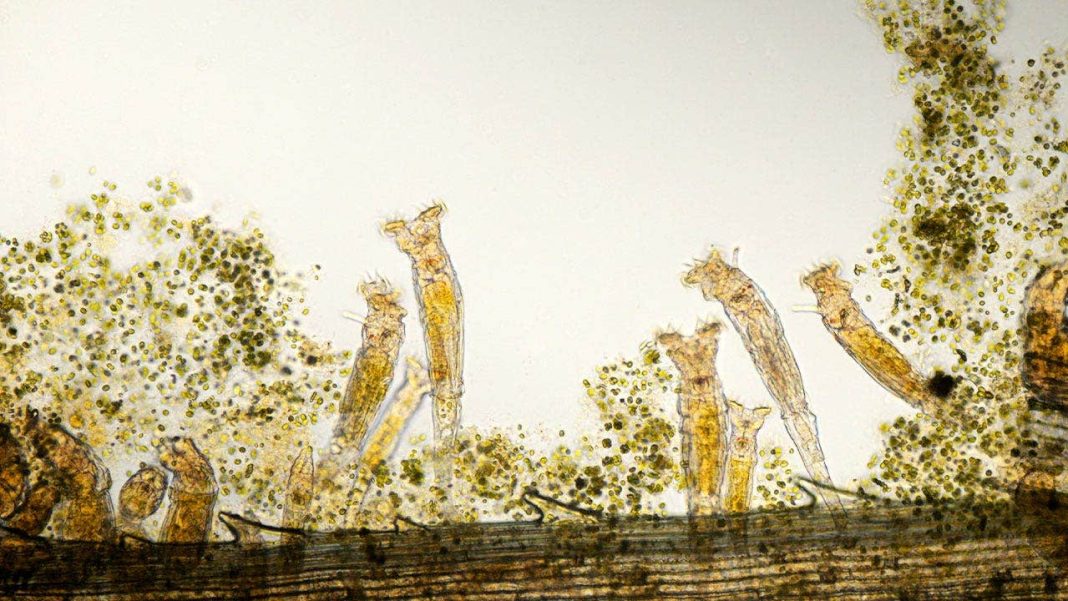
Imagine finding something frozen solid for twenty-four millennia. Something that last saw the light of day when woolly mammoths roamed the Earth. Now, imagine that thing not just thawing out, but actually wiggling, eating, and then, impossibly, having babies. Sounds like the plot of a sci-fi movie, right? Well, scientists just made it a stunning reality in the frozen heart of the Arctic.
They didn’t find a monster, but something far more extraordinary in its own tiny way: a microscopic creature known as a rotifer, affectionately dubbed a “zombie worm” by some, which has defied biological odds and brought an ancient past back to life.
The Arctic’s Ancient Awakening
Deep within the Siberian permafrost, a team of dedicated researchers uncovered a true relic. This wasn’t just any old ice; it was a time capsule, preserving life in suspended animation for an incomprehensible span. The creature they found belongs to a phylum called rotifers – tiny, multi-celled invertebrates, often found in freshwater environments. They might be small, but their resilience is gargantuan.
The particular rotifer discovered had been locked in an icy embrace for 24,000 years, a period that predates virtually all human civilization as we know it. Its ability to enter a state of cryptobiosis, a metabolic shutdown allowing survival in extreme conditions, is well-documented, but for this long? That was the mind-boggling question facing the scientific community. Finding it was one thing; bringing it back was another entirely.
“It’s truly humbling to witness such an ancient spark of life rekindle after so long,” remarked Dr. Elena Petrova, a microbiologist studying extremophiles. “It challenges our fundamental understanding of life’s tenacity and the boundaries of biological time.”
From Deep Freeze to Future Life
The process of coaxing the rotifer back to life was a delicate dance. Scientists slowly thawed the ice core where the creature resided. What followed was nothing short of miraculous. After gradually warming, the rotifer began to stir. Not just a twitch, but a purposeful movement. It started feeding, absorbing nutrients as if no time had passed at all. This alone was a monumental achievement, demonstrating an unprecedented level of cellular and tissue preservation.
But the story doesn’t end there. The rotifer didn’t just survive; it thrived. Within weeks of its revival, this ancient organism began to reproduce asexually, creating clones of itself. This reproductive success underscores the complete restoration of its biological functions, proving that its cells, DNA, and intricate biological machinery were perfectly preserved, ready to spring back into action when conditions were right. It’s an incredible testament to the power of natural selection and the extraordinary survival strategies evolved by some of Earth’s tiniest inhabitants.
This discovery opens up a world of questions and possibilities. Could other, more complex organisms also possess such an incredible capacity for long-term cryopreservation? What secrets do these ancient survivors hold about adapting to a changing world, or even about the potential for life in extraterrestrial environments? The “zombie worm” has certainly given us much to ponder.
A Testament to Life’s Resilience
The tale of the 24,000-year-old rotifer is more than just a scientific curiosity; it’s a profound narrative about life’s indomitable will. It reminds us that even in the most extreme conditions, in suspended animation for epochs, the spark of life can endure. This tiny creature from the Arctic ice offers not only insights into astrobiology and cryopreservation but also a powerful symbol of hope and persistence. It’s a vivid illustration that life, in all its forms, is capable of miracles when given the chance.
The Arctic, often seen as a desolate, frozen frontier, continues to reveal breathtaking secrets, and this ancient traveler from the past has undoubtedly given us a new appreciation for the hidden depths of our planet’s biodiversity.

