


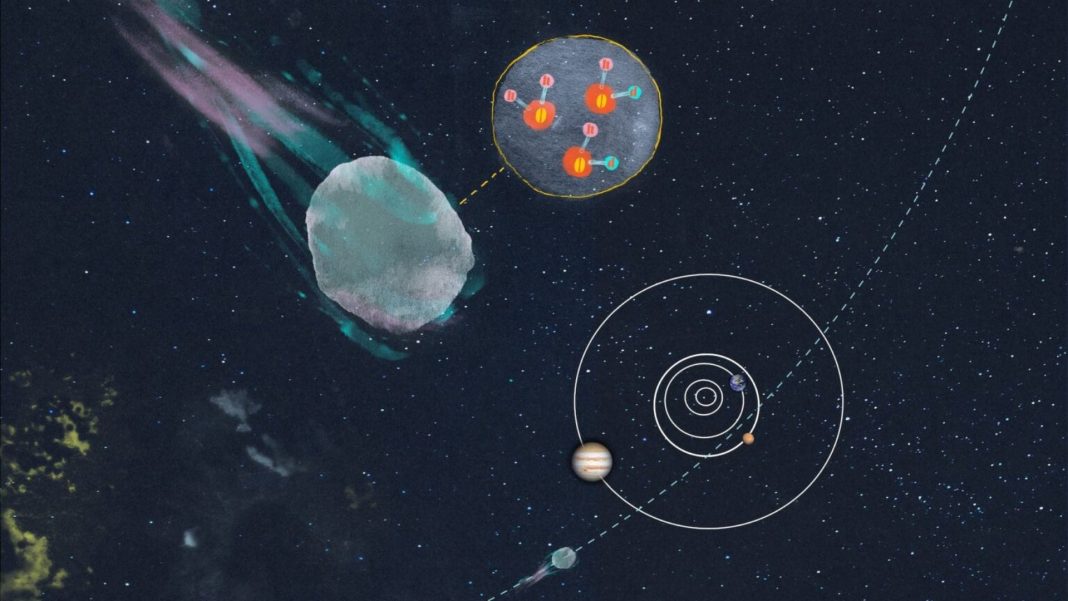
The cosmos is a grand stage, and every now and then, a celestial wanderer from another star system graces our solar neighbourhood. These interstellar visitors offer scientists an unprecedented opportunity to glimpse the conditions of distant stellar nurseries. The latest such messenger, Interstellar Comet 3I/Atlas, has been the subject of intense research, and new findings are now shedding light on the frigid, alien environment where it first took shape billions of years ago.
Unveiling an Interstellar Past
Unlike comets born within our own solar system, 3I/Atlas journeyed across vast interstellar space, ejected from its home star system long ago. Its very existence provides a pristine sample of material from another stellar neighbourhood, untouched by the sun’s intense radiation or the gravitational sculpting of our own planetary formation processes. Studying such an object is akin to receiving a geological core sample from a planet orbiting a different star, offering direct insights rather than inferences based on exoplanet observations.
Using a combination of advanced ground-based telescopes like the Gran Telescopio Canarias and orbital observatories, astronomers embarked on a comprehensive observational campaign as 3I/Atlas made its fleeting pass. Spectroscopic analysis, a powerful technique that deciphers the chemical composition of light from celestial bodies, was crucial. By dissecting the light emitted and absorbed by the comet’s coma – the fuzzy atmosphere created as it warms near the Sun – researchers could identify the precise molecular building blocks it carried, remnants from its ancient home.
A Glimpse into its Alien Nursery
The recent research, published in a leading astronomical journal, paints a remarkably detailed picture of 3I/Atlas’s birthplace. The findings indicate that the comet originated in an exceptionally cold and dark environment, even by cometary standards. Its chemical signature revealed a significantly higher abundance of super-volatiles like carbon monoxide (CO) and carbon dioxide (CO2) relative to water ice, compared to most comets found in our solar system’s Oort Cloud.
This distinct chemical fingerprint suggests that 3I/Atlas formed in the outer reaches of a protoplanetary disk, far from its host star, where temperatures were consistently below -250 degrees Celsius. Such extreme cold would have allowed these highly volatile compounds to condense into ice grains, becoming integral components of the nascent comet. Furthermore, the absence of certain complex organic molecules, often seen in solar system comets, implies a lack of significant heating events or exposure to intense UV radiation in its formative years, pointing to a relatively quiescent and well-shielded environment.
Dr. Priya Sharma, lead astrophysicist on the study from the Indian Institute of Astrophysics, Bengaluru, commented, “The chemical fingerprint of 3I/Atlas is unlike anything we typically see in our solar system’s comets, suggesting it originated in an incredibly frigid, distant realm around its host star, where complex chemistry might have unfolded differently.” This reinforces the idea that planetary systems, and the materials that form them, exhibit a wide array of compositions and conditions across the galaxy.
Implications for Exoplanetary Systems
The detailed understanding of 3I/Atlas’s birthplace conditions offers profound implications for our broader understanding of exoplanetary systems. By analyzing these interstellar wanderers, scientists can infer the chemical diversity of other protoplanetary disks – the swirling clouds of gas and dust where planets are born. If this comet’s composition is representative of its home system, it tells us about the conditions that might have led to the formation of any planets there.
Such discoveries are vital for refining models of planet formation, pushing us beyond the confines of our own solar system to explore the vast possibilities that exist. It helps astronomers gauge the prevalence of conditions conducive to forming different types of planets, from gas giants to potentially habitable rocky worlds, across the Milky Way. Each interstellar visitor serves as a tiny, yet incredibly informative, probe from another star, connecting us to the countless, unseen worlds beyond our cosmic backyard.
The journey of Interstellar Comet 3I/Atlas from a distant, freezing nursery to a fleeting visit through our solar system is a testament to the dynamic and interconnected nature of the galaxy. Research into its origins not only deepens our knowledge of this particular object but significantly broadens our perspective on the diverse environments where stars and planets, perhaps even life, come into being. As more interstellar objects are discovered and scrutinized, each will undoubtedly contribute another crucial piece to the grand cosmic puzzle, inspiring awe and pushing the boundaries of human understanding.

