


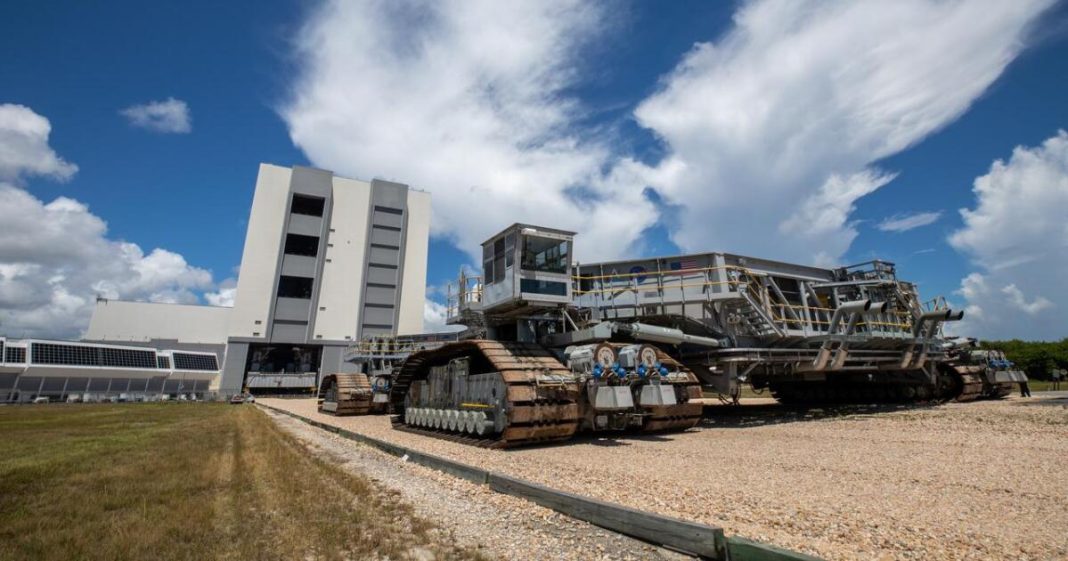
The vast, silent expanse of space has always captivated humanity, and few celestial bodies hold as much mystique as our Moon. As global space agencies gear up for a renewed era of lunar exploration, the subtle rumble of a colossal machine at NASA’s Kennedy Space Center signals the crucial commencement of preparations for the next Artemis mission. It’s not a rocket launch, nor an astronaut donning a spacesuit, but the majestic, glacial movement of the Crawler-Transporter 2 (CT-2) – an engineering marvel that, in its quiet power, heralds the beginning of humanity’s next great lunar leap.
The Unsung Titan: NASA’s Crawler-Transporter
For decades, the Crawler-Transporters have been the unsung heroes of American spaceflight, a critical link between assembly and launch. These twin behemoths, built in the 1960s for the Apollo program, are essentially mobile launch pads, tasked with transporting the gargantuan Space Launch System (SLS) rocket and its Orion spacecraft from the Vehicle Assembly Building (VAB) to Launch Complex 39B. CT-2, a titan weighing 3,000 tonnes, recently embarked on its short but significant journey to the pad, not yet with a rocket, but to enable essential modifications and testing for the upcoming Artemis II mission.
Operating at a painstaking top speed of just 1.6 kilometres per hour, the Crawler-Transporter’s movement is a symphony of precision engineering. Its eight tracks, each composed of 57 shoes weighing over 900 kg, distribute its immense weight across the specially constructed crawlerway. This recent journey of CT-2 is more than just a logistical exercise; it’s a ceremonial passing of the torch, an initiation of the ground systems for what promises to be a pivotal mission in humanity’s journey back to the Moon. Its role in ensuring the launch pad is perfectly configured for the SLS and Orion is paramount, underscoring the incredible detail and preparation that goes into every space mission.
Artemis II: Paving the Way for Lunar Return
The mission CT-2 is helping prepare for is Artemis II, a historic crewed flight that will orbit the Moon and return to Earth. Unlike the uncrewed Artemis I, which successfully demonstrated the SLS rocket and Orion spacecraft’s capabilities, Artemis II will carry four astronauts: Reid Wiseman, Victor Glover, Christina Koch (the first woman to fly a lunar mission), and Jeremy Hansen (the first non-American to venture this far into deep space). This mission is crucial, as it will validate all of Orion’s life-support systems and flight operations with humans aboard, proving the technology and procedures necessary for future lunar landings.
Scheduled for late 2025, Artemis II serves as a direct precursor to Artemis III, which aims to land astronauts on the lunar surface for the first time since Apollo 17 in 1972. The preparatory work being done now at the launch pad, facilitated by the Crawler-Transporter, includes modifications for crew access and egress, as well as testing of ground support equipment to ensure seamless operations during launch countdown. This meticulous attention to detail ensures the safety and success of the astronauts who will venture further than any human has gone in over fifty years.
Reflecting on the significance of this groundwork, NASA Associate Administrator for Human Exploration and Operations, Jim Free, was quoted saying, The movement of CT-2 isn’t just a logistical step; it’s a profound declaration of our readiness and commitment to the next phase of human lunar exploration. Every component, every test, every journey of the Crawler, brings us closer to returning humanity to the Moon, preparing for Mars, and inspiring the world.
India’s Lunar Ambitions: A Shared Horizon
While the Artemis program is spearheaded by NASA, its vision for sustainable lunar presence and deep-space exploration resonates globally, including with India. Our nation, with its burgeoning space capabilities and impressive track record in lunar exploration through the Chandrayaan missions, stands as a significant player in this renewed global push towards the Moon. India’s successful Chandrayaan-3 mission, which achieved a soft landing near the lunar south pole, demonstrated our nation’s prowess and commitment to scientific discovery on the Moon.
Furthermore, India is a signatory to the Artemis Accords, a set of principles designed to guide peaceful and responsible lunar exploration. This alignment underscores India’s aspiration to not only conduct its own independent missions but also to potentially collaborate on future international endeavours, sharing scientific data, technological expertise, and a collective vision for humanity’s future in space. As the Crawler-Transporter inches forward, preparing the launchpad for Artemis II, it symbolises a collective human endeavour – one that India, with its growing space ambitions, is keenly observing and actively participating in through its own impressive strides towards the lunar horizon.
The preparations for Artemis II, beginning with the methodical movement of the Crawler-Transporter, serve as a tangible reminder that monumental journeys are built upon meticulous groundwork. Each step, no matter how small or slow, contributes to the grand narrative of human exploration. As the world watches, the stage is being set for another historic chapter in lunar exploration, promising not just scientific advancement but also a renewed sense of wonder and possibility for generations to come, uniting nations like India in a shared quest for the stars.

