


We think we know randomness. It’s the roll of a die, the lottery numbers drawn, the flip of a coin. It’s that beautiful, chaotic unpredictability that makes life interesting, art inspiring, and digital security a constant chess match. But what if our understanding, and indeed our generation, of randomness wasn’t truly random enough? What if there was a deeper, more fundamental layer of chaos waiting to be tapped? Recent groundbreaking research suggests we might just be on the cusp of making randomness even more random, redefining what we thought was possible.
The Quest for True Chaos
For centuries, humans have sought to understand and harness randomness. From ancient divination to modern cryptography, true unpredictability is a coveted commodity. Our digital world, however, often relies on what are called pseudo-random number generators. These are sophisticated algorithms that produce sequences of numbers that appear random, but are in fact entirely deterministic. Given the same starting “seed,” they will always produce the same sequence. For many applications, this is fine. But when it comes to truly secure encryption, robust scientific simulations, or cutting-edge AI, even the slightest hint of a pattern can be a vulnerability.
Enter the realm of quantum physics. For decades, scientists have explored quantum phenomena – like the decay of a radioactive atom or the polarization of a photon – as sources of “true” randomness, as these events are inherently probabilistic at a fundamental level. Yet, even these methods can sometimes be subject to subtle biases or require complex setups to ensure their impartiality. The new experiment pushes beyond these existing boundaries, delving into an even more obscure corner of the universe’s inherent unpredictability.
Unlocking the Universe’s Deepest Unpredictability
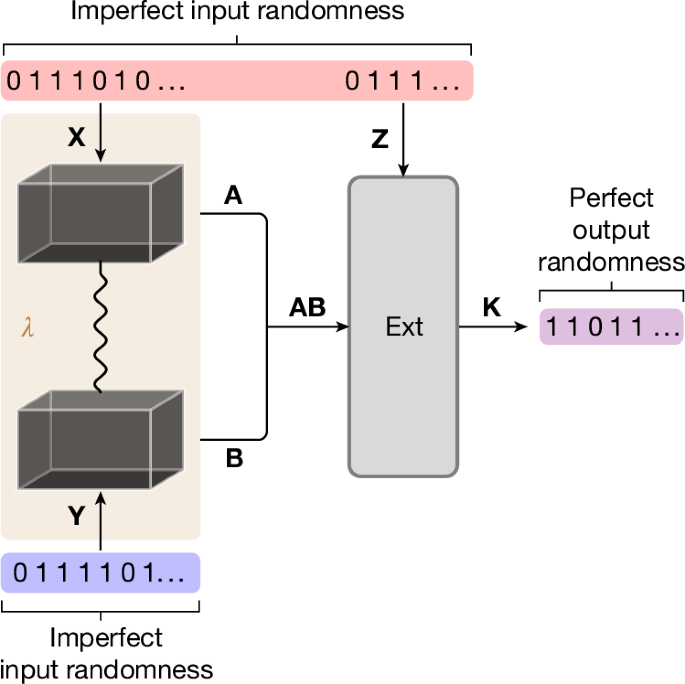
The breakthrough lies in a novel approach that doesn’t just observe quantum events but actively manipulates a previously untapped reservoir of chaotic energy. Imagine not just observing a leaf falling, but somehow tapping into the infinitesimal, unseen eddies of air that determine its every wobble. Without getting too bogged down in the quantum mechanics, researchers have engineered a system that amplifies microscopic fluctuations in an exotic material at near absolute zero – fluctuations so subtle they were previously considered noise. These amplified signals are then converted into digital data streams.
What emerges are number sequences that defy all known statistical tests for randomness with unprecedented rigor. They exhibit no discernible patterns, no correlations, and no periodicities, even after exhaustive analysis. “This isn’t just about better numbers; it’s about touching the very fabric of unpredictability,” remarked Dr. Anya Sharma, a theoretical physicist involved in the project. “It redefines what we thought was possible for secure communication and robust data generation.” This new method promises to deliver randomness that isn’t just quantum-derived, but profoundly, almost aggressively, unpredictable.
Beyond Security: A Randomness Revolution
The implications of this “super-randomness” are far-reaching. The most immediate impact will be felt in areas demanding absolute security. Imagine truly unbreakable encryption keys, immune to even theoretical attacks from future quantum computers. Think of secure digital currencies with an unparalleled layer of intrinsic randomness protecting transactions.
Beyond security, the ripple effects are immense. Scientific simulations, from modeling climate change to predicting molecular interactions, could achieve new levels of accuracy by incorporating truly unbiased random variables. AI and machine learning algorithms, often constrained by the biases inherent in pseudo-random data, could explore solution spaces more effectively and robustly. The very foundation of what constitutes “noise” in our universe might even be re-evaluated. This experiment isn’t just a technical achievement; it’s a philosophical statement about the depths of chaos the universe holds and our burgeoning ability to harness it.
As we continue to build ever more complex digital worlds and seek to understand the universe around us, the ability to generate truly, deeply random numbers will become an indispensable tool. This new leap makes the unpredictable more accessible than ever, opening doors to innovations we can scarcely yet imagine.

