


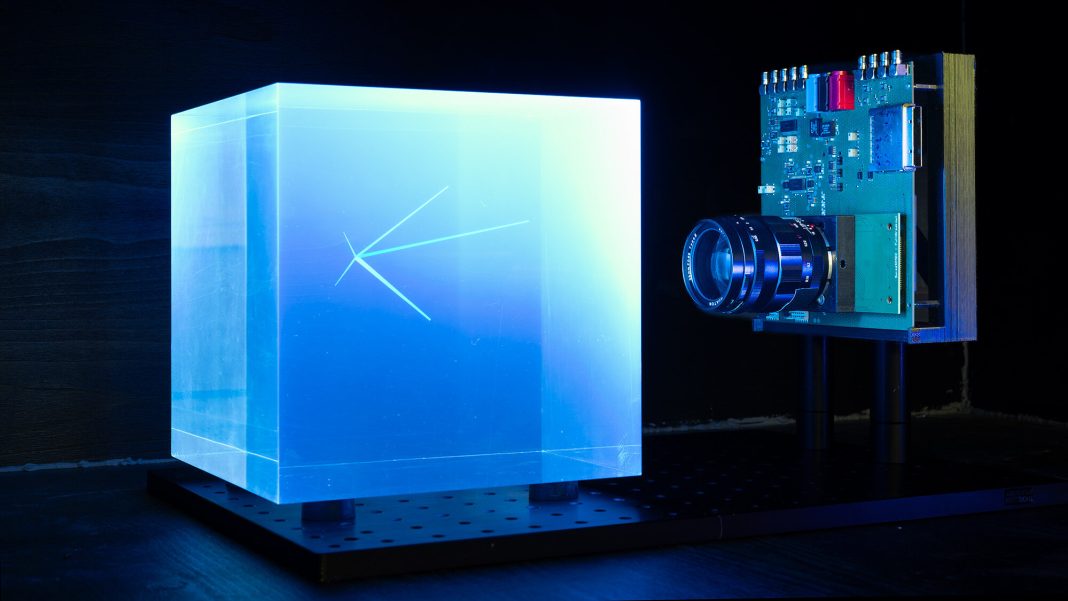
Imagine trying to capture a photograph of something that passes through solid objects, rarely interacts with anything, and carries almost no mass. This is the daily challenge for physicists studying neutrinos, the universe’s ultimate elusive particles. However, a significant step has been taken with the successful test of a new prototype particle detector, which has effectively “caught” these ghostly particles on camera, offering an unprecedented visual glimpse into their fleeting existence.
The Universe’s Most Elusive Messengers
Neutrinos are among the most abundant particles in the cosmos, born from cataclysmic events like supernovae, nuclear reactions in stars (including our own Sun), and even radioactive decay here on Earth. Despite their prevalence, they are incredibly difficult to detect. This is because neutrinos are electrically neutral and interact with matter only through the weak nuclear force, making them incredibly shy. Trillions of neutrinos pass through your body every second, completely unnoticed, leaving no trace. For decades, detecting them has been a monumental task, often requiring massive detectors buried deep underground to shield them from other cosmic radiation, patiently waiting for the rare instance a neutrino might interact.
Understanding neutrinos is crucial for a complete picture of fundamental physics. Their tiny, non-zero mass, for example, challenges the Standard Model of particle physics, suggesting there might be new physics beyond what we currently understand. Furthermore, they carry unique information directly from the hearts of stars and other cosmic phenomena, acting as messengers from places light cannot easily escape.
A New Way to “See” the Invisible
The breakthrough lies in a novel prototype detector that employs a sophisticated visual approach. While neutrinos themselves cannot be directly photographed, their extremely rare interactions with the detector’s medium can produce tell-tale signs. This prototype is designed to detect the faint flashes of light produced when a neutrino, against all odds, collides with an atom within the detector. This collision generates secondary particles, which, moving faster than the speed of light in that specific medium (though not faster than the universal speed limit of light in a vacuum), emit what’s known as Cherenkov radiation—a faint, blue glow similar to a sonic boom for light.
The “camera” in question is not a traditional photographic device but rather an array of highly sensitive light sensors, or photomultiplier tubes, capable of detecting these minute light signals. These sensors capture the patterns and intensity of the Cherenkov light, allowing scientists to reconstruct the path and energy of the original, unseen neutrino interaction. This new method provides a far more detailed and immediate visual record of neutrino events than many previous detection techniques, moving beyond mere counts to a more observational understanding.
The Promise of Visual Neutrino Astronomy
The successful test of this prototype marks a significant advancement for neutrino science. Being able to visualize these interactions with greater clarity opens up new possibilities for studying neutrino properties, such as their mass hierarchy and how they oscillate between different “flavors.” More importantly, it heralds a new era for neutrino astronomy, allowing scientists to better pinpoint the cosmic origins of these particles.
“This visual approach doesn’t just confirm their existence; it promises a richer understanding of their behavior and origins,” shared one researcher close to the project. “Being able to ‘see’ their indirect effects in real-time opens up entirely new avenues for astrophysical discovery, potentially revealing previously hidden processes in the universe’s most extreme environments.”
The ability to observe these elusive particles with a new level of detail could revolutionize our understanding of everything from solar processes to the most energetic phenomena in the distant universe. As this prototype evolves into larger, more sensitive detectors, the universe’s most ghostly messengers may finally begin to reveal their long-held secrets, picture by picture.

