


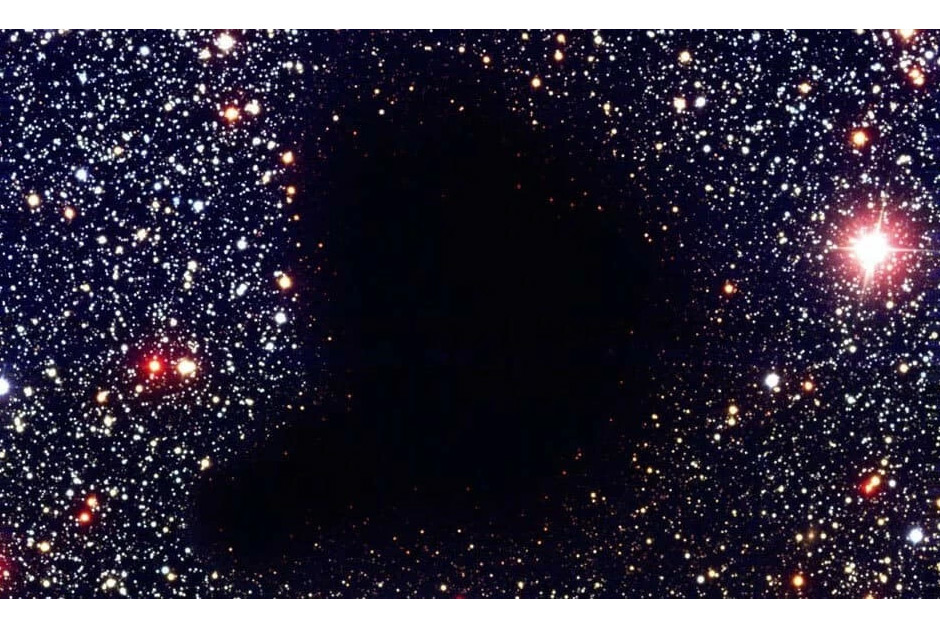
Meet the Boötes Void: The Universe’s Grand Emptiness
A vast, dark expanse, stretching for an unimaginable 330 million light-years. It’s not a black hole, nor is it the farthest edge of the observable universe. This is the Boötes Void, often dubbed “The Great Nothing,” and it’s less a region of space and more a monumental absence, a cosmic whisper in a universe roaring with galaxies. Prepare to dive into the profound emptiness that challenges our understanding of everything.
What Exactly is a Cosmic Void?
Our universe isn’t uniformly packed with stars and galaxies. Instead, it resembles a cosmic sponge or a colossal web, with dense filaments of galaxies and clusters interwoven with immense, sparsely populated regions known as cosmic voids. These voids are vast areas where the density of matter, including galaxies, is significantly lower than the cosmic average. Think of them as the bubbles in a cosmic foam, while the filaments are the soap film connecting them.
While voids are a common feature of the universe’s large-scale structure, the Boötes Void stands apart. It’s not just a void; it’s the undisputed king of emptiness, a stark testament to the universe’s capacity for desolation on an unbelievable scale. Its sheer size and the profound lack of galactic inhabitants within its boundaries make it a truly unique and humbling cosmic anomaly.
The Eerie Emptiness of Boötes
Imagine a sphere of space so large that if our own Milky Way galaxy were at its center, it would take a light beam 165 million years to reach the edge. Now, multiply that by two for its diameter, and you begin to grasp the scale of the Boötes Void, stretching an incredible 330 million light-years across. To put this into perspective, our entire Local Group of galaxies, including Andromeda, would be a mere speck within such a volume.
What truly defines the Boötes Void isn’t just its size, but its haunting lack of content. In a region of space this immense, cosmologists would typically expect to find thousands of galaxies. Yet, within the Boötes Void, astronomers have only identified about 60, perhaps 70 at most, scattered like lonely dust motes in an otherwise pristine vacuum. These few galaxies are themselves clustered into narrow tubes, giving rise to the idea that they might be part of an overarching filamentary structure that merely passes through the void rather than being truly in it. This leads some to speculate if it’s truly empty or if our detection methods are limited.
As Dr. Elena Petrova, a theoretical astrophysicist, once mused, “The Boötes Void isn’t just empty; it’s a profound statement about the universe’s architecture. It whispers of forces and processes on scales we’re still striving to fully comprehend, a cosmic canvas where the absence of light tells a story as compelling as any nebula.”
Unraveling the Great Nothing’s Origins
How does such a colossal vacuum come to be? The prevailing theory suggests that the Boötes Void isn’t a single, pristine bubble but rather the result of smaller, adjacent voids merging over billions of years. Think of it like soap bubbles coalescing into a single, much larger bubble. As the universe expands, propelled by dark energy, these less dense regions grow, pulling matter away from themselves and into the surrounding cosmic web. Over eons, this process could have carved out the immense emptiness we observe today.
The existence of the Boötes Void provides crucial insights into the evolution of the universe’s large-scale structure. It helps cosmologists test models of dark energy, gravity, and the distribution of matter. Its extreme characteristics remind us that while the universe is teeming with life and light in some areas, it also contains unimaginable stretches of profound, almost absolute, emptiness, pushing the boundaries of what we perceive as ‘space’ itself.
The Boötes Void stands as a monumental testament to the universe’s staggering scale and its capacity for both breathtaking grandeur and awe-inspiring desolation. It challenges our intuitive grasp of space and matter, revealing a cosmos far more intricate and enigmatic than we often imagine. This “Great Nothing” is, paradoxically, a window into everything, guiding our quest to understand the fundamental forces that sculpt the universe. As we continue to gaze into the vastness, regions like the Boötes Void remind us that the universe holds countless secrets, waiting to be unveiled by our insatiable curiosity.

