


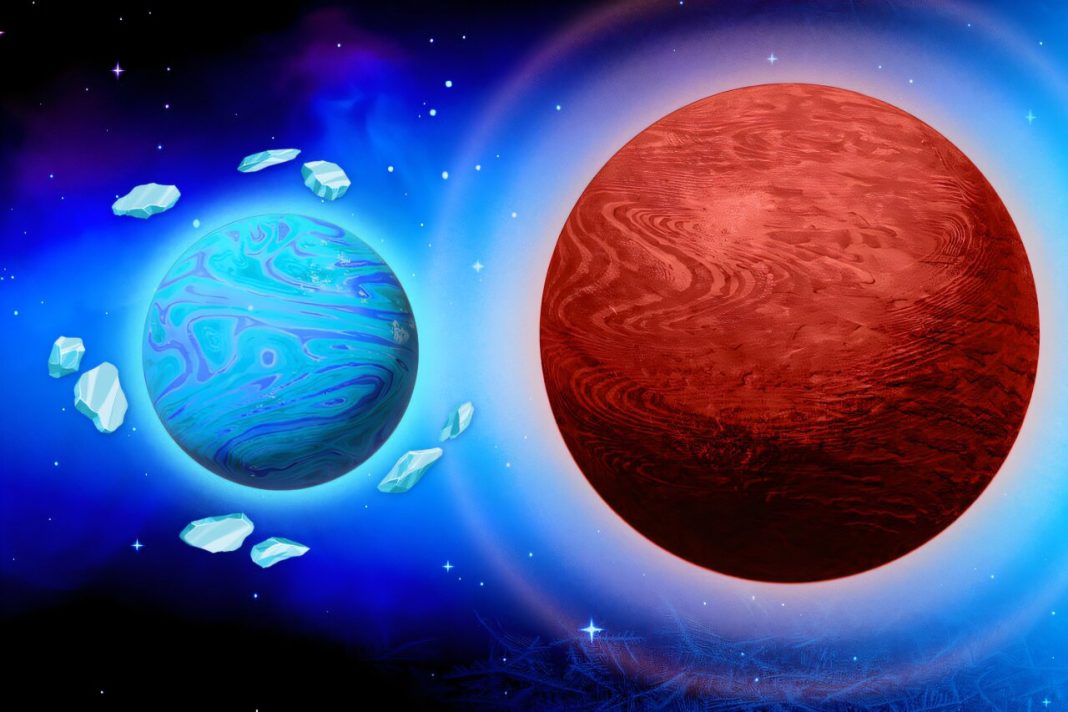
The cosmos continues to reveal its intricate secrets, often through the groundbreaking eyes of instruments like the James Webb Space Telescope (JWST). Since its deployment, JWST has consistently delivered stunning images and unprecedented data, pushing the boundaries of our cosmic understanding. Its latest insights have turned closer to home, offering fresh perspectives on the enigmatic “ice giants” of our own solar system – Uranus and Neptune. Often referred to as a planetary odd couple due to their unique characteristics, their origins have long puzzled scientists. Now, JWST’s keen infrared vision is helping to pin down the dramatic events that may have shaped these distant worlds.
Decoding the Ice Giants’ Enigmas
Far beyond the fiery embrace of the Sun, Uranus and Neptune stand apart from their gas giant siblings, Jupiter and Saturn. While all are massive, Uranus and Neptune are primarily composed of water, ammonia, and methane ices, earning them the moniker “ice giants.” Yet, it’s not merely their composition that sets them apart, but a host of baffling eccentricities. Uranus, for instance, famously rotates on its side, with an axial tilt of nearly 98 degrees, making it appear to roll around the Sun like a ball. Neptune, while more conventionally oriented, possesses a highly inclined and off-centre magnetic field, unlike any other planet in our solar system.
These peculiar features have long fuelled scientific speculation, with the most dominant theories pointing towards colossal impact events early in their formation. However, proving such ancient cataclysms from billions of years ago has been a formidable challenge. For decades, researchers relied on theoretical models and limited observational data, but the advent of next-generation telescopes like JWST is fundamentally changing the game.
JWST’s Unprecedented Gaze Illuminates the Past
The James Webb Space Telescope, with its unparalleled sensitivity to infrared light, offers a unique window into the atmospheres and internal structures of these remote planets. Unlike the Hubble Space Telescope, which primarily observes in visible and ultraviolet light, JWST can penetrate deeper into the frigid, cloudy veils of Uranus and Neptune. This capability allows scientists to map their atmospheric compositions, temperature profiles, and even glimpse subtle thermal emissions emanating from their interiors.
Recent observations from JWST have focused on capturing detailed spectral data and imaging the dynamic weather patterns of these ice giants. By analysing the distribution of molecules like methane and hydrogen sulphide at various atmospheric depths, scientists can infer details about their internal heat distribution and energy transport mechanisms. It is this intricate data that provides crucial clues, aligning strongly with the hypothesis of a violent past.
Dr. Priyanka Sharma, an astrophysicist based in Bengaluru with a keen interest in planetary dynamics, remarks, “JWST isn’t just taking pretty pictures; it’s providing the detailed spectroscopic fingerprints that allow us to reconstruct the cosmic history of these planets. The precision with which it measures atmospheric constituents and temperatures is truly revolutionary for understanding formation models.” This kind of data helps planetary scientists simulate how an enormous collision could have imparted the necessary angular momentum and energy to create their current configurations.
A Cosmic Collision Course: The Origins Unveiled
The leading theory, now gaining significant traction with JWST’s supportive data, posits that both Uranus and Neptune experienced massive collisions with other protoplanets or planetary-sized objects early in the solar system’s history, approximately 4 billion years ago. For Uranus, a single, enormous impactor, perhaps several times the mass of Earth, is thought to have knocked it onto its side, fundamentally altering its rotation and potentially influencing the distribution of its interior materials. This catastrophic event would have effectively reset its clock, leaving it with its distinctive, almost horizontal, axis.
Neptune’s tilted and offset magnetic field could similarly be a remnant signature of a colossal impact. Such an event would have disrupted its internal convection and dynamo processes, leading to the highly unusual magnetic signature we observe today. The JWST’s ability to provide more precise measurements of the planets’ energy balance and atmospheric stratification helps to refine these impact models, offering stronger evidence for the sheer scale and profound effects of these ancient cosmic smash-ups.
These findings not only rewrite chapters in the history of our own solar system but also have profound implications for understanding exoplanetary systems. As astronomers discover more and more “ice giant” exoplanets, comprehending the formation and evolution of our local examples becomes crucial. JWST is not merely observing; it is actively helping to reconstruct the violent, chaotic, and ultimately beautiful process of planetary birth and evolution, reminding us that even the most stable-looking worlds bear scars from their tumultuous past.
The journey to fully understand these distant oddities continues, but with JWST leading the charge, the origins of our solar system’s planetary odd couple are becoming increasingly clear, painting a vibrant picture of cosmic creation.

