


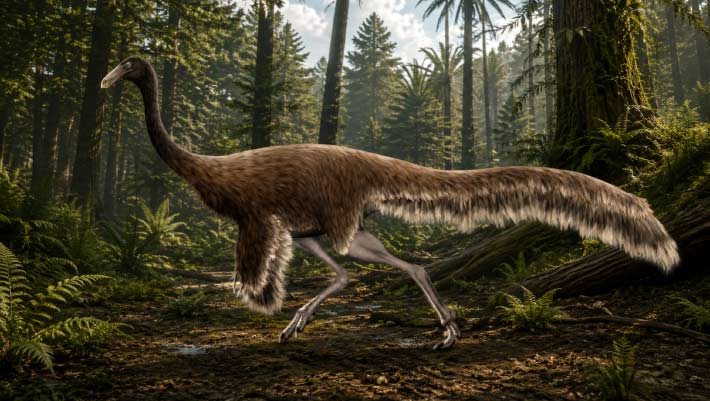
Island Mystery Solved: A Rare Ostrich-Dinosaur Fossil Rocks Canada!
Hold onto your hats, prehistoric enthusiasts! Just when you thought the ancient world had revealed most of its secrets, a truly remarkable discovery has emerged from an unexpected corner of the globe. Imagine a dinosaur that looked a bit like a modern ostrich, swift and agile, but scaled up and living millions of years ago. Now imagine finding its fossilized remains not in the dusty badlands typically associated with dinosaur digs, but on a Canadian island. That’s exactly what’s stirring up excitement in the paleontological community, offering a fresh glimpse into a bygone era and challenging our understanding of ancient Earth.
A Feathered Flash from the Past on an Unlikely Shore
This isn’t just any dinosaur find; it’s a significant one. The fossil belongs to an ornithomimosaur, a fascinating group often dubbed ‘ostrich-mimic dinosaurs’ due to their distinctive features: long, powerful legs, slender necks, small heads, and often toothless beaks. These creatures were built for speed, likely capable of outrunning most predators, and many paleontologists believe they were covered in a coat of feathers, enhancing their bird-like appearance. While ornithomimosaurs are known from various parts of the world, finding one on a Canadian island presents a particularly intriguing puzzle.
The rarity of such a find in this specific geographic context is what makes it truly groundbreaking. Canada has a rich fossil record, but discoveries of ornithomimosaurs, especially on its islands, are far less common than in other North American regions. This particular specimen acts as a critical timestamp and geographical marker, begging the question: how did an ostrich-like dinosaur come to inhabit an island that is now separated from the mainland? Its presence forces scientists to reconsider the ancient landmasses, migration routes, and even the climate that once defined this surprising locale.
Rewriting Ancient Maps and Ecosystems
The implications of this discovery stretch far beyond simply adding another species to the dinosaur roster. It compels us to re-evaluate the ancient geography and climate of what is now Canada. During the Cretaceous period, when these dinosaurs roamed, sea levels were significantly different, and coastlines were drastically altered from what we know today. The presence of an ornithomimosaur on this particular island suggests a more complex ancient landscape, perhaps indicating the existence of previously unknown land bridges, different ecological zones, or even a different connection to the mainland than previously assumed.
This fossil acts as a critical piece of a colossal prehistoric jigsaw puzzle, helping scientists reconstruct the intricate web of life that thrived millions of years ago. What did these dinosaurs eat on this island? What other creatures shared their habitat? How did they cope with their environment? Each answer provides invaluable data that can refine our understanding of ancient biodiversity and paleogeography. “This discovery is like finding a polar bear in the Sahara – completely unexpected and utterly thrilling,” mused Dr. Evelyn Reed, a paleo-geographer reportedly consulting on the find. “It forces us to reconsider the paleogeography of this region entirely. Was this island connected to a mainland? Did these dinosaurs swim? Or did they arrive much earlier when the landscape was fundamentally different? Every new fossil is a whisper from the past, and this one is practically shouting new possibilities.”
What Lies Ahead
This groundbreaking find reminds us that our planet still holds countless secrets beneath its surface. The ostrich-like dinosaur from the Canadian island isn’t just a fossil; it’s a time capsule, offering tantalizing clues about ancient migrations, forgotten landscapes, and the incredible adaptability of life. As paleontologists continue to meticulously study this specimen, analyzing its bone structure, geological context, and potential dietary habits, we can expect even more revelations about the dynamic world that existed long before our time. This discovery serves as a powerful reminder of how much more there is to learn and explore, proving that the age of dinosaur discoveries is far from over. Who knows what other prehistoric marvels are waiting to be unearthed?
*

