


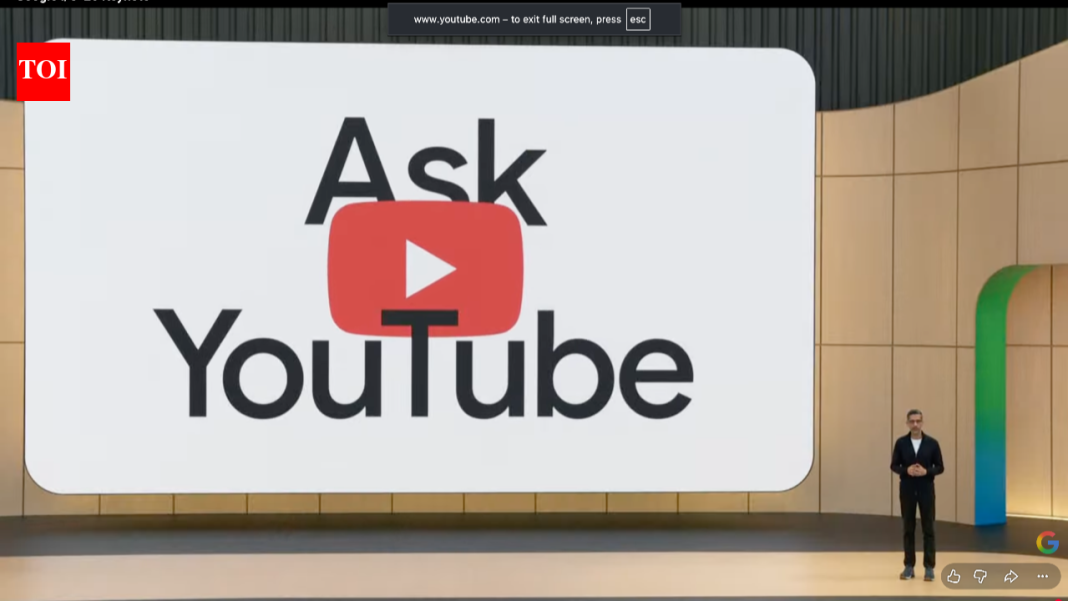
The annual Google I/O developer conference has consistently been a stage for groundbreaking innovations, and Google I/O 2026, held earlier this week, was no exception. Among a slew of exciting announcements, one feature stood out for its potential to fundamentally reshape how we interact with the world’s largest video platform: the introduction of “Ask YouTube AI.” This new capability promises to revolutionize video search, moving beyond traditional keyword queries to a conversational, voice-activated experience powered by advanced artificial intelligence. For a diverse and digitally evolving nation like India, its implications are particularly profound.
The Dawn of Conversational Video Search
Gone are the days of laboriously typing obscure keywords into the YouTube search bar, hoping to stumble upon the right video. With Ask YouTube AI, users will be able to simply speak their queries in natural language, much like having a conversation with a knowledgeable assistant. Imagine asking, “Show me quick and easy paneer butter masala recipes under 15 minutes,” or “Find tutorials on fixing a leaky tap for beginners in Hindi,” and the AI intelligently sifts through millions of videos to present the most relevant results, often pointing to specific segments within longer videos.
Google demonstrated the feature’s impressive capability during the keynote, showcasing how it leverages sophisticated natural language processing (NLP) and multimodal AI. This means the system doesn’t just convert speech to text; it understands context, intent, and even nuances in regional accents. The AI is designed to analyze video transcripts, audio cues, visual content, and user engagement data to pinpoint exact moments in videos that answer a user’s question, rather than just linking to entire videos that might contain the answer. This precision promises to dramatically cut down the time spent searching and enhance the discovery of niche or very specific content.
Bridging the Digital Divide: An Indian Perspective
For India, a country with immense linguistic diversity and varying levels of digital literacy, Ask YouTube AI represents a significant leap towards digital inclusion. The ability to search for content using one’s voice, in vernacular languages, addresses a crucial barrier for millions who may find typing in English or navigating complex interfaces challenging. From remote villages seeking agricultural advice to urban dwellers looking for regional cultural content, the accessibility factor is paramount.
Consider a farmer in rural Maharashtra wanting to learn about a new pest control technique. Instead of struggling to type technical terms in English, they could simply ask in Marathi, “माझ्या सोयाबीन पिकासाठी नवीन कीटकनाशक उपचार काय आहेत?” (What are the new pesticide treatments for my soybean crop?). The AI’s ability to process and respond to such queries could unlock a vast repository of educational and informative content for previously underserved communities. Similarly, for India’s burgeoning population of senior citizens, voice command offers a far more intuitive and less intimidating way to access entertainment, news, or even spiritual content.
The implications for content creators in India are equally exciting. While ensuring good audio quality and clear communication will become even more critical, creators producing content in regional languages now have an unprecedented opportunity for their work to be discovered by a wider, more diverse audience. As Dr. Anya Sharma, Head of YouTube AI Initiatives at Google, remarked during the I/O keynote, “This is about breaking down barriers and making information accessible to everyone, regardless of language or digital literacy. We believe that empowering users with natural language search will unlock a new era of content discovery and consumption, especially in markets as diverse and vibrant as India.”
Beyond Simple Queries: The Future Potential
While the initial rollout of Ask YouTube AI focuses on voice-activated search, its underlying technology hints at a much broader future. Imagine an AI that not only finds a cooking video but also, upon request, generates a shopping list of ingredients from that video and integrates it with your Google Shopping account. Or an AI that can answer follow-up questions about a tutorial directly from the video’s content, creating a truly interactive learning experience.
The path forward will undoubtedly involve continuous refinement, ensuring accuracy across a multitude of languages and accents, and addressing privacy concerns related to voice data. However, the introduction of Ask YouTube AI at Google I/O 2026 marks a pivotal moment. It signifies YouTube’s evolution into a more intelligent, intuitive, and universally accessible platform, promising to deepen engagement and democratize knowledge access for billions worldwide, with India at the forefront of this digital transformation.
The journey from keyword search to conversational AI is not just a technological upgrade; it’s a paradigm shift that could fundamentally change how we learn, consume, and interact with video content in the coming years.

