


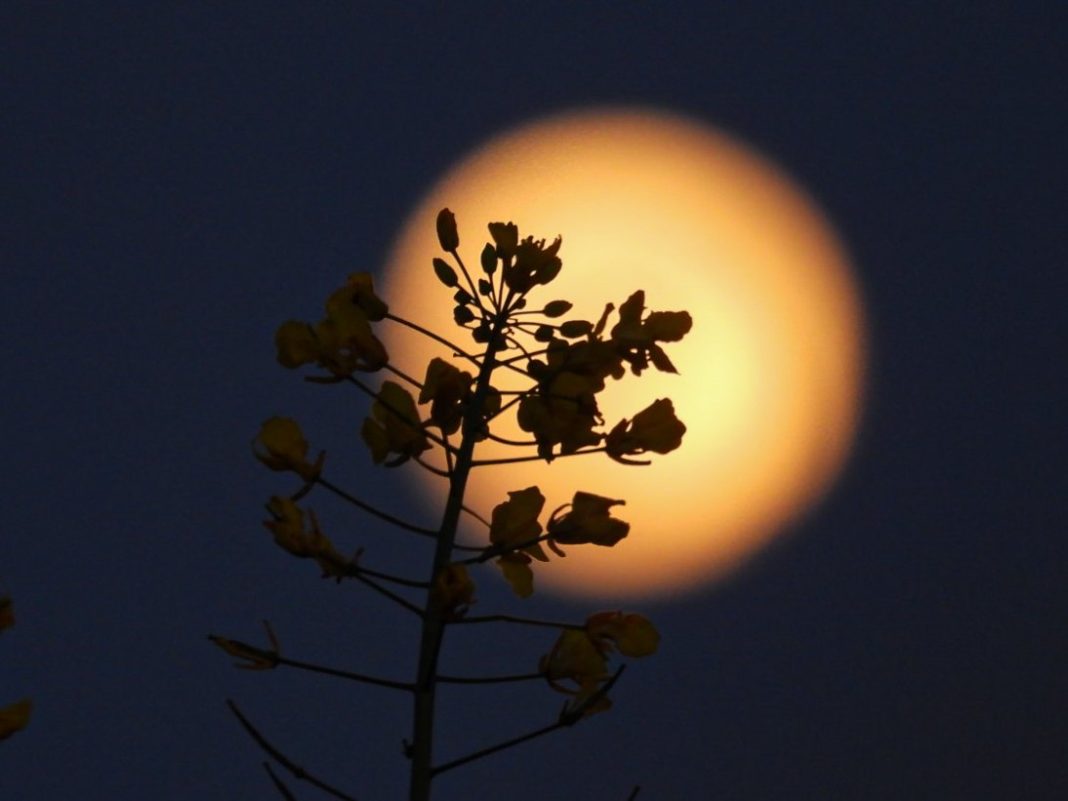
As May unfolds its vibrant tapestry across the Indian subcontinent, bringing with it the fragrant promise of monsoon and the peak of summer blooms, the celestial sphere prepares for its own annual spectacle: the Flower Moon. In 2026, this full moon, traditionally associated with the flourishing of wildflowers, is set to grace our skies, offering a breathtaking sight. For astrophotographers across India and the globe, it presents a prime opportunity to capture the luminous beauty of May’s lunar bloom, blending ancient folklore with cutting-edge photographic artistry.
The Celestial Spectacle: Understanding the Flower Moon
The Flower Moon is the traditional name given to the full moon of May, a nomenclature rooted in various Native American cultures that observed the natural world for their calendars. This particular full moon coincided with the abundant blossoming of flowers across the Northern Hemisphere, marking a period of growth and fertility. While the moon itself doesn’t change colour or shape in a way that truly resembles a flower, its name evokes the vibrant terrestrial beauty that it overlooks.
Astronomically, the Flower Moon is simply the full moon occurring in May. During this phase, the moon is directly opposite the Sun in its orbit around Earth, resulting in its entire face being illuminated from our perspective. For observers in India, the Purnima (full moon) of May often holds profound spiritual and cultural significance, coinciding with auspicious occasions such as Buddha Purnima or Narasimha Jayanti, making its appearance deeply resonant beyond its astronomical charm. Its gentle glow has inspired poets, adorned religious ceremonies, and guided agricultural practices for millennia.
Astrophotography in Focus: Capturing May’s Lunar Bloom
For the growing community of Indian astrophotographers, the Flower Moon of 2026 is more than just a pretty sight; it’s a photographic challenge and a creative canvas. Capturing the intricate details of the lunar surface – its craters, maria, and subtle tonal variations – requires a blend of technical skill, patience, and the right equipment. Unlike deep-sky objects, the full moon is remarkably bright, demanding precise exposure settings to prevent overexposure and maintain detail.
Amateur and professional photographers alike will prepare their gear: high-resolution DSLR or mirrorless cameras, equipped with powerful telephoto lenses or coupled with telescopes, often mounted on equatorial trackers to compensate for Earth’s rotation. Techniques like exposure bracketing, where multiple images are taken at different exposures and later blended, are common to achieve a balanced dynamic range. Post-processing then brings out the subtle textures and contrasts that might be less visible to the naked eye.
India, with its diverse landscapes ranging from the clear, unpolluted skies of Ladakh and Spiti to the vast deserts of Rajasthan, offers spectacular vantage points for lunar photography. Even urban photographers in cities like Bengaluru, Pune, or Delhi, with access to appropriate filters and long lenses, strive to capture the moon’s majesty amidst cityscapes. “The Flower Moon, with its inherent connection to new life and vibrant colours on Earth, offers a unique canvas for photographers. It’s not just about capturing light; it’s about framing a moment where celestial beauty meets earthly rejuvenation,” remarks Dr. Priya Sharma, an independent astrophotographer based in Bengaluru, highlighting the artistic pursuit behind the technical endeavour.
Beyond the Lens: The Moon’s Enduring Cultural Resonance
While technology allows us to capture the Flower Moon with unprecedented clarity, its cultural significance in India remains timeless. The moon (Chandra) is a revered deity in Hindu mythology, often associated with fertility, purity, and the mind. Its phases dictate important festivals, fasting days, and auspicious timings in the lunisolar calendar that governs much of Indian life. From the romantic verses of classical poetry that equate the beloved’s face to the full moon, to the lullabies sung to children, the moon is woven into the very fabric of Indian consciousness.
The Flower Moon, as a specific manifestation of the Purnima, thus carries a dual charm: it’s an astronomical event for scientific observation and artistic capture, and simultaneously, a deeply embedded symbol in the nation’s spiritual and artistic heritage. It reminds us that whether viewed through a high-powered telescope or merely with appreciative eyes from a balcony, the moon continues to inspire wonder, contemplation, and connection.
As the Flower Moon 2026 approaches, it will once again illuminate our skies, inviting millions to look up. For astrophotographers, it will be a night of focused dedication, transforming light into art. For everyone else, it will be a gentle reminder of the natural world’s cyclical beauty and the enduring magic of our celestial neighbour, perfectly in sync with the earthly blossoms it oversees.

