


Imagine, for a moment, you’re tasked with introducing humanity to an alien civilization. Not with words, which they wouldn’t understand, but with images. What would you choose to represent us? Our greatest achievements? Our most beautiful art? Or perhaps, simply, ourselves – in our natural, biological form? This wasn’t a hypothetical thought experiment for Carl Sagan and his team working on the Voyager Golden Record. It was a very real, very human dilemma, one that ultimately led to a fascinating pivot in our cosmic self-portrait.
The Pioneer Plaque: A Naked Truth, and Terrestrial Outcry
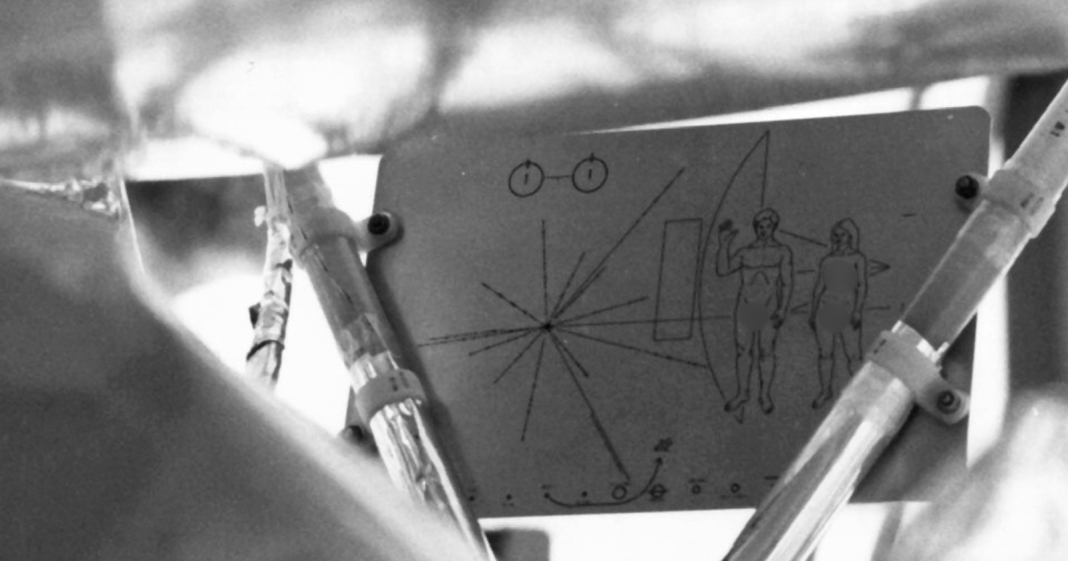
Before Voyager set sail into the interstellar void, its predecessor, the Pioneer 10 and 11 spacecraft, carried a small, etched plaque. Designed by Carl Sagan, Frank Drake, and Linda Salzman Sagan, it featured a line drawing of a naked man and woman. The intention was clear: to convey fundamental biological information about our species, including our size, form, and reproductive capabilities, using universal scientific principles. A bold, honest, and scientifically sound approach, one might think.
Yet, upon its reveal, the Pioneer plaque wasn’t met with universal admiration on Earth. Instead, it sparked a surprising amount of controversy. Newspapers across the globe ran headlines scrutinizing the nudity. Some found it unnecessary, others indecent. It was a bizarre terrestrial tempest over a message intended for beings light-years away. This wasn’t about alien understanding; it was about human prudishness, cultural norms, and the unexpected public reaction to seeing our own species depicted in its most basic form, destined for the stars.
Voyager’s Dilemma: Stripping Down or Stepping Back?
Fast forward a few years to the Voyager Golden Record project. Carl Sagan’s team was once again wrestling with how to represent humanity. Their initial inclination for the Voyager record, a far more ambitious time capsule of Earth’s sounds and images, mirrored the Pioneer plaque’s directness. They considered including a nude photograph of a man and a pregnant woman. The idea was to present a clear, unambiguous image of human anatomy, gender, and the miracle of procreation – fundamental aspects of what it means to be human.
However, the echoes of the Pioneer plaque controversy still resonated. The team understood that even an extraterrestrial message had a terrestrial audience, and the potential for another wave of domestic outrage was very real. The fear wasn’t just about public relations; it was about ensuring the mission’s integrity and focus remained on scientific exploration, not societal scandal. “It’s fascinating,” muses Dr. Aris Thorne, a semiotics expert, “how our attempts to reach out to the cosmos often reveal more about our own terrestrial anxieties and cultural hang-ups than about universal truths.” This insight perfectly encapsulates the challenge Sagan’s team faced.
Ultimately, a pragmatic decision was made. Instead of a nude photograph, the final Voyager Golden Record opted for a silhouette of a man and a pregnant woman. It conveyed the essential information – two human forms, one clearly pregnant – without the literal nudity that had caused such a stir. It was a compromise, a strategic retreat from explicit biological detail in favor of broader, less controversial representation. It’s a subtle but profound difference, reflecting a careful balancing act between scientific ambition and cultural sensitivity, even when our intended audience is literally out of this world.
More Than Just Pictures: What Our Choices Say About Us
The journey from the Pioneer plaque’s naked figures to Voyager’s nuanced silhouettes isn’t just a quirky footnote in space history. It’s a vivid illustration of the complexities inherent in representing ourselves, not just to theoretical aliens, but to ourselves. These aren’t just scientific artifacts; they are cultural statements. They show us grappling with questions of identity, universality, and how our human biases, even our perceived modesty, can influence our grandest cosmic ambitions. The messages we send into the void are as much a reflection of who we are as they are an attempt to explain ourselves to others, revealing the very human stories behind our greatest leaps into the unknown.
—

