


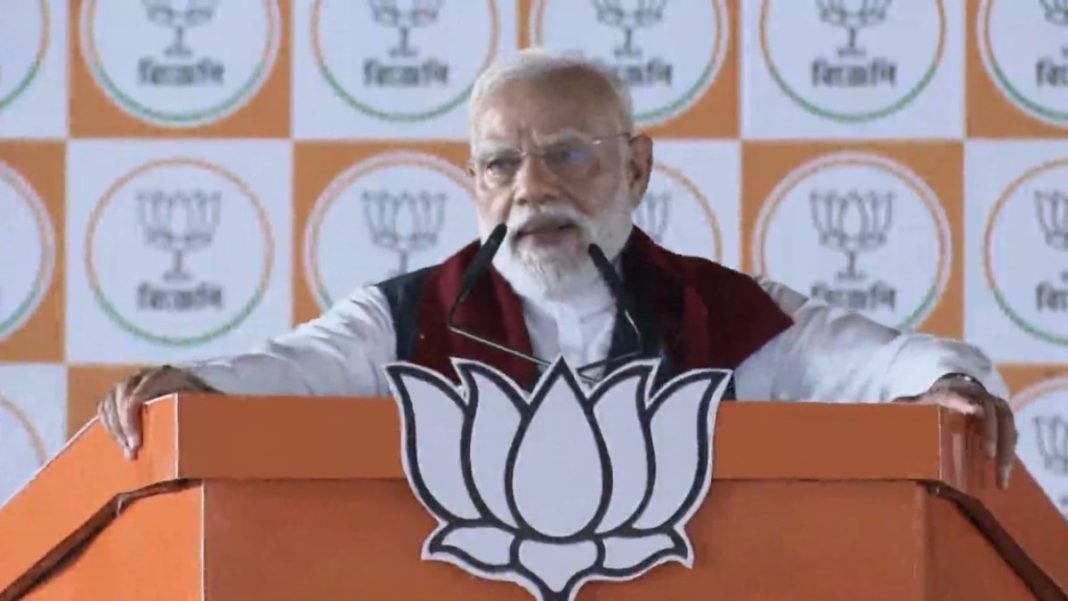
As the political mercury begins its early ascent towards the 2026 Assembly Elections, the Indian political landscape is already abuzz with sharp exchanges, setting the tone for what promises to be a fiercely contested battle. In a recent significant development that has ignited fervent debate, Prime Minister Narendra Modi launched a scathing attack on the Trinamool Congress (TMC), the ruling party in West Bengal, asserting that they have ‘earned a PhD in looting’. This pointed remark, delivered amidst a series of public addresses, underscores the heightened political rhetoric that is expected to dominate discussions in the run-up to the crucial polls.
The Escalating Rhetoric and Ground Realities
Prime Minister Modi’s accusation, delivered at a public gathering, was a direct assault on the TMC’s governance, implying systematic and institutionalized corruption within the state administration. The phrase “Trinamool has earned a PhD in looting” is a powerful metaphor designed to resonate with the electorate, suggesting not mere instances of corruption, but a sophisticated, well-entrenched system. This strong statement is not an isolated incident but rather a continuation of the Bharatiya Janata Party’s (BJP) persistent efforts to highlight alleged irregularities in West Bengal.
The BJP, which has been making significant inroads into West Bengal politics, particularly after its impressive performance in recent national and local elections, frequently raises issues concerning various alleged scams. These often include controversies surrounding public recruitment, particularly in the education sector, and alleged irregularities in the distribution of public welfare provisions. These accusations form the bedrock of the BJP’s campaign narrative, aimed at discrediting the incumbent government and positioning itself as a credible alternative for good governance.
For the BJP, West Bengal remains a critical state in its ambition for pan-India dominance. Despite winning a substantial number of Lok Sabha seats, the party has yet to secure a majority in the state assembly. The early commencement of such aggressive campaigning, therefore, is strategic, designed to maintain pressure on the TMC and galvanize its own cadre and voter base well ahead of the official election notification.
Speaking with characteristic vigour, Prime Minister Modi reportedly stated,
“Trinamool has earned a PhD in looting. They have perfected the art of corruption, making it systematic across various levels of governance, from employment to welfare schemes.”
Trinamool’s Counter-Offensive and Defence
The Trinamool Congress, under the formidable leadership of Chief Minister Mamata Banerjee, has consistently rejected such allegations as politically motivated. The party often characterizes these accusations, especially those involving central investigative agencies like the CBI and ED, as a “witch-hunt” orchestrated by the central government to destabilize opposition-ruled states. TMC leaders frequently argue that these probes are tools of political vendetta, designed to undermine their democratic mandate.
In response to the BJP’s focus on alleged corruption, the TMC typically pivots its narrative to highlight its extensive array of welfare schemes, often cited as models of good governance and direct benefit transfer. Initiatives like Duare Sarkar (Government at Doorstep), Lakshmir Bhandar (Women’s Financial Aid Scheme), and Swasthya Sathi (Health Scheme) are showcased as evidence of the government’s commitment to the welfare of its citizens. The party’s defence often includes emphasizing its fight for federalism and accusing the Centre of withholding funds due to the state, thereby impeding development.
The resilience of the TMC in the face of persistent challenges, including defections and intense scrutiny, has been a defining feature of West Bengal’s political landscape. Its leaders are expected to launch a strong counter-offensive, not just by defending their track record but also by raising questions about the BJP’s own promises and performance, both at the Centre and in states where it governs.
The Stakes and the Road to 2026
The intensity of this early rhetoric underscores the high stakes involved in the 2026 Assembly Elections. For the BJP, securing West Bengal would signify a major triumph in its ‘Look East’ policy and consolidate its national footprint. For the Trinamool Congress, retaining power is crucial not only for its regional dominance but also for its aspiration to play a significant role in national opposition politics.
The political discourse is thus becoming increasingly polarized, with both major parties attempting to frame the narrative in their favour. While the BJP seeks to project the TMC as corrupt and inefficient, the TMC aims to portray the BJP as a divisive force that undermines state autonomy and misuses central agencies. Beyond these two dominant forces, the Left Front and Congress, though diminished, also strive to carve out their space, further complicating the electoral calculus.
As the countdown to 2026 officially begins, the common voter in West Bengal will be left to discern between competing claims and counter-claims. The eventual decision will hinge not just on allegations of corruption or promises of welfare, but also on issues of identity, local grievances, and the perceived ability of each party to deliver stable and progressive governance. The ongoing verbal volleys are merely the initial tremors of what promises to be an earthquake of political activity.
The 2026 Assembly Elections in West Bengal are shaping up to be a defining moment for both state and national politics. Prime Minister Modi’s sharp “PhD in looting” jibe sets an aggressive tone, signaling a no-holds-barred campaign. As the TMC prepares its robust defence and counter-strategy, the political stage is set for an epic electoral battle, with the electorate ultimately holding the key to the state’s future direction.

