


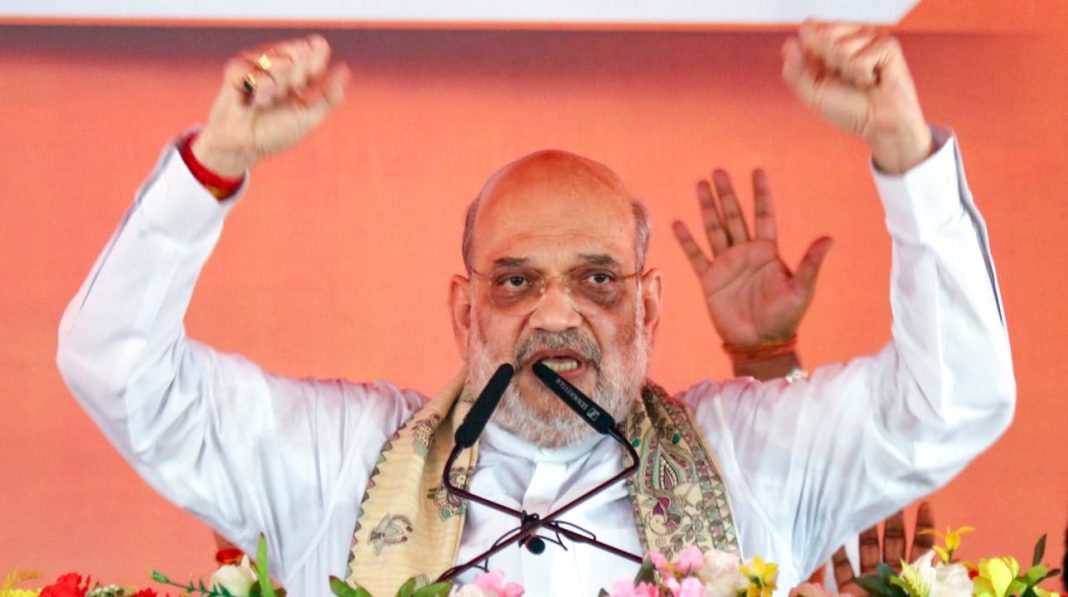
As the political dust began to settle following the crucial first phase of assembly elections in West Bengal, a state keenly watched by the entire nation, the Union Home Minister and senior Bharatiya Janata Party (BJP) leader, Amit Shah, delivered a resounding pronouncement. With characteristic assertiveness, Shah claimed a sweeping victory for his party in a significant portion of the electoral landscape, setting the stage for an intensified political battle in the phases to come.
Addressing the media after the initial round of polling, Shah’s declaration resonated across political circles. While the actual first phase encompassed 30 constituencies, his broader projection, often interpreted as gauging momentum from the initial groundswell, pointed towards an ambitious target. He emphatically stated that out of a specific initial segment of 152 seats, the BJP was poised to win a substantial majority, signaling a strong start to their campaign to unseat the incumbent Trinamool Congress (TMC) government.
The Claim and its Political Echoes
Union Home Minister Amit Shah’s bold assertion, made in the aftermath of the first phase of voting, sent ripples through Bengal’s charged political atmosphere. Shah, a key strategist for the BJP, declared with confidence that his party was well on its way to securing victory in a significant number of seats from the initial phases. Specifically, he claimed the BJP would win “over 125 out of the 152 seats” he referenced as part of the early electoral battleground, effectively projecting dominance in a crucial initial chunk of constituencies. While the first phase itself involved 30 seats, Shah’s statement aimed at building a narrative of overwhelming momentum for the party across a wider initial grouping of constituencies.
The pronouncement was instantly interpreted as a strategic move to boost the morale of BJP cadres and voters, while simultaneously attempting to demoralise the opposition. Political analysts noted that such grand claims, often made by leaders of major parties, serve a dual purpose: to project an image of invincibility and to influence voter perception in subsequent phases. Shah underscored his confidence by attributing the projected success to a perceived strong undercurrent of support for the BJP’s agenda of ‘poriborton’ (change) and good governance.
“Our ground reports and the immense public enthusiasm witnessed in the initial phases confirm that the people of Bengal are yearning for poriborton,” Amit Shah was quoted saying. “The TMC’s misgovernance and corruption will be rejected comprehensively. We are confident of securing victory in over 125 seats out of the initial 152, marking a clear mandate for development and good governance.” This statement, delivered with unwavering conviction, encapsulated the BJP’s aggressive posture in the high-stakes Bengal elections.
Bengal’s High-Stakes Electoral Arena
West Bengal holds immense strategic importance for the Bharatiya Janata Party. Having established a formidable presence in the 2019 Lok Sabha elections, the state represents the last major frontier for the party’s pan-India expansion. For the incumbent Trinamool Congress, led by Chief Minister Mamata Banerjee, the election is a battle for retaining their stronghold and preserving regional identity against what they often term ‘outsider’ forces. This clash of narratives has defined the electoral discourse, making every phase of polling a keenly contested affair.
The initial phases of the election were particularly crucial for both parties, as they aimed to set the tone and build momentum. High voter turnout, often seen as a sign of enthusiasm, was reported in many constituencies, indicating a politically engaged electorate. Issues ranging from economic development, law and order, and alleged corruption, to cultural identity and social welfare schemes, have dominated public debate. The BJP has consistently attacked the TMC on issues of governance and political violence, while the TMC has focused on its welfare schemes and sought to galvanize local sentiment against the national party.
The intense campaigning saw top leaders from both sides crisscrossing the state, holding rallies and roadshows that drew massive crowds. The strategic importance of these early phases cannot be overstated, as a perceived strong performance here could significantly influence voter behaviour and party worker enthusiasm in the later, larger phases of the election.
Beyond the Numbers: Decoding the Projection
Amit Shah’s projection of winning a significant chunk of seats in the early electoral battle is more than just a numerical claim; it is a calculated political maneuver designed to shape perceptions. Such declarations, common in Indian elections, serve as a psychological weapon, aiming to project an image of inevitability for the party and potentially demoralize opponents and fence-sitters. For the BJP, which has invested heavily in its Bengal campaign, such a confident pronouncement reiterates their firm belief in achieving their ‘Mission Bengal’ of securing a majority.
Political analysts suggest that these claims, while often not perfectly aligning with final results, are crucial for narrative building. They provide a focal point for media discussions and party communication, influencing public discourse leading up to subsequent polling dates. The opposition, primarily the Trinamool Congress, has predictably dismissed Shah’s claims as mere election theatrics, asserting that the ground reality favours the incumbent government and its popularity among the masses. They often counter such claims by highlighting specific local factors and the perceived loyalty of Bengal’s voters to their regional party.
The ultimate test of such claims, however, lies in the final vote count. Factors like voter turnout distribution, the success of ground-level mobilisation efforts, the impact of various campaign narratives, and potential last-minute shifts in voter sentiment will all play a decisive role. As the election cycle progresses, these early claims will undoubtedly be scrutinised, debated, and ultimately, confirmed or refuted by the ballot boxes.
Amit Shah’s confident declaration underscores the high stakes and the fierce competition characteristic of the West Bengal elections. While the claim itself is a strong statement of intent, the intricate electoral dynamics of Bengal mean that the actual outcome will remain a subject of intense speculation until the final results are declared, offering a compelling narrative for the future of Indian politics.

