


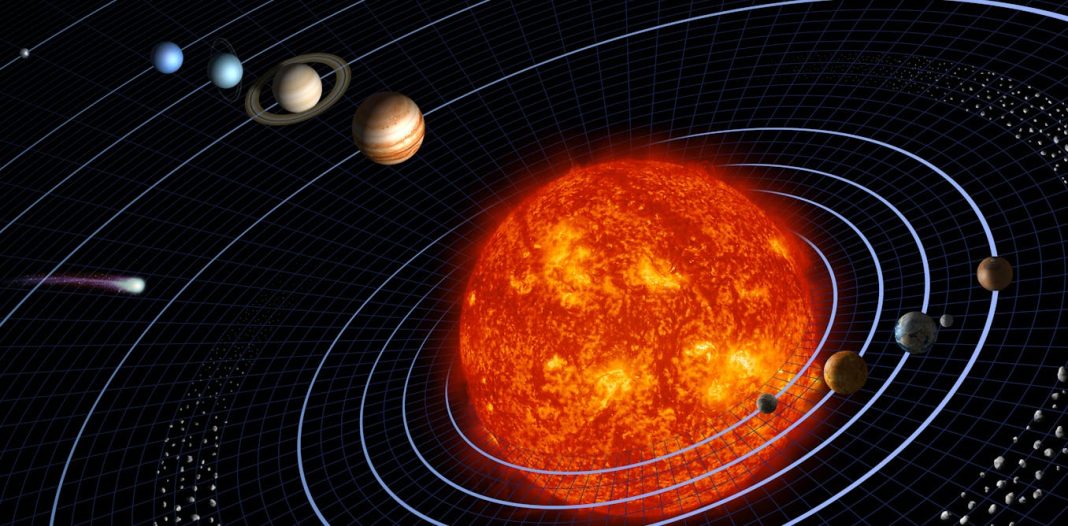
Ever gazed up at the night sky and felt a profound sense of awe, wondering about the endless expanse above? We often think about “up” as reaching for the stars, but what about “down”? If space truly surrounds us, infinite and everywhere, then what exactly lies “below” Earth once you dig past the crust? It’s a question that playfully challenges our intuitive understanding of direction, and the answer is far more mind-bending than you might imagine.
The Gravity of Perception: When ‘Down’ Becomes Relative
Our terrestrial understanding of “up” and “down” is deeply rooted in Earth’s gravity. When you drop an apple, it falls “down” towards the center of our planet. This defines our local sense of direction. But step onto the International Space Station, and suddenly “down” loses its meaning. Astronauts float, and their perspective shifts entirely. There’s no inherent “up” or “down” in the vast vacuum between celestial bodies. Earth itself, a magnificent blue marble, isn’t resting on anything. It’s an astronomical object, suspended by the gravitational pull of the Sun, orbiting through the very same space we perceive as “above” us.
So, when we ask what’s “below” Earth, we’re not asking what it’s sitting on. We’re asking what lies in the direction pointed by our feet, if we could somehow pass through the planet itself. It’s a fundamental shift in perspective: Earth isn’t at the bottom of anything; it’s simply in space, like every other planet, star, and galaxy.
A Journey Through Earth’s Heart: What’s Actually Inside?
Before we fully venture into the cosmic “below,” let’s consider the literal journey inwards. If you could hypothetically tunnel straight through the Earth, you’d encounter layers of incredible density and heat. First, the relatively thin crust we stand on. Then, the colossal mantle, a semi-solid rock layer that makes up the bulk of our planet. Deeper still, you’d reach the scorching liquid outer core, and finally, the solid iron-nickel inner core, where temperatures rival the surface of the Sun and pressures are immense beyond comprehension.
This internal journey is fascinating in its own right, revealing the dynamic engine that drives our planet’s geology and magnetic field. But even if you could survive such a trip, passing through the core and emerging on the opposite side of the globe, where would you be? You’d be standing on land, likely in a vastly different time zone, still on the surface of Earth. And looking “up” (or “down,” depending on your new orientation), you’d see… more space.
As one astrophysicist succinctly put it, “Thinking about ‘below’ Earth in a cosmic sense isn’t about finding a cosmic floor. It’s about recognizing that our planet is a ball, and every direction away from its surface, whether we call it ‘up’ or ‘down,’ leads into the same boundless universe.” Our directional terms are a convenience for local navigation, not universal truths.
The Universal Answer: More Space
This brings us to the ultimate, humbling truth. If you could dig past the Earth’s core, traverse its entire diameter, and emerge on the antipodal side, you’d still be on Earth, which is still in space. If you then stepped off into the void, regardless of which “direction” you chose relative to your starting point, you would find yourself drifting further and further into the vacuum. The Earth doesn’t have an underside that’s different from its topside in the cosmic scheme of things.
Think of Earth as a speck within an enormous, unimaginably vast bubble. Every direction away from that speck, whether it’s the direction of the moon, or the sun, or a distant galaxy, is simply a journey deeper into that same bubble. There isn’t a “bottom” to space, no cosmic floor beneath our feet. There is only more space, filled with other planets, stars, nebulae, galaxies, and the mysterious dark matter and energy that shape the universe.
So, the next time you ponder what’s “below” Earth, remember that our planet is not an anchor but a vessel, sailing through an infinite cosmic ocean. “Down” isn’t a destination; it’s just another vector pointing into the boundless, awe-inspiring expanse of the universe itself.

