


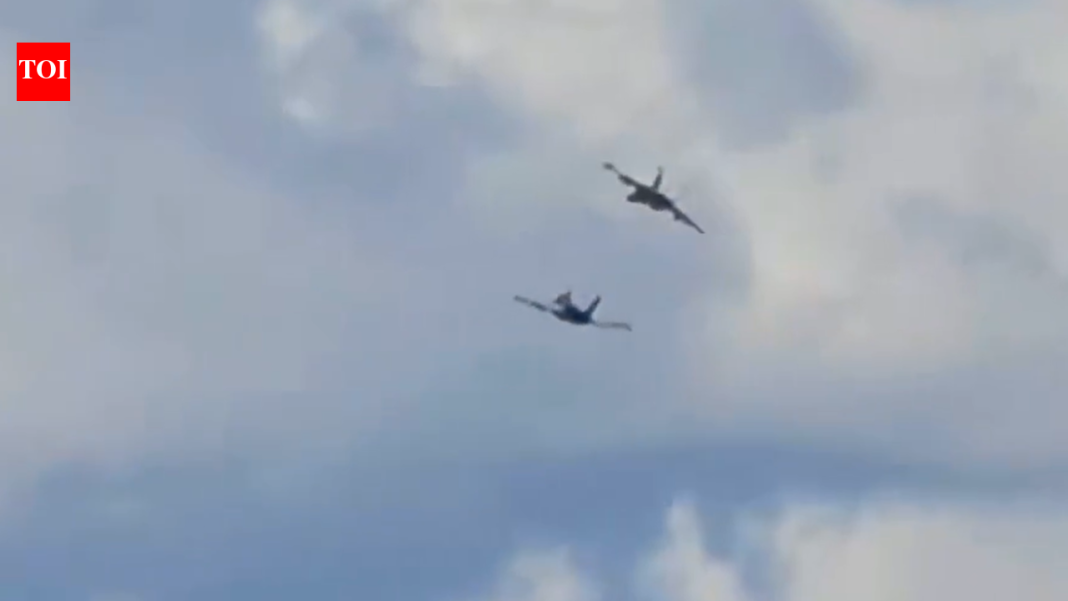
The roar of fighter jets, a symphony of power and precision, is a highlight of airshows worldwide, drawing millions to witness the marvels of aerial acrobatics. However, the inherent risks associated with high-speed, close-proximity manoeuvres were starkly brought into focus recently when two EA-18 fighter jets collided mid-air during an air show in Idaho, USA. The dramatic incident, captured on video by horrified spectators, sent shockwaves across the global aviation community, raising immediate concerns about safety protocols at such public events.
Mid-Air Collision Shocks Spectators at Idaho Air Show
The incident occurred during the annual Idaho National Guard Air Show at Gowen Field in Boise, Idaho. On a clear afternoon, as thousands of attendees looked skyward, two U.S. Navy EA-18 fighter jets, believed to be EA-18G Growlers – electronic warfare variants of the F/A-18 Super Hornet – were performing a synchronized demonstration. Eyewitness accounts and widely circulated video footage show the two aircraft on what appeared to be an intersecting flight path. In a terrifying split-second, the jets made contact, resulting in a visible explosion and debris scattering in the air.
The videos, which quickly went viral across social media platforms including those popular in India, depict the horrifying moment with stark clarity. One moment, the jets were performing; the next, a cloud of smoke and fire marked the collision point. Fortunately, early reports indicated that both pilots were able to eject successfully and safely parachuted to the ground. Miraculously, there were no reported casualties or injuries among the ground crew or the thousands of spectators, thanks to the debris falling within the designated safety zones away from the crowd.
The U.S. Navy immediately launched an investigation into the collision, with initial reports focusing on pilot error, mechanical malfunction, or communication issues as potential causes. The EA-18G Growlers are advanced aircraft, integral to the U.S. Navy’s electronic warfare capabilities, and incidents involving such high-value assets are taken with utmost seriousness, not just for the loss of equipment but for the deeper implications concerning operational safety and training.
Navigating the Aftermath: Investigations and Safety Revisions
Following the crash, the air show was promptly suspended, and Gowen Field was secured for investigation by U.S. military authorities. The immediate priority shifted to pilot recovery, securing the crash sites, and gathering all available evidence. Expert teams from the U.S. Navy and the Federal Aviation Administration (FAA) are expected to meticulously analyse flight data recorders, air traffic control communications, and eyewitness testimonies to reconstruct the events leading up to the collision.
Such incidents, though rare, invariably lead to rigorous reviews of airshow regulations and safety protocols. Airshows, while designed to showcase aviation prowess and inspire interest in aerospace, are inherently risky endeavours. The precision demanded from pilots, often operating at high speeds and low altitudes, leaves minimal margin for error. As Mr. Rajesh Singh, a retired Indian Air Force pilot and aviation safety analyst, observed, “Every airshow manoeuvre is meticulously planned and rehearsed, yet the dynamic environment means pilots are constantly making real-time decisions. Even a fractional miscalculation or a sudden change in conditions can have catastrophic consequences. This incident serves as a stark reminder of the fine line between spectacle and danger in aerial displays, compelling us to continuously re-evaluate safety margins.”
In India, where events like Aero India and Air Force Day displays attract massive crowds, safety is paramount. The Indian Air Force has an impeccable safety record for public displays, built on stringent protocols, extensive pilot training, and vast safety perimeters. The global aviation community often learns from such incidents, prompting a collective re-evaluation of best practices to ensure the continued safety of both participants and spectators.
Lessons for the Global Aviation Community
The Idaho air show collision, while a distressing event, underscores the universal challenges and responsibilities inherent in military aviation displays. It highlights the need for continuous vigilance, technological advancements in collision avoidance, and robust training regimes for pilots involved in aerobatic teams. The detailed findings from the U.S. Navy’s investigation will undoubtedly contribute valuable data and insights that can be shared globally, potentially influencing safety standards for air shows and military aviation exercises worldwide.
For nations like India, with a growing aerospace industry and a vibrant air force that frequently engages in public demonstrations, understanding the root causes of such incidents is crucial. It reinforces the importance of maintaining an unwavering commitment to safety, ensuring that the awe and excitement of aerial displays never come at the cost of human lives or public confidence. The aviation world will be closely watching the outcomes of this investigation, hoping to glean lessons that will prevent similar tragedies in the future, allowing the magic of flight to continue inspiring generations safely.

