


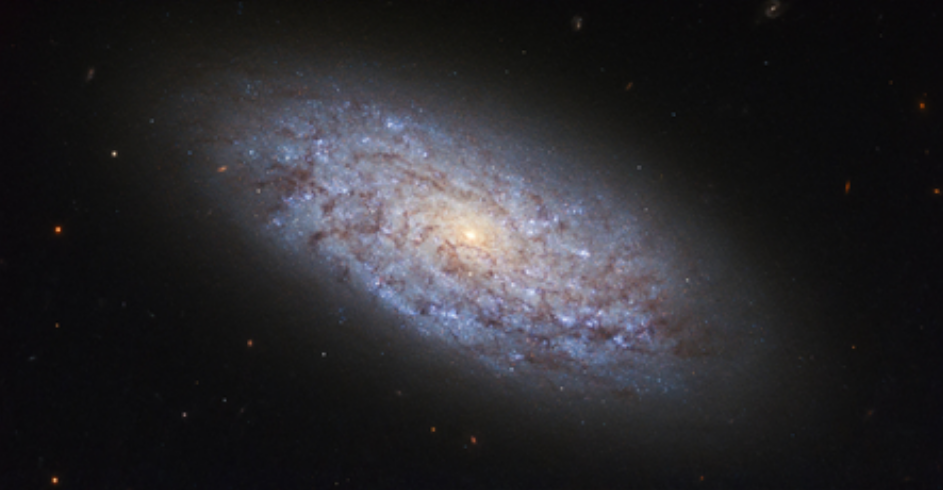
The universe, in its vastness, continues to challenge our understanding, revealing mysteries that push the boundaries of current scientific theory. Among these cosmic enigmas are black holes, objects of immense gravity from which nothing, not even light, can escape. While stellar-mass black holes, born from collapsing stars, and supermassive black holes, residing at the hearts of most galaxies including our own Milky Way, are relatively well-understood, a crucial “missing link” has long eluded direct observation: intermediate-mass black holes (IMBHs).
These enigmatic entities, theorised to bridge the gap between their smaller and larger cousins, hold the key to unlocking how supermassive black holes grow and how galaxies evolve. Now, a groundbreaking new study has turned traditional thinking on its head, suggesting that these elusive IMBHs may not be found in the grandest of cosmic structures, but rather in the universe’s most unassuming inhabitants: dwarf galaxies. This revelation offers a compelling new pathway for detection and significantly reshapes our cosmic narrative.
The Elusive Middle Child of Black Holes
Intermediate-mass black holes are defined by their mass, typically ranging from a few hundred to several hundred thousand times the mass of our Sun. This places them squarely between stellar-mass black holes (tens to hundreds of solar masses) and supermassive black holes (millions to billions of solar masses). Their existence has been theorised for decades, yet direct, unambiguous detection has remained incredibly challenging. Unlike supermassive black holes, which power bright quasars and active galactic nuclei, IMBHs are thought to be much quieter, making them difficult to spot through their gravitational effects or the light they emit as they consume matter.
Scientists believe IMBHs could be the “seeds” from which supermassive black holes grew in the early universe, accumulating mass over billions of years. Understanding their formation and distribution is therefore paramount to comprehending the evolutionary pathways of galaxies themselves. Without a firm grasp on IMBHs, our picture of cosmic evolution remains incomplete, leaving a significant gap in the story of how the universe’s most powerful objects came to be.
Dwarf Galaxies: Unexpected Cosmic Nurseries
Historically, the search for IMBHs often focused on dense star clusters or the outskirts of larger galaxies, environments thought to provide the necessary conditions for their formation. However, the new study, leveraging advanced observational techniques and computational models, suggests that dwarf galaxies might be far more promising hosts.
Dwarf galaxies are small, faint galaxies containing only a few billion stars, significantly less than the Milky Way’s hundreds of billions. Their relatively tranquil nature and lower star formation rates mean that any IMBH residing within them would be less obscured by bright gas and dust, or the overwhelming gravitational influence of a larger galaxy’s central supermassive black hole. This makes the subtle signatures of an IMBH, such as X-ray emissions from accreting matter or peculiar stellar motions, potentially easier to isolate and identify.
Researchers analysed data from numerous dwarf galaxies, looking for tell-tale signs like unusually bright X-ray sources not attributable to stellar phenomena, or stars moving at unexpectedly high velocities near the galaxy’s core. The findings indicate a higher probability of IMBH presence in these smaller galaxies than previously thought, opening up a new frontier for exploration. “This discovery significantly shifts our focus,” says Dr. Anjali Verma, a leading astrophysicist at the Indian Institute of Astrophysics. “By targeting dwarf galaxies, we are peering into environments that might be pristine relics from the early universe, offering a clearer view of black hole formation without the complexities introduced by larger, more active galaxies. It’s akin to finding ancient fossils in undisturbed ground.”
Implications for Galaxy Evolution and India’s Cosmic Quest
The implications of this study are profound. If dwarf galaxies indeed harbour a significant number of IMBHs, it could fundamentally alter our models of how supermassive black holes form and how galaxies co-evolve with their central black holes. It suggests that these “missing link” black holes might be more common than imagined, simply residing in less conspicuous locations. This finding provides fresh impetus for observational astronomy, guiding future missions and telescope time towards these smaller cosmic structures.
For India’s burgeoning space science community, this research offers exciting avenues. With observatories like ISRO’s Astrosat already contributing valuable X-ray data and the nation’s increasing participation in global astronomical projects, Indian researchers are well-positioned to contribute to this quest. Future missions or collaborations focusing on high-resolution X-ray observations and advanced spectroscopic analysis could be instrumental in confirming these findings and identifying more IMBH candidates in dwarf galaxies. The pursuit of intermediate-mass black holes is not just an academic exercise; it’s a vital step towards completing our cosmic family portrait and understanding the intricate dance of matter and gravity that has shaped our universe.
As scientists continue to push the boundaries of detection and analysis, the once-elusive intermediate-mass black holes may soon step out of the shadows, revealing their secrets and enriching our understanding of the universe’s grand evolutionary tale.
*

