


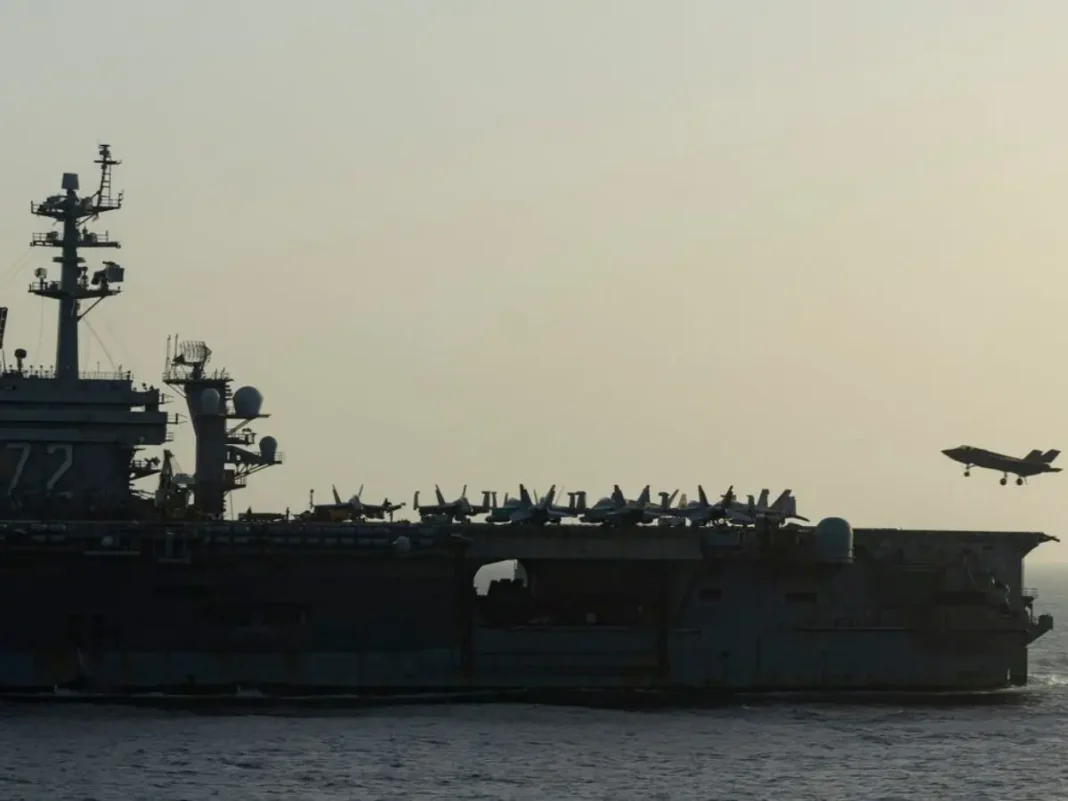
The vast, azure expanse of the Arabian Sea, a critical artery for global trade and energy, is once again witnessing heightened naval activity. Recent reports, accompanied by striking visuals, confirm that the USS Abraham Lincoln Carrier Strike Group (CSG) is actively conducting what the US Navy describes as “maritime interdiction and security operations” – colloquially referred to as blockade operations – within this vital waterway. This significant deployment by the United States, a frequent sight in these strategic waters, carries multifaceted implications for regional security, international maritime law, and notably, for India’s burgeoning geopolitical interests.
For New Delhi, which relies heavily on sea lanes through the Arabian Sea for its energy imports and trade, the presence and actions of major naval powers like the US are under constant scrutiny. While the declared objective of these operations often centers on safeguarding maritime commerce, deterring illicit activities, and maintaining regional stability, the scale and nature of a US carrier strike group’s presence invariably reshape the strategic calculus for all stakeholders.
The USS Abraham Lincoln’s Mission and Regional Context
The USS Abraham Lincoln (CVN-72), a Nimitz-class supercarrier, along with its accompanying destroyers, cruisers, and air wing, represents a formidable projection of power. While specific targets or enforcement actions are rarely detailed publicly for such operations, the term “blockade operations” in this context typically refers to efforts aimed at preventing the flow of specific goods, materials, or even personnel deemed illegal or contrary to international sanctions, rather than a full military blockade against a sovereign nation. These operations fall under the broader umbrella of maritime security, counter-smuggling, and ensuring freedom of navigation, often in support of various UN Security Council resolutions or international mandates.
The Arabian Sea serves as the gateway to the Persian Gulf, a region synonymous with global oil production and transit, notably through the Strait of Hormuz. Any disruption here has immediate and profound economic reverberations worldwide. The US Fifth Fleet, headquartered in Bahrain, consistently maintains a robust presence in the area, citing national interests in protecting crucial maritime commons, deterring potential adversaries, and responding to regional crises. The deployment of a Carrier Strike Group like the USS Abraham Lincoln underscores a strong commitment to these objectives, signaling resolve and capability.
Implications for India’s Maritime Security and Strategy
India, situated at the crossroads of the Indian Ocean, views any significant naval deployment in its extended neighborhood with a strategic lens. The Arabian Sea is India’s western maritime frontier, crucial for its trade with the Middle East, Africa, and Europe. Ensuring the security and unhindered flow of commerce through these waters is a paramount national interest. On one hand, the US presence can be seen as a stabilizing factor, contributing to the broader objective of a free, open, and rules-based Indo-Pacific, an ideal frequently echoed by both New Delhi and Washington.
Cooperation between the Indian Navy and the US Navy has significantly deepened in recent years, encompassing joint exercises, intelligence sharing, and maritime domain awareness initiatives. This collaboration often focuses on common threats such as piracy, terrorism, and illicit trafficking. However, India also maintains a stance of strategic autonomy, carefully balancing its partnerships with its independent foreign policy objectives. The presence of a powerful external naval force conducting “blockade operations” necessitates careful monitoring, even from a friendly nation.
As Rear Admiral (Retd.) Raja Menon, a prominent Indian strategic analyst, observed, “While India and the US share converging interests in maintaining a secure maritime environment, New Delhi must always assess the broader geopolitical implications of any external power’s increased footprint in our immediate strategic space. Our own growing naval capabilities are testament to our commitment to being a net security provider in the Indian Ocean Region.” This sentiment encapsulates India’s dual approach: acknowledging shared security interests while steadfastly asserting its role as a key regional player with its own strategic imperatives.
Navigating Geopolitical Undercurrents
The Arabian Sea is not just a commercial thoroughfare but also a theatre of complex geopolitical dynamics. Beyond the US, other major naval powers, including China and Russia, have shown increasing interest in expanding their presence and influence in the broader Indian Ocean Region. Iran, a littoral state of the Persian Gulf and Arabian Sea, also closely monitors foreign naval activities, often viewing such deployments with suspicion.
The USS Abraham Lincoln’s operations, therefore, occur against a backdrop of delicate diplomatic and security balances. For India, maintaining robust trade relations with various nations, including Iran, while adhering to international norms and navigating complex geopolitical realities, requires deft diplomacy. The continued US presence, especially when framed as “blockade operations,” adds another layer of complexity to this already intricate strategic landscape. It underscores the ever-present need for dialogue, transparency, and multilateral cooperation to ensure that vital maritime commons remain open for all, free from conflict and coercion.
In conclusion, the USS Abraham Lincoln’s current deployment and “blockade operations” in the Arabian Sea are a clear demonstration of US commitment to maritime security and strategic influence in a critical global choke point. For India, this development is a reminder of the complex and interconnected nature of regional security. While such operations contribute to broader maritime stability in certain aspects, they also highlight the ongoing need for India to solidify its own naval power, champion a rules-based order, and pursue a pragmatic foreign policy that safeguards its national interests in an increasingly contested maritime domain.

