


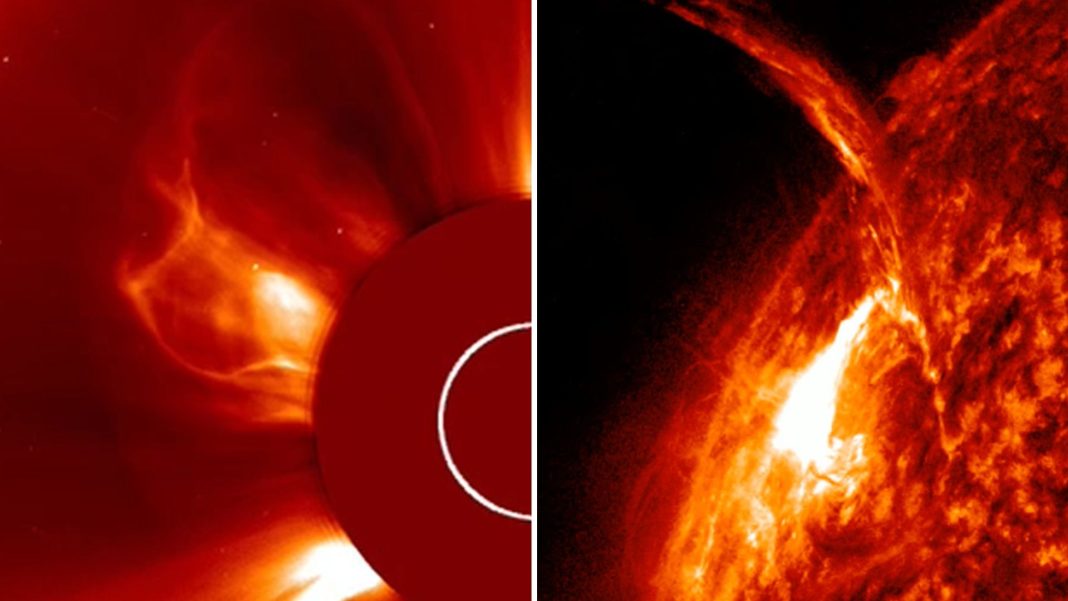
Imagine the night sky… not just a canvas of stars, but a vibrant, dancing tapestry of color, swirling in hues of green, purple, and red. This isn’t a scene from a science fiction movie; it could be your reality this week. A colossal solar flare has erupted from the Sun, unleashing a powerful Coronal Mass Ejection (CME) that is currently hurtling towards Earth. Scientists are issuing a rare “Northern Lights Alert,” suggesting this event could trigger one of the most spectacular aurora displays in recent memory, potentially visible far beyond the usual polar regions.
The Sun’s Fiery Embrace: What’s Happening?
Our life-giving Sun, usually a steady furnace, occasionally lets out a cosmic sneeze. This week, it was more like a roar. A significant solar flare, an intense burst of radiation, shot out from a sunspot. Following close behind, and even more crucial for our celestial show, was a massive Coronal Mass Ejection. Think of a CME as a giant bubble of superheated plasma and magnetic field, weighing billions of tons, ejected from the Sun’s outer atmosphere. This particular CME is not just big; it’s predicted to be highly energetic, making its journey across space at an astonishing speed.
When this energized plasma cloud eventually collides with Earth’s magnetic field, it triggers what’s known as a geomagnetic storm. Our planet’s magnetic field, a protective invisible shield, gets compressed and distorted, allowing these charged particles to funnel down into the atmosphere near the poles. As they collide with gases like oxygen and nitrogen, they excite these atoms, causing them to emit light – the dazzling aurora borealis (Northern Lights) and aurora australis (Southern Lights) we so deeply admire. The sheer scale of this incoming CME suggests a geomagnetic storm that could push the aurora oval much further south, or north in the southern hemisphere, than typical displays.
Chasing the Celestial Dancer: Are You Ready for the Show?
This isn’t just another pretty light show; it’s a profound connection to the raw power of our nearest star. The potential for visibility across a wider swathe of the globe has everyone from seasoned aurora hunters to casual stargazers buzzing with anticipation. While predicting the exact timing and location can be tricky, the general advice remains the same: find a dark spot away from city lights, ideally with an unobstructed view to the north (for those in the Northern Hemisphere). Patience is key, as the aurora can ebb and flow over several hours.
“This is the kind of event we dream about – a chance to see the aurora dance over latitudes that usually only get a whisper,” commented a local amateur astrophotographer, scanning the latest space weather forecasts. “The energy involved here is immense; it’s humbling to think about our place in the cosmos when you watch the Sun’s power manifest as art in our own sky.” Even if you’re not in the “prime viewing zone,” the geomagnetic storm could still paint the horizon with a subtle glow, a silent testament to the Sun’s activity.
So, keep your eyes on the sky. This isn’t just about pretty lights; it’s a vivid reminder of the dynamic, awe-inspiring universe we inhabit. We are poised for a potentially unforgettable display of nature’s grandeur, a direct message from the heart of our solar system. Charge your phones, grab a warm blanket, and prepare to be enchanted. The universe is calling, and it’s asking you to look up.
*

