


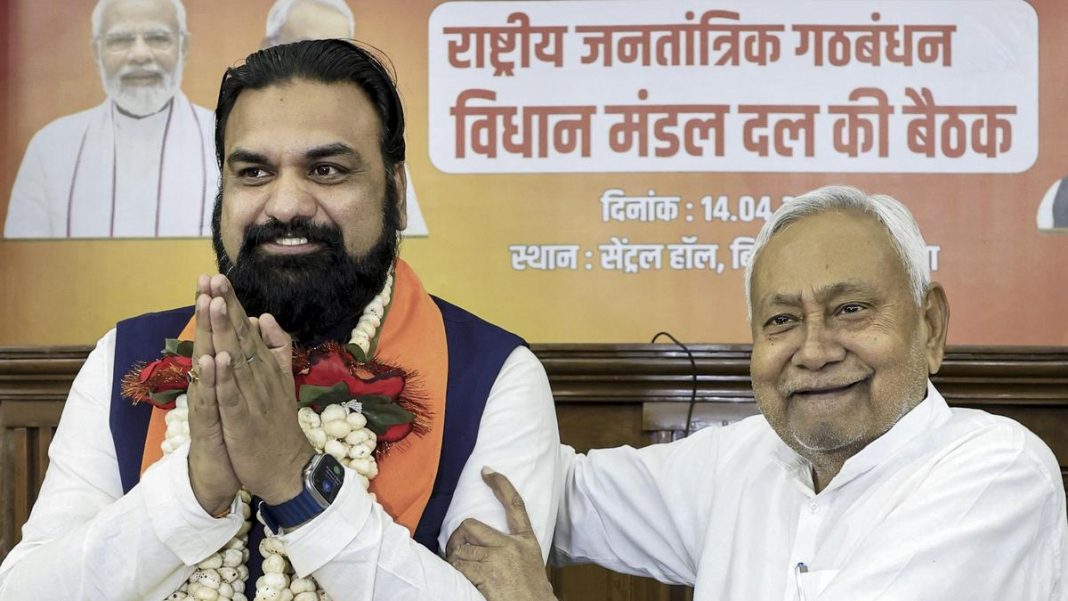
Bihar’s political landscape has been dramatically reshaped with the sudden resignation of Chief Minister Nitish Kumar, paving the way for the Bharatiya Janata Party (BJP) to claim the state’s top executive position. In a swift turn of events that underscores the fluid nature of Indian coalition politics, Samrat Choudhary, a prominent BJP leader, is set to assume the mantle of Chief Minister, marking a significant power shift in the crucial Hindi heartland state.
The development brings an end to the nearly 1.5-year-old Mahagathbandhan (Grand Alliance) government, which saw Nitish Kumar’s Janata Dal (United) allied with the Rashtriya Janata Dal (RJD), Congress, and Left parties. This change of guard is not merely a local affair but carries considerable weight, potentially recalibrating national political equations ahead of the impending Lok Sabha elections.
A Sudden Turn in Bihar Politics
The political drama unfolded rapidly, culminating in Nitish Kumar tendering his resignation to Governor Rajendra Arlekar. Citing irreconcilable differences and dissatisfaction with the functioning of the Mahagathbandhan, particularly with alliance partner RJD, Kumar chose to end his tenure at the helm of the coalition government. This move is not unfamiliar territory for the veteran politician, often dubbed a “paltu ram” (turncoat) for his frequent shifts in alliances, having previously allied with the BJP, then the RJD, and now seemingly poised to support the BJP from the outside.
The dissolution of the previous government was a meticulously orchestrated affair. Reports of growing friction within the Grand Alliance had been circulating for weeks, ranging from disagreements over portfolio allocations to concerns regarding governance and law and order. Nitish Kumar’s characteristic silence on these matters often serves as a precursor to significant political maneuvers. His resignation speech hinted at an environment where decision-making was hampered and the common minimum program of the alliance was not being effectively pursued. This cleared the path for the BJP, which had been actively strategizing to reassert its dominance in Bihar after being sidelined in the previous assembly elections.
Samrat Choudhary: Bihar’s New Helmsperson
The elevation of Samrat Choudhary to the Chief Minister’s position marks a pivotal moment for the BJP in Bihar. Choudhary, who has been serving as the party’s state president and leader of the opposition in the legislative council, represents a new generation of BJP leadership in the state. His political journey is rooted in Bihar’s complex caste dynamics; he belongs to the Koeri community, an influential OBC group, which is a crucial vote bank for any party aspiring for power in the state.
Choudhary’s political career began with the Rashtriya Janata Dal (RJD), where he served as a minister in various capacities. He switched allegiance to the BJP in 2018, steadily rising through the party ranks due to his organizational skills and robust criticism of the incumbent RJD-JD(U) alliance. His assertive style and ability to mobilize party cadres have made him a formidable force. His appointment as CM is widely seen as a strategic move by the BJP to strengthen its OBC outreach and consolidate its independent identity in Bihar, rather than being solely reliant on coalition partners.
Political analyst Dr. Priya Sharma observes, “The BJP’s decision to install Samrat Choudhary as Chief Minister, rather than allowing Nitish Kumar to continue, marks a decisive turn in Bihar’s political narrative. It signals a clear intent to consolidate power and potentially redefine political equations in the state beyond the traditional Nitish vs. RJD binary, especially with an eye on the upcoming general elections.“
Implications for Bihar and National Politics
This political realignment has profound implications for both Bihar and the broader national political landscape. For Bihar, the new government under Samrat Choudhary faces the immediate challenge of ensuring administrative continuity and delivering on developmental promises. Issues such as employment, infrastructure development, and managing the state’s substantial migrant worker population will remain critical. The BJP’s emphasis on good governance and its national agenda will now directly influence state policies.
Nationally, the collapse of the Mahagathbandhan in Bihar is a significant blow to the opposition’s INDIA bloc. Nitish Kumar, a key architect and convenor of the alliance, had been instrumental in bringing disparate opposition parties together. His departure weakens the bloc’s unity and credibility, especially just months before the 2024 Lok Sabha elections. Bihar, with its 40 Lok Sabha seats, is a crucial state, and the BJP’s resurgence here could significantly bolster its prospects in the general elections. The shift demonstrates the BJP’s aggressive strategy to expand its footprint and weaken regional opposition strongholds.
The coming months will be crucial in observing how Samrat Choudhary navigates the complexities of Bihar politics, consolidates his position, and leads the state. His tenure will not only shape Bihar’s future but also send a strong message about the evolving power dynamics in Indian federalism.
The political chessboard of Bihar has been reset, and the focus now shifts to the new leadership and its ability to govern a state known for its unique political complexities and vibrant electoral contests.

