


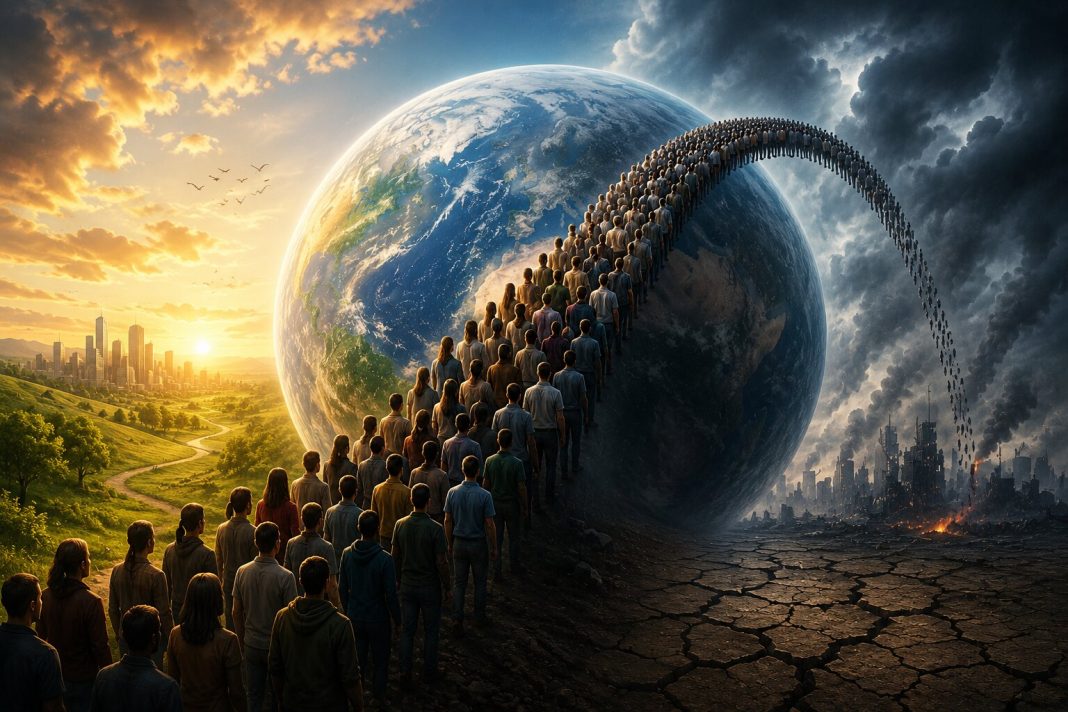
For decades, the global narrative has been dominated by concerns of overpopulation, resource scarcity, and environmental strain driven by an ever-growing human presence. However, a startling new mathematical model is challenging this entrenched perception, presenting a dramatically different future. Developed by researchers at the Global Sustainability Institute, this sophisticated model predicts a peak in global population around 2040, followed by a rapid and significant decline, with profound implications that could reshape societies by 2064. This provocative forecast compels us to reconsider our long-term strategies, especially in densely populated nations like India.
The Model’s Mechanisms and Stark Projections
The model, dubbed “Earth 3000,” employs a complex systems approach, integrating numerous interdependent variables like global fertility, aging populations, resource depletion, pollution, economic inequality, and climate change impacts. Drawing inspiration from “The Limits to Growth” by the Club of Rome, Earth 3000 incorporates advanced demographic transitions and feedback loops between human systems and the environment.
Its central prediction outlines a scenario where global population will likely peak at approximately 8.5 to 9 billion around 2040. What follows, according to the model, is not a gradual plateau but a swift and steep downturn. This “overshoot and collapse” dynamic suggests that human consumption and societal structures will push ecological limits to a breaking point, triggering a rapid unwinding of demographic growth. Key drivers include sustained sub-replacement fertility rates across an increasing number of nations, coupled with the cumulative effects of environmental degradation impacting health and resource availability. The model posits that by 2064, the global population could be significantly lower than today, initiating profound social and economic restructuring.
India’s Demographic Dividend Faces a New Horizon
India, the world’s most populous nation, stands at a unique demographic crossroads. With nearly two-thirds of its population under 35, the country currently enjoys a significant demographic dividend – a period where a large working-age population can fuel economic growth. However, this new model’s predictions introduce a new layer of analysis for India’s future.
While India’s fertility rates are still higher than many developed nations, they have been steadily declining, with several states already below the replacement level of 2.1 children per woman. If global trends accelerate as predicted, India, despite its current youthful bulge, could face similar challenges to an aging population sooner than anticipated. A rapid global population contraction could lead to reduced demand for goods and services from international markets, impacting India’s export-driven sectors. Domestically, while a smaller future population might alleviate pressure on resources like water and land, it could also lead to a shrinking workforce, strain on social security and healthcare systems for the elderly, and a potential slowdown in economic dynamism.
This scenario calls for proactive policy adjustments. India needs to leverage its current demographic dividend through education and skill development, while also planning for a future with a potentially older and smaller population. Investments in automation, elderly care, and sustainable resource management become paramount to mitigate future shocks and ensure long-term stability.
Global Implications and the Call for Resilience
The “Earth 3000” model is not without its critics, with some demographers arguing that human adaptability and technological innovation are underestimated. However, its sophisticated framework compels a serious re-evaluation of long-held assumptions. A global population decline of this magnitude would usher in unprecedented challenges, including shifts in geopolitical power, economic contraction due to reduced consumption, and fundamental changes in social structures designed for growth.
The model underscores the interconnectedness of population, environmental health, and economic stability. It suggests that focusing solely on growth metrics, without accounting for ecological limits and social well-being, is unsustainable.
Dr. Priya Sharma, a demographer at the Indian Institute of Population Sciences, commented:
“While projections vary, the underlying message is clear: unbridled growth is not a sustainable path. We must pivot towards building resilient societies that can thrive with fluctuating demographics and within ecological boundaries. For India, this means leveraging our current youth to build a future that values sustainability over sheer numbers.”
The conversation shifts from managing overpopulation to managing decline, or at least, stagnation. Governments globally, including India, might need to re-examine policies on family planning, immigration, retirement ages, and economic productivity. The emphasis would move from maximizing numbers to maximizing quality of life and ecological balance.
The “Earth 3000” model’s prediction of a global population crash by 2064 presents a sobering, yet potentially transformative, perspective on humanity’s future. While the exact trajectory remains a subject of ongoing debate, the model serves as a powerful reminder of the complex interplay between human society, economics, and the environment. For India, a nation poised to shape the 21st century, this forecast necessitates a proactive and nuanced approach. By focusing on sustainable development, robust social safety nets, and adaptive economic strategies, India can navigate demographic shifts, ensuring resilience and prosperity. The future, it suggests, is less about managing an unending boom and more about intelligently adapting to profound change.

