


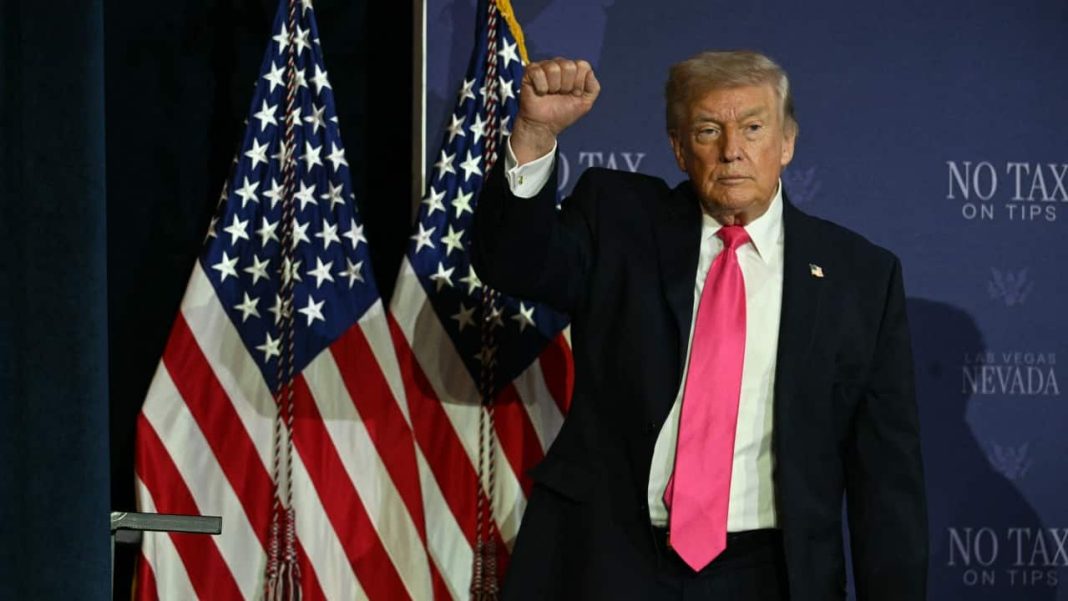
Former US President Donald Trump recently reignited global concerns over Iran’s nuclear ambitions with a stark warning, asserting that the Middle East and Europe would have faced catastrophic consequences had his administration not withdrawn from the Joint Comprehensive Plan of Action (JCPOA), commonly known as the Iran nuclear deal.
Trump’s dramatic pronouncement underscores the persistent anxieties surrounding Iran’s nuclear program and the fraught history of international efforts to contain it. For India, a nation deeply intertwined with West Asian stability due to energy needs, trade, and its diaspora, these renewed tensions represent a complex diplomatic tightrope walk, demanding careful consideration of regional dynamics and global power plays.
Trump’s Vehement Stance and the JCPOA’s Lingering Shadow
During a recent address, Donald Trump unequivocally stated that his decision to unilaterally withdraw the United States from the Iran nuclear deal in 2018 was a move that averted widespread destruction. He has consistently championed his “maximum pressure” campaign against Tehran as a successful strategy to curb its alleged nuclear aspirations and destabilising regional activities.
‘The Middle East and Europe would have been blown to pieces had it not been for the fact that I pulled out of the horrible Iran Nuclear Deal,’ Trump asserted, reiterating his long-held belief that the JCPOA was a flawed agreement. He argued that the deal, which exchanged sanctions relief for curbs on Iran’s nuclear program, merely paved the way for Iran to eventually develop nuclear weapons once key provisions expired. His administration’s withdrawal led to the re-imposition of crippling sanctions on Iran, severely impacting its economy and oil exports.
Conversely, proponents of the JCPOA, including most European allies, have maintained that despite its imperfections, the deal was the most effective mechanism for preventing Iran from acquiring nuclear weapons. They argue that Trump’s withdrawal empowered Iranian hardliners and prompted Tehran to progressively roll back its commitments under the agreement, enriching uranium to higher levels and restricting international inspections, thereby increasing, rather than decreasing, the proliferation risk.
A Region on Edge: International Reactions and Iranian Resolve
Trump’s strong rhetoric casts a spotlight on a region perpetually on edge. His claims resonate with countries like Israel and Saudi Arabia, who have long viewed Iran as a primary threat to regional security and have vocally opposed the JCPOA. These nations have frequently expressed concerns over Iran’s ballistic missile program and its support for various proxy groups across the Middle East, from Lebanon to Yemen.
Iran, for its part, has consistently denied any ambition to develop nuclear weapons, asserting that its nuclear program is for peaceful energy purposes. However, following the US withdrawal and subsequent sanctions, Tehran began to incrementally exceed the JCPOA’s limits on uranium enrichment and stockpile, maintaining that these actions are reversible if the US returns to the deal and lifts sanctions. International Atomic Energy Agency (IAEA) reports have confirmed Iran’s increasing enrichment levels, further fuelling global anxieties.
The absence of a functional nuclear deal, coupled with regional proxy conflicts and heightened rhetoric, creates a volatile environment. Any escalation in this standoff carries the potential for widespread destabilisation, impacting global energy markets and international shipping lanes, consequences that would be acutely felt across the world.
India’s Delicate Balance: Geopolitics, Energy, and Strategic Interests
For India, the unfolding drama surrounding Iran’s nuclear program and Trump’s incendiary statements are far from abstract. India has significant stakes in the stability of the Middle East. Its energy security heavily relies on oil and gas imports from the region, making any disruption a direct threat to its economic growth. Furthermore, millions of Indian expatriates reside in the Gulf countries, sending crucial remittances back home, and their safety and well-being are paramount.
India’s traditional foreign policy emphasizes strategic autonomy and maintaining balanced relations with all major players, including the US, Iran, and Gulf nations. This position becomes increasingly challenging amidst such sharp geopolitical divisions. India has historically called for dialogue and diplomatic solutions to the Iranian nuclear issue, advocating for a peaceful resolution that ensures regional stability.
Beyond energy and diaspora, India’s strategic investments, such as the Chabahar Port in Iran, designed to provide connectivity to Afghanistan and Central Asia, underscore its long-term interests in the region. Sanctions and instability directly impact the viability and progress of such crucial infrastructure projects. A nuclear crisis or broader conflict would severely jeopardise India’s economic and strategic outreach.
Conclusion
Donald Trump’s dramatic assertions about the catastrophic potential of Iran’s nuclear program serve as a stark reminder of the unresolved tensions that continue to plague global security. While his ‘maximum pressure’ campaign undoubtedly put immense strain on Iran, it also dismantled a painstakingly negotiated agreement, leaving a void that is yet to be filled by a viable diplomatic alternative. The implications of a renewed US presidential term for Trump, with his declared intent to revisit the “horrible” Iran deal, weigh heavily on the geopolitical landscape.
For India, the path forward remains one of cautious engagement, advocating for de-escalation, adherence to international law, and robust diplomacy. The precarious balance of power in the Middle East, coupled with the critical importance of regional stability for India’s economic and strategic interests, necessitates a vigilant and measured approach as the world grapples with the enduring challenge of Iran’s nuclear future.

