


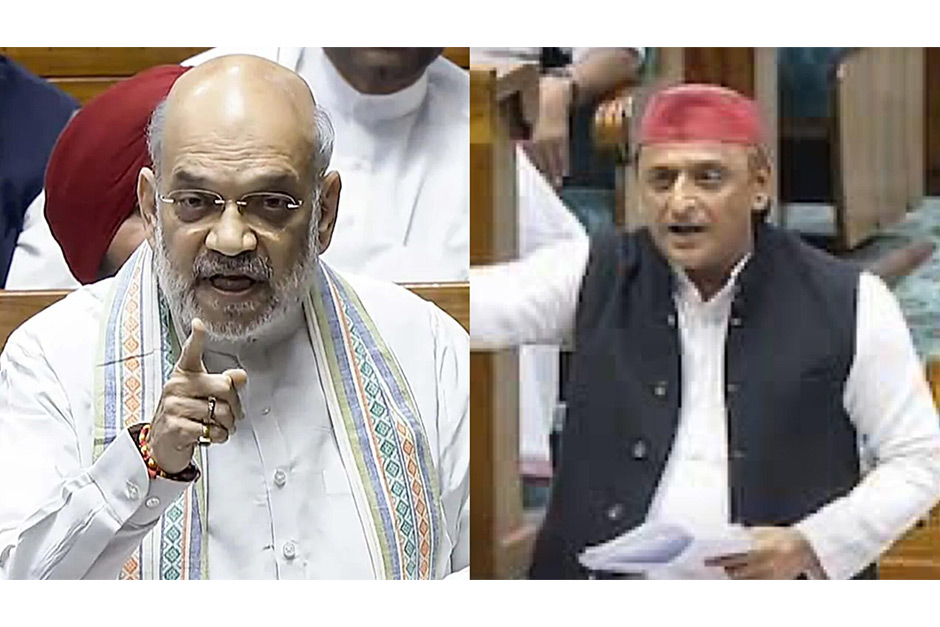
The hallowed halls of India’s Parliament, often a stage for impassioned debate, recently witnessed a significant exchange during discussions surrounding the historic Women’s Reservation Bill, officially known as the Nari Shakti Vandan Adhiniyam. This landmark legislation, aiming to reserve 33% of seats for women in the Lok Sabha and state assemblies, has been met with broad political consensus on its intent, yet its implementation framework has ignited a fresh round of contention. At the heart of this parliamentary joust were Union Home Minister Amit Shah and Samajwadi Party chief Akhilesh Yadav, their remarks highlighting the intricate balance between legislative intent, procedural realities, and political posturing.
The Delimitation Dilemma and Shah’s Offer
The Nari Shakti Vandan Adhiniyam, a bill long-awaited and debated for decades, finally received parliamentary approval, marking a pivotal moment for women’s political representation in India. However, a key provision within the bill has become a flashpoint: its implementation is contingent upon the completion of the next census and a subsequent delimitation exercise. This clause stipulates that the reserved seats will only come into effect after these two crucial processes are concluded, effectively deferring the bill’s practical application to a future date, potentially after the 2029 general elections.
It was amidst this backdrop of parliamentary debate, with opposition parties raising concerns about the delay, that Union Home Minister Amit Shah intervened. Recognizing the dissent and questions regarding the staggered implementation, Shah proposed an unusual, yet direct, solution. He offered to “halt proceedings for an hour” to allow for a comprehensive discussion on the provisions of the delimitation and census requirements. His intent, as articulated, was to address the opposition’s apprehensions in a transparent and democratic manner, allowing members to seek clarifications and engage in a detailed examination of the clauses that link the bill’s enforcement to these future exercises. Shah emphasized that the government was open to explaining the constitutional and logistical necessities behind the phased approach, aiming to clear any misunderstandings or political criticisms.
Akhilesh Yadav’s Counter-Punch: A ‘Woman PM’ Dig
While Shah’s offer aimed to foster dialogue, it was met with a sharp political retort from Samajwadi Party leader Akhilesh Yadav. Yadav, a prominent voice among those skeptical of the bill’s immediate impact, rejected the proposal for a one-hour discussion. He viewed the offer not as a genuine attempt at clarification, but rather as a tactic to divert attention from what he perceived as the government’s deliberate delay in empowering women. Yadav’s response transcended the procedural debate, injecting a broader political challenge into the discourse.
Hitting back at the government’s claims of commitment to women’s empowerment, Akhilesh Yadav posed a pointed question, taking a direct dig at the ruling party: “If you are giving 33% reservation to women, then when will you make a woman the Prime Minister?” This remark resonated widely, shifting the focus from the legal intricacies of the bill to the fundamental question of leadership and power. Yadav’s statement implied a perceived hypocrisy, questioning the BJP’s long-term vision for women in top leadership roles while simultaneously delaying a bill that aims to increase their representation at lower legislative levels. The Samajwadi Party has historically advocated for a “quota within quota” for women from backward classes and minorities, adding another layer to their nuanced opposition to the bill’s current form and delayed implementation.
Broader Implications and Political Chess
The exchange between Amit Shah and Akhilesh Yadav underscores the complex interplay of legislative process and political strategy in India. For the BJP, passing the Women’s Reservation Bill, even with a deferred implementation clause, is a significant political victory, fulfilling a long-standing electoral promise and burnishing its image as a champion of women’s rights. Shah’s offer for an extended discussion can be seen as an attempt to project an image of democratic openness, ready to address legitimate concerns while maintaining the government’s stance on the necessity of census and delimitation before implementation.
Conversely, for opposition parties like the Samajwadi Party, the delay in implementation is a critical point of contention. They argue that by tying the bill to future, unspecified processes, its immediate impact is neutralized, turning a potentially transformative law into a symbolic gesture for the foreseeable future. Akhilesh Yadav’s “woman PM” remark, therefore, serves multiple political purposes. It challenges the BJP’s narrative, questions its sincerity on women’s empowerment, and attempts to expose what he perceives as a gap between rhetoric and reality. This statement also appeals to a broader sentiment about meaningful representation, moving beyond numerical quotas to actual leadership roles, while perhaps subtly hinting at the dynamics of dynastic politics often associated with the Yadav family and its own history of leadership.
The parliamentary confrontation highlights that while the Nari Shakti Vandan Adhiniyam has crossed significant legislative hurdles, its journey towards full realization is still fraught with political negotiations and strategic maneuvers. The debate is no longer just about the bill itself, but about the control of narrative, the timing of reforms, and the deeper questions of power and representation in Indian politics.

