


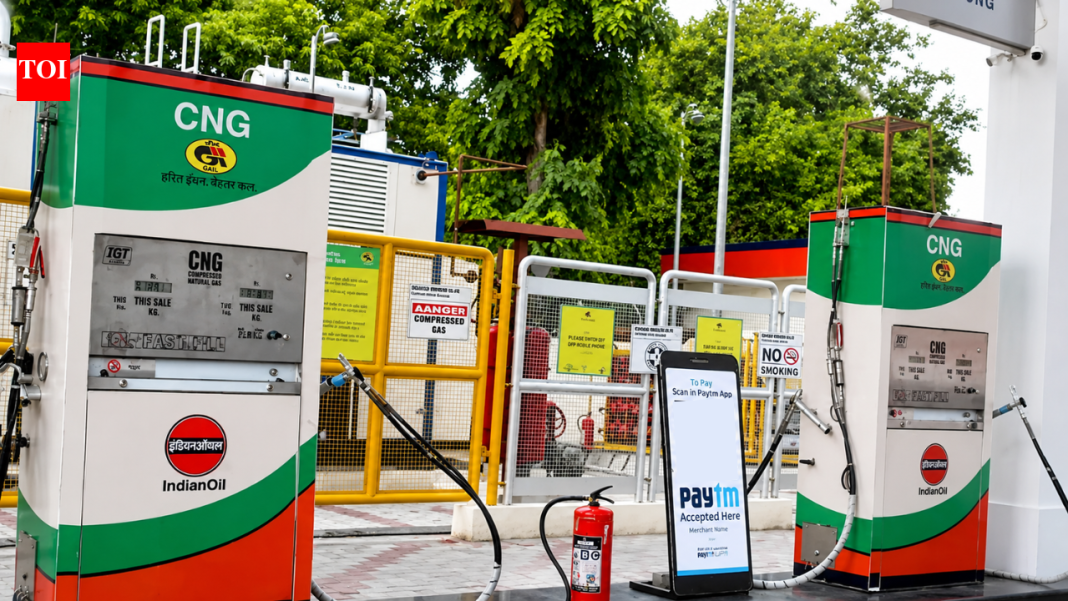
New Delhi, NCR – Commuters and commercial vehicle operators in the National Capital Region (NCR) are once again grappling with increased transportation costs as Indraprastha Gas Limited (IGL) has announced its fourth hike in Compressed Natural Gas (CNG) prices this year. Effective immediately, the price of CNG across Delhi, Noida, Greater Noida, and Ghaziabad has risen by Rs 2 per kilogram, marking a significant financial challenge for a wide spectrum of users.
This latest revision pushes the cumulative increase in CNG prices to an unprecedented level within a short span, adding to the inflationary pressures already burdening households and businesses. The decision, attributed to the escalating input costs, particularly for imported R-LNG (Regasified Liquefied Natural Gas), underscores the volatility in global energy markets and its direct impact on India’s domestic fuel landscape.
The Latest Surge and Its Immediate Impact
Following the new directive, CNG in Delhi will now cost nearly Rs 79.56 per kilogram, while prices in Noida, Greater Noida, and Ghaziabad have climbed to around Rs 82.12 per kilogram. This uniform increase of Rs 2 per kg affects millions, from daily commuters relying on public transport to the backbone of urban mobility – auto-rickshaw and taxi drivers, as well as private car owners who opted for CNG as a more economical and environmentally friendly alternative.
For commercial drivers, who operate on thin margins, each price hike translates directly into reduced daily earnings or necessitates an increase in fares, which can deter customers. The cumulative effect of four such increases in a relatively short period is particularly punishing. Many drivers had transitioned to CNG vehicles, making significant investments based on the promise of lower running costs. Now, they find themselves caught between rising fuel expenses and the challenge of passing these costs onto passengers in a competitive market.
Understanding the Underlying Causes
IGL, like other city gas distributors (CGDs) in India, largely attributes these continuous price revisions to the soaring international prices of natural gas. India heavily relies on imported LNG to meet its energy demands, especially for the city gas distribution network. The global supply chain disruptions, geopolitical tensions, and increased demand in other parts of the world have pushed LNG spot market prices to historic highs. The strengthening US dollar against the Indian Rupee further exacerbates the situation, making imported gas more expensive in local currency terms.
Furthermore, the government’s periodic revision of the domestic natural gas price, based on a formula linked to international hub prices, also plays a role. While a portion of CNG is sourced from domestic fields under the Administered Price Mechanism (APM) gas, the increasing reliance on imported R-LNG to bridge the supply-demand gap means that global price trends inevitably dictate domestic pricing.
Ripple Effects Across the Economy
The consistent upward trajectory of CNG prices extends its impact far beyond the direct users. Transportation costs are a significant component of the overall cost structure for goods and services. A hike in CNG prices invariably leads to an increase in logistics expenses, which is then passed on to consumers in the form of higher prices for essential commodities, fueling inflationary pressures across the economy. From fresh produce reaching local markets to e-commerce deliveries, the cost of transport underpins almost every transaction.
The sentiment among commercial drivers is one of growing frustration. “Every few weeks, the price goes up again. How are we supposed to manage?” lamented Rajesh Kumar, an auto-rickshaw driver in Delhi. “Our earnings are already tight, and now we have to pay more for fuel. If we increase fares, customers complain. It’s a lose-lose situation for us.” This sentiment reflects the broader struggle faced by daily wage earners and small businesses navigating an unpredictable economic environment.
Moreover, the successive hikes risk eroding the incentive for adopting cleaner fuels like CNG. Consumers and fleet operators might reconsider their investment in CNG vehicles if the cost advantage over petrol and diesel diminishes significantly. This could potentially slow down India’s transition towards cleaner mobility options, a crucial aspect of the nation’s environmental agenda.
As the NCR braces for the implications of the fourth CNG price hike, the focus remains on how long this inflationary trend will persist and what measures, if any, the government and gas distributors might take to stabilize prices. The challenge lies in balancing the global economic realities with the need to ensure affordable and sustainable urban mobility for millions.
The recurring price adjustments highlight the intricate link between global energy markets and the everyday lives of Indian citizens, urging a deeper conversation about energy security and diversification in the long run.

