


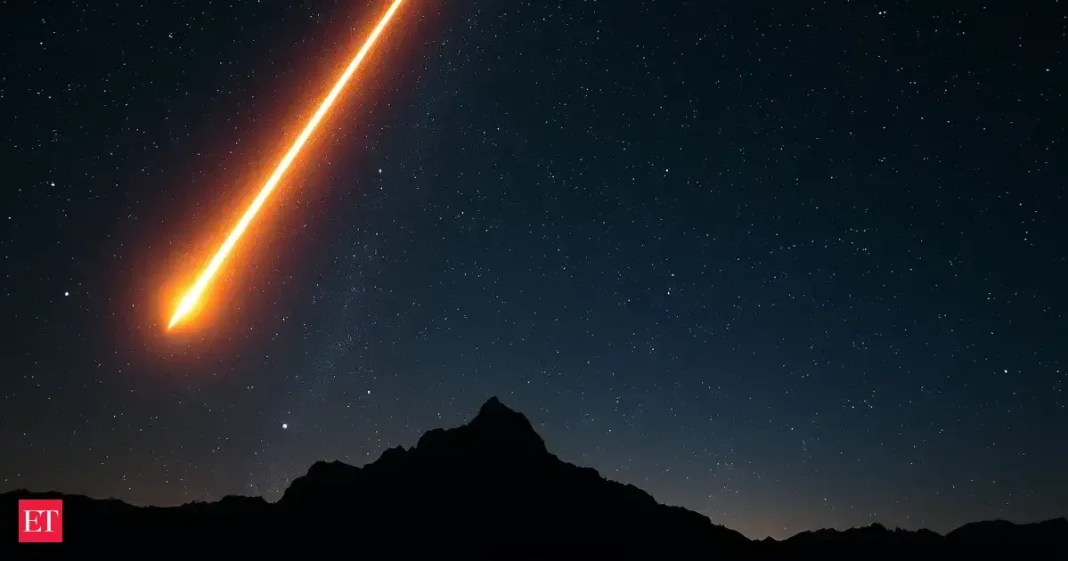
The vast canvas of the night sky, often a source of wonder and calm, occasionally presents phenomena that remind us of the universe’s dynamic nature. Such was the case on a recent evening over the northeastern United States, where a dazzling streak of light followed by a thunderous boom sent shockwaves — both literal and metaphorical — across several states. What initially led to widespread confusion, from speculations of earthquakes to military exercises, was quickly identified by experts as a spectacular meteor event, leaving residents of cities like Boston with a rare tale of celestial drama.
The Celestial Spectacle: A Fireball Over the Northeast
On a seemingly ordinary evening, the skies above Massachusetts, New Hampshire, and beyond lit up with an intense, rapidly moving fireball. Eyewitness accounts flooded social media and local news channels, describing a brilliant green or blue flash, visible for several seconds, streaking across the dusk sky. The sightings were remarkably widespread, reported from as far south as New Jersey and Pennsylvania, and north into Maine and Vermont, illustrating the high altitude and significant brightness of the object.
The visual spectacle was soon followed by a powerful sonic boom, an event that truly set this incident apart. Residents reported windows rattling, houses shaking, and a deep, resonant rumble that many initially mistook for an explosion or a tremor. The sound, heard across vast swathes of the region, became the defining characteristic of the event, transforming a beautiful visual display into a palpable, jarring experience for thousands. This distinction between a simple shooting star and a meteor capable of generating an audible blast underscores the considerable size and speed of the object as it entered Earth’s atmosphere.
For an Indian audience, such events, though geographically distant, resonate with our shared fascination for the cosmos. We, too, are familiar with the awe-inspiring sight of meteor showers and the occasional, brighter ‘bolide’ meteor. This incident over Boston serves as a global reminder of the constant cosmic ballet playing out above us, often unseen, but sometimes dramatically making its presence felt.
Decoding the Phenomenon: Science Behind the Shockwave
Scientists and space enthusiasts quickly mobilized to analyze the data and eyewitness reports. Organisations like NASA’s Meteor Watch and the American Meteor Society (AMS) confirmed that the event was indeed a meteor — specifically, a bolide, which is an exceptionally bright meteor that often explodes in the atmosphere. The term ‘meteoroid’ refers to the object in space, ‘meteor’ when it enters the atmosphere and burns up, and ‘meteorite’ if any fragments survive the fiery descent and land on Earth.
The sonic boom heard across the Northeast was a result of the meteoroid entering the Earth’s atmosphere at hypersonic speeds, breaking the sound barrier. As it plummeted, intense atmospheric friction heated the object to extreme temperatures, causing it to glow brightly and eventually fragment or explode, releasing a massive amount of energy that propagated as sound waves. Seismographs and infrasound detectors, typically used to monitor earthquakes or nuclear tests, registered the shockwave, providing valuable scientific data on the object’s trajectory and energy release.
Bill Cooke, who leads NASA’s Meteoroid Environments Office, provided clarity on the event. “This was a relatively small object, likely no more than a few feet in diameter, but its speed and the angle of entry created a very energetic event,” he explained. “The sonic boom is a clear indicator of its size and the depth it penetrated into the atmosphere before breaking apart.” Such expert analysis helps demystify these spectacular but sometimes unnerving celestial visitors, grounding our wonder in scientific understanding.
Global Skies, Shared Discoveries
While the skies over Boston delivered a brief but unforgettable spectacle, it highlights a universal truth: our planet is constantly interacting with debris from space. From the everyday dust motes that create faint shooting stars to the rarer, larger objects like the one seen over the Northeast, Earth is on an endless cosmic journey. Incidents like this underscore the importance of global observation networks, where amateur and professional astronomers contribute to a collective understanding of our cosmic neighbourhood.
For organisations like ISRO in India, and space agencies worldwide, monitoring near-Earth objects (NEOs) is a critical endeavor. While this particular meteor posed no threat, it serves as a potent reminder of the need for continued scientific research and international collaboration in tracking and understanding these celestial wanderers. The flash and boom over Boston were not just local news; they were a global reminder of the universe’s grandeur and our place within it, sparking conversations about space, science, and the wonders that lie just beyond our terrestrial sphere.
The event, captured on countless security cameras and mobile phones, has become a trending topic globally, fascinating millions and reinforcing humanity’s enduring fascination with the mysteries above. It wasn’t an earthquake, nor a military operation, but simply a magnificent, natural phenomenon – a cosmic visitor making a grand, albeit brief, entrance.

