


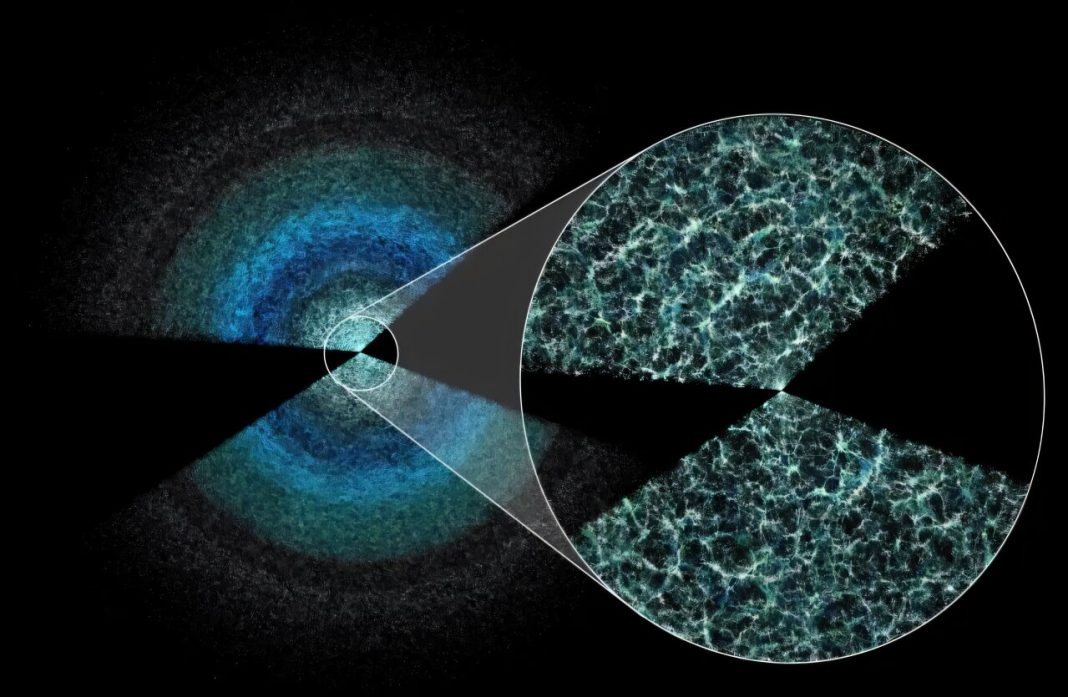
For millennia, humanity has gazed at the night sky, a canvas painted with distant stars and shrouded in cosmic mystery. We’ve always yearned to understand our place in it all, to chart the uncharted. Now, a monumental chapter in that quest has been written. The Dark Energy Spectroscopic Instrument (DESI), perched atop Kitt Peak in Arizona, has officially completed its ambitious mission to create the most detailed 3D map of our universe ever conceived. But here’s the exciting part: while the map is done, the true exploration has only just begun.
Mapping the Cosmos, One Galaxy at a Time
Imagine trying to understand a vast, sprawling city by only looking at a flat, two-dimensional picture. You’d miss so much! The universe is infinitely more complex, and DESI set out to give us its true depth. Over its three-year survey, DESI meticulously measured the precise distances to over 6 million galaxies and quasars, stretching billions of light-years away. How did it do this? By splitting the light from these celestial bodies into their individual colors, allowing scientists to measure their “redshift” – a phenomenon that tells us exactly how far away an object is and how fast the universe is expanding.
The result is a breathtaking cosmic tapestry, far beyond anything we’ve had before. This isn’t just a pretty picture; it’s a colossal dataset, a precise rendering of the universe’s structure across immense timescales. By charting the distribution of these galaxies, DESI has given us an unprecedented look at the intricate web of matter that spans the cosmos, revealing how it has evolved and expanded since the Big Bang. It’s like getting the definitive blueprint for the entire universe.
The Compass is Ready: Now for the Real Journey
While wrapping up the mapping phase is a huge milestone, it’s crucial to understand that it’s not the finish line. Think of DESI’s map as the ultimate guide for future cosmic voyages. This incredibly detailed 3D structure is designed to help us unravel the universe’s greatest enigma: dark energy. This mysterious force is believed to be responsible for the accelerating expansion of the universe, and it makes up roughly 68% of the cosmos, yet we know remarkably little about it.
With this new map, scientists now have an unparalleled tool to precisely measure the rate of cosmic expansion throughout various epochs of the universe’s history. They can scrutinize subtle patterns in the distribution of galaxies to detect the faint imprints of sound waves from the early universe, allowing them to test and refine our cosmological models with unprecedented accuracy. This data will be instrumental in exploring the fundamental nature of dark energy – is it a constant force, or does it change over time? Does it even exist as we imagine it?
Dr. Elena Ramirez, a cosmologist who has followed DESI’s journey, perfectly captures this sentiment: “While the map itself is a monumental achievement, it’s really just the most incredible compass we’ve ever had. Every data point is a breadcrumb leading us deeper into the universe’s secrets, especially those of dark energy.” Her words highlight the excitement reverberating through the scientific community.
A Universe of Questions Still Await
The completion of DESI’s map marks a triumphant step, not an endpoint. It’s a powerful new lens through which to view the universe, offering countless opportunities for groundbreaking discoveries. Researchers worldwide will now pore over this immense dataset, searching for anomalies, testing theories, and perhaps even uncovering entirely new phenomena that challenge our current understanding of physics. It’s a testament to human ingenuity and our unyielding curiosity.
From understanding the earliest moments of the universe to predicting its ultimate fate, DESI’s map provides an indispensable foundation. It reminds us that even as we answer some of the biggest questions, new ones emerge, pushing the boundaries of what we know and inspiring the next generation of explorers to look up and wonder. The universe is vast, mysterious, and endlessly fascinating, and thanks to DESI, we’re better equipped than ever to navigate its wonders.

