


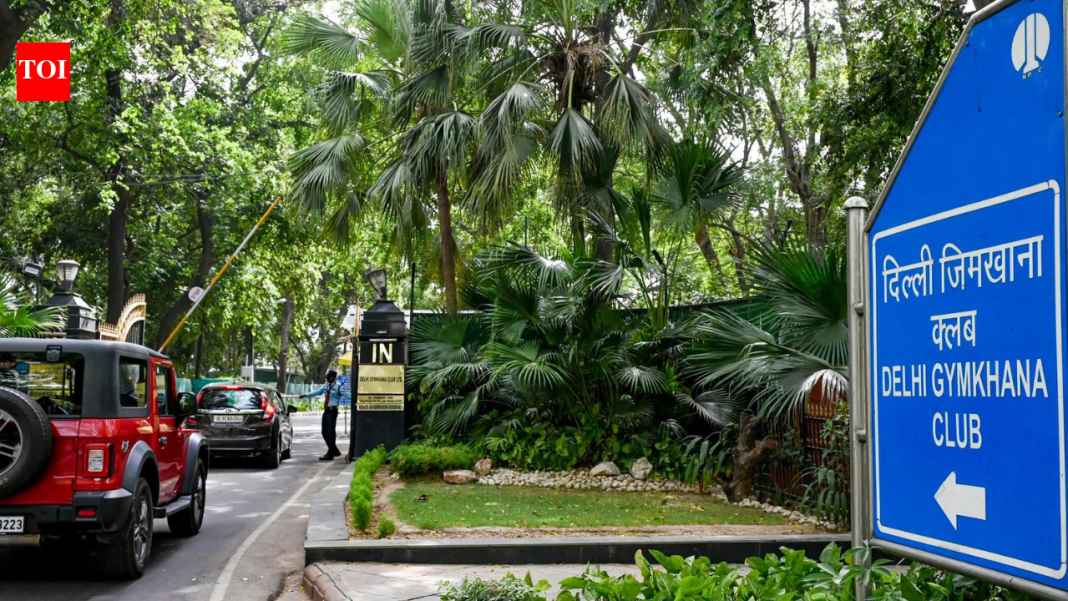
The venerable halls of the Delhi Gymkhana Club, a historic institution in the heart of the national capital, are once again at the epicentre of a significant legal and administrative battle. In a dramatic escalation of the long-running dispute with the government, members and employees of the club are preparing to challenge a recent eviction order in court. Concurrently, the club management has voiced a strong demand for clarity regarding an alternative land plot, essential for the continuity of its operations and the livelihoods dependent on it.
Government Eviction Order Triggers Legal Challenge
The latest flashpoint arrived in the form of an eviction notice issued by the Land & Development Office (L&DO) under the Ministry of Housing and Urban Affairs. The order, which gave the club a mere 15 days to vacate the premises, has sent ripples of concern through its membership and, more critically, among its hundreds of employees. The government’s directive cites alleged breaches of lease conditions and the larger public interest as grounds for the eviction, claiming the club’s actions were detrimental to its original purpose.
For the Delhi Gymkhana Club, an entity steeped in over a century of history and tradition, this move marks a pivotal moment. Club officials, while confirming their intent to comply with legal processes, have unequivocally stated their decision to contest the eviction through judicial channels. Their argument is expected to hinge on questions of due process, the interpretation of lease agreements, and the broader implications of such an executive action on an autonomous institution.
Beyond the elite membership, the eviction notice poses an immediate and grave threat to the livelihoods of an estimated 1,200 employees. From service staff and groundskeepers to administrative personnel, the sudden displacement could plunge numerous families into uncertainty. Employee representatives have joined hands with the club’s administration, stressing the need for a humane approach and seeking judicial intervention to protect their employment.
A Deep-Rooted Conflict: NCLAT, CoA, and Governance
The current eviction order is not an isolated incident but rather the latest chapter in a protracted legal saga that has seen the government progressively assert control over the club. The roots of this conflict trace back several years, involving allegations of mismanagement, irregularities in membership allocation, and violations of the club’s memorandum and articles of association.
Key turning points in this dispute include a significant ruling by the National Company Law Tribunal (NCLT) in 2020, which found evidence of alleged “mismanagement” and “prejudicial conduct.” This was followed by the National Company Law Appellate Tribunal (NCLAT) upholding the NCLT’s decision in 2021, affirming the government’s right to take over the club’s management. Consequently, a government-appointed Committee of Administrators (CoA) was installed to oversee the club’s day-to-day operations, replacing the elected general committee.
The club’s management and members have consistently challenged these decisions, arguing that the government’s intervention goes beyond regulatory oversight and infringes upon the autonomy of a private association. The appointment of the CoA, in particular, has been a contentious issue, with critics alleging it was an unprecedented move aimed at gaining control over the prestigious institution. The present eviction order is seen by many as the government’s final step in this long-drawn process, aiming for complete physical possession.
Seeking Clarity on Alternative Plot: A Path Forward?
Amidst the looming threat of eviction and the impending legal battle, a crucial demand from the Delhi Gymkhana Club management pertains to an alternative land plot. While preparing to challenge the eviction, the club has simultaneously engaged with authorities, seeking explicit assurances and details about any potential relocation site. The club argues that given its historical significance, the extensive infrastructure built over decades, and the large number of employees, a straightforward eviction without an alternative would be unjust and impractical.
“This isn’t just about a piece of land; it’s about a community, a legacy, and the livelihoods of hundreds of families,” stated a senior club official, speaking on condition of anonymity. “If the government truly believes in the public interest, then facilitating a smooth transition with an alternative plot should be part of the solution, not just an eviction notice. We need concrete plans, not just promises.“
The demand for an alternative plot raises questions about potential governmental assurances made in the past or established precedents for such large-scale dispossessions in the capital. The club’s legal strategy is likely to incorporate arguments about fair compensation, rehabilitation, and the broader principles of natural justice, especially if an alternative site is not provided or is deemed unsuitable.
As Delhi Gymkhana Club members and employees gear up for a fresh legal confrontation, the coming weeks are set to define the future of one of India’s most iconic institutions. The outcome of this legal challenge will not only determine the fate of the club and its dependent workforce but could also set a significant precedent for similar land lease disputes involving historical entities across the country.
*

