


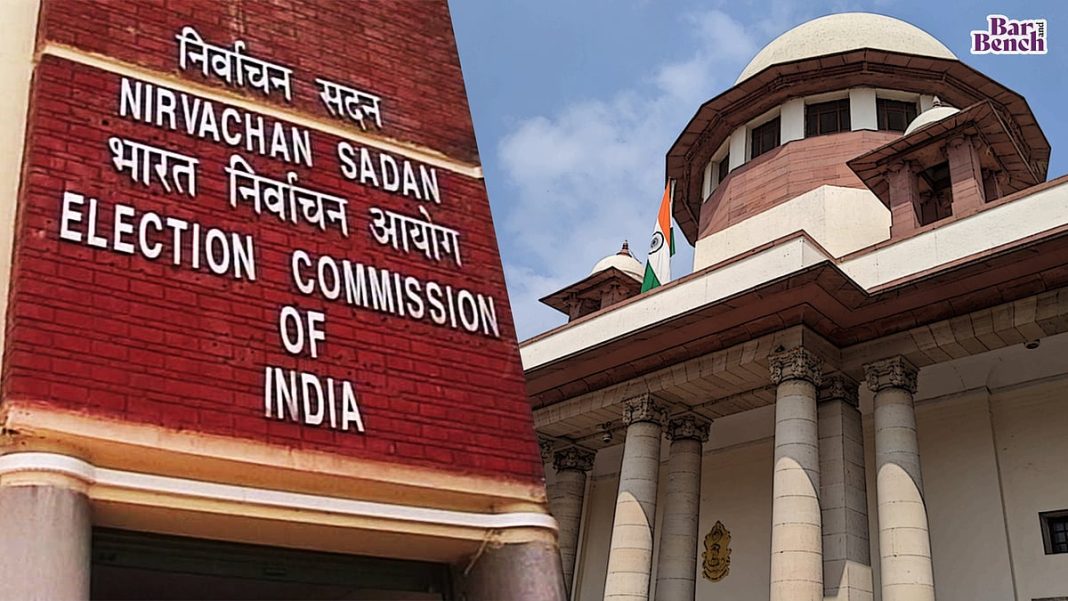
The sanctity of electoral outcomes is a cornerstone of any vibrant democracy. In a significant pronouncement that will undoubtedly shape the landscape of election disputes in India, the Supreme Court has recently clarified the precise conditions under which poll results can be interfered with. The apex court, while dealing with a challenge arising from a West Bengal Assembly election, firmly stated that an election result cannot be set aside unless the winning margin is less than the number of excluded votes. This ruling sets a crucial precedent, reinforcing the principle that the declared mandate should not be lightly overturned and emphasizes the high bar for judicial intervention in democratic processes.
The Apex Court’s Stance on Electoral Challenges
The case in question involved a challenge to the election of Trinamool Congress (TMC) candidate Madan Mitra from the Kamarhati Assembly constituency in the 2021 West Bengal Assembly elections. The Calcutta High Court had previously set aside Mitra’s election based on alleged irregularities, including the improper exclusion of a significant number of votes during the counting process. However, the Supreme Court, comprising Justices Hima Kohli and Ahsanuddin Amanullah, critically examined the High Court’s decision.
The core of the Supreme Court’s judgment lies in its emphasis on the material effect principle. The bench underscored that for an election to be declared void, the irregularities must be proven to have materially affected the election result. Simply pointing to irregularities, even significant ones, is not enough. The court clarified that the winning candidate’s victory could only be annulled if the margin of victory was smaller than the total number of votes alleged to have been wrongly excluded or deemed invalid. In the Kamarhati case, the winning margin was 6,947 votes, while the number of excluded votes cited was 4,206. Since the winning margin significantly exceeded the number of excluded votes, the Supreme Court found no basis to interfere with the election result, thereby overturning the High Court’s order.
Upholding the Mandate: The Principle of Material Irregularity
This ruling is deeply rooted in the established legal principle that election petitions are not meant to disturb the popular mandate on flimsy grounds. The burden of proving that the outcome was materially affected by an irregularity rests squarely on the petitioner. The Supreme Court’s pronouncement serves as a strong reiteration of Section 100(1)(d)(iv) of the Representation of the People Act, 1951, which states that an election can be declared void if the High Court is of the opinion that the result of the election, in so far as it concerns a returned candidate, has been materially affected by any non-compliance with the provisions of the Act or of any rules or orders made thereunder.
Justice Ahsanuddin Amanullah, delivering the judgment, observed, “Unless the winning margin is less than the number of exclusions, we cannot interfere with the poll results.” This succinct statement encapsulates the stringent standard now set for challenging election victories. The court further elaborated that even if certain votes were wrongly excluded, it would not automatically lead to the setting aside of the election unless a direct correlation could be established showing that, had those votes been counted, the outcome would likely have been different. The practical implication is that a mere arithmetic possibility of a different result is insufficient; a concrete demonstration of actual impact is required. This approach safeguards the democratic process from being repeatedly challenged on grounds that do not genuinely alter the will of the electorate.
Implications for Future Election Petitions
The Supreme Court’s latest ruling has profound implications for how election petitions will be adjudicated across India. It sets a clear, quantifiable benchmark for petitioners seeking to overturn election results. This standard will likely reduce the number of frivolous challenges based on minor procedural lapses or statistical discrepancies that do not fundamentally alter the outcome. Petitioners will now need to present compelling evidence not just of irregularities, but also of their direct and material impact on the winning margin.
This decision strengthens the finality of election results and enhances the stability of the democratic process. By demanding a high threshold for judicial interference, the Supreme Court reinforces public faith in the declared mandates and discourages prolonged litigation that can undermine governmental stability and the public’s perception of electoral integrity. It implicitly recognizes the significant effort and resources invested by the Election Commission of India (ECI) in conducting free and fair elections, ensuring that their outcomes are respected unless there’s a demonstrable and substantial flaw affecting the will of the voters.
The Supreme Court’s definitive stance on electoral challenges marks a critical development in Indian election law. By stipulating that interference with poll results is permissible only when the winning margin is less than the number of excluded votes, the apex court has provided a clear and practical guideline for lower courts and petitioners alike. This ruling champions the principle of the popular mandate, ensuring that election outcomes are not easily overturned unless there is undeniable proof that irregularities materially affected the result. It is a judgment that upholds the sanctity of the ballot box and reinforces the bedrock principles of India’s parliamentary democracy.

