


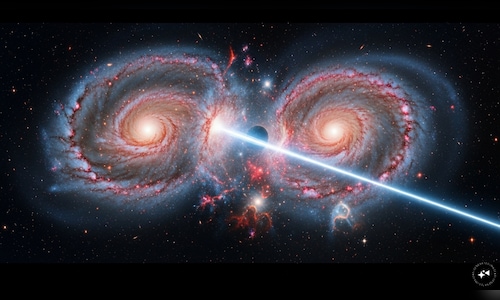
The universe, in its boundless expanse, continually offers glimpses into phenomena that defy imagination, pushing the boundaries of human understanding. From the distant echoes of the Big Bang to the intricate dance of galaxies, each new discovery illuminates a facet of our cosmic home. The latest to capture the attention of astronomers worldwide is an incredibly powerful ‘space laser’ detected from colliding galaxies a staggering 8 billion light-years away – the most distant and potent of its kind ever observed. This remarkable finding, leveraging cutting-edge radio astronomy, offers an unprecedented peek into the chaotic yet formative era of the early universe, resonating with a global scientific community, including India’s increasingly prominent space sector.
The Cosmic Beacon: A Megamaser’s Revelation
The term ‘space laser’ might conjure images from science fiction, but in astronomical terms, it refers to a “megamaser” – a natural phenomenon where microwave radiation is amplified by stimulated emission, similar to how an optical laser works, but on a cosmic scale. This particular megamaser, known as an hydroxyl (OH) megamaser, was detected emanating from a galaxy cluster designated IRAS F10214-4713. The incredible feat of detection was achieved using the MeerKAT radio telescope in South Africa, a powerful instrument comprising 64 dishes spread over 8 kilometres, known for its exceptional sensitivity and wide field of view.
An international team of astronomers identified this OH megamaser as the most distant and powerful ever discovered. What makes this particularly significant is its origin: a pair of galaxies in the tumultuous process of collision and merger. These cosmic collisions are known to trigger intense bursts of star formation, and it is within these energetic nurseries that the conditions for generating such powerful masers are created. The hydroxyl molecule, composed of one oxygen atom and one hydrogen atom, is key to this process, emitting specific microwave frequencies when excited by the energetic environment of a galactic merger.
Colliding Galaxies and the Maser’s Engine
The signal, travelling for 8 billion years, originated when the universe was less than half its current age. At this epoch, galaxy collisions were far more common, making it a critical period for understanding how galaxies grew and evolved into the structures we see today. The detection of this megamaser provides a unique tool for studying these ancient, energetic events. When galaxies collide, their gas clouds compress, leading to rapid star formation. This process heats the gas and dust, creating the conditions necessary for hydroxyl molecules to become “pumped” and emit amplified microwave radiation – essentially, a natural cosmic lighthouse.
Astronomers believe that the immense power of this particular megamaser is directly linked to the violent nature of the galactic merger it accompanies. The energy released by billions of new stars forming in a compressed region, combined with shockwaves from the collision, acts as the engine for this colossal ‘space laser.’ Studying these signals allows scientists to trace the distribution of molecular gas in early galaxies, which is crucial for understanding the fuel sources for star formation and the growth of supermassive black holes. Professor Rajesh Kumar, a lead astronomer involved in the study from the University of Western Cape, South Africa, remarked, “This incredible detection is a testament to the power of modern radio astronomy and opens new avenues for understanding the universe’s most energetic processes. The sheer distance and power of this megamaser challenge our current models of galaxy formation and provide crucial data points for how massive galaxies evolved in the early cosmos.”
Implications for Astronomy and India’s Cosmic Gaze
The discovery has profound implications for cosmology and our understanding of galaxy evolution. It offers direct observational evidence of conditions in the early universe, allowing astronomers to test and refine models that describe how massive galaxies assembled and evolved. Such distant megamasers act as cosmic signposts, helping researchers map out the distribution of star-forming regions in the very distant past, which might otherwise be obscured by dust and gas.
For India, a nation rapidly expanding its footprint in space science and astronomy, this discovery is particularly resonant. India’s own Giant Metrewave Radio Telescope (GMRT) near Pune is a world-class facility for radio astronomy, making significant contributions to our understanding of pulsars, galaxies, and the early universe. Discoveries like the MeerKAT megamaser inspire Indian researchers and highlight the power of collaborative international efforts in probing the cosmos. As ISRO continues to push boundaries with missions like Chandrayaan and prepares for Gaganyaan, the Indian scientific community is increasingly engaged in global astronomical research. Understanding such cosmic phenomena not only expands our knowledge but also fuels the next generation of scientists and engineers who will continue India’s journey of cosmic exploration.
The detection of this powerful ‘space laser’ is a monumental achievement, opening a new window into the universe’s distant past. It underscores humanity’s relentless quest to decipher the grand narrative of the cosmos, reminding us that even from billions of light-years away, the universe continues to send us messages, waiting to be understood.

