


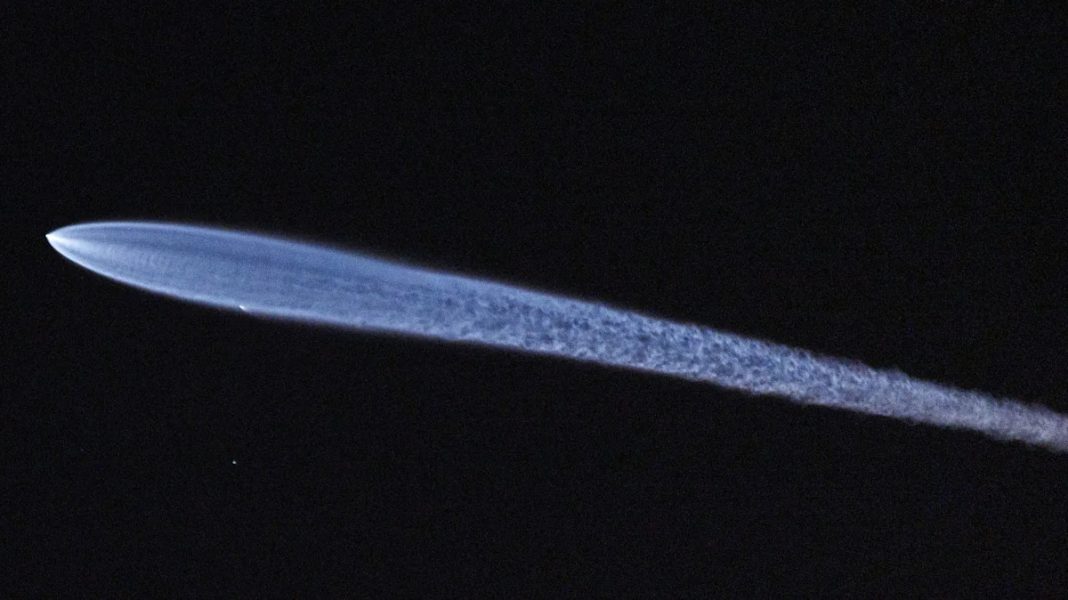
A discarded piece of rocket hardware, specifically a second stage from a SpaceX Falcon 9 rocket, is currently on an unavoidable collision course with the Moon. Experts predict an impact at an astounding speed of Mach 7, making it a unique, albeit unintended, celestial event.
The Object’s Unintended Lunar Journey
The object in question is the upper stage of a Falcon 9 rocket that launched the Deep Space Climate Observatory (DSCOVR) satellite back in February 2015. After successfully deploying its payload towards the Sun-Earth L1 Lagrange point, the rocket stage lacked sufficient fuel to either return to Earth for a controlled re-entry or to achieve escape velocity from Earth’s orbit and enter a stable heliocentric trajectory. Consequently, it was left in a somewhat chaotic orbit influenced by the gravitational pulls of both the Earth and the Moon.
For the past seven years, this inert rocket stage has been tumbling through space, an unguided wanderer within the Earth-Moon system. Over time, its trajectory was perturbed by various gravitational forces, leading it gradually closer to the Moon. Now, orbital analysts have precisely calculated its path, confirming an imminent impact. Traveling at approximately 9,200 kilometers per hour (about 5,700 miles per hour), or Mach 7, the momentum of this 4-ton metallic cylinder is considerable.
Why Space Debris Hits the Moon
While intentional lunar impacts have occurred previously – notably during the Apollo missions to generate seismic data, or more recently with NASA’s LCROSS mission to search for water ice – an unintentional impact of this scale is a less common occurrence. The phenomenon is a testament to the complex gravitational dance within our solar system. Objects left in Earth orbit that don’t perform controlled maneuvers are eventually subject to the gravitational influences of larger bodies.
In this particular case, the Falcon 9 stage spent years in a somewhat unpredictable “free return trajectory” that brought it near the Moon multiple times. Each pass subtly altered its path until it was ultimately captured by lunar gravity onto a collision course. There’s no way to steer or divert it; it is simply following the laws of physics to its ultimate destination.
The impact is expected to occur on the far side of the Moon, an area not directly visible from Earth. However, lunar orbiters, such as NASA’s Lunar Reconnaissance Orbiter (LRO) and India’s Chandrayaan-2, might be able to observe the event or locate the newly formed crater in the aftermath. The scientific community is keenly interested in the potential data this event could provide.
Scientific Insights from an Unplanned Impact
Despite its accidental nature, the impending impact presents a unique opportunity for scientific observation. The collision will create a fresh crater on the lunar surface, and studying its characteristics could offer valuable insights into the Moon’s geology, regolith composition, and impact dynamics. Observing the size and shape of the crater, potentially the ejecta plume, and even looking for any exposed subsurface material could enhance our understanding of our celestial neighbor.
“While it wasn’t designed for this purpose, any impact on the Moon gives us a chance to learn something new about its geology and the dynamics of crater formation,” commented one astronomer following the object’s path. “It’s a rare, albeit unplanned, experiment.”
The event underscores the growing issue of space debris, not just in Earth orbit but also for objects that escape our planet’s immediate vicinity. While this particular piece of debris poses no threat to Earth, its eventual impact serves as a reminder of the various objects, both natural and man-made, that traverse and occasionally collide within our solar system.
The Moon, scarred by billions of years of impacts, is about to receive another, a new mark left by humanity’s reach into space.

