


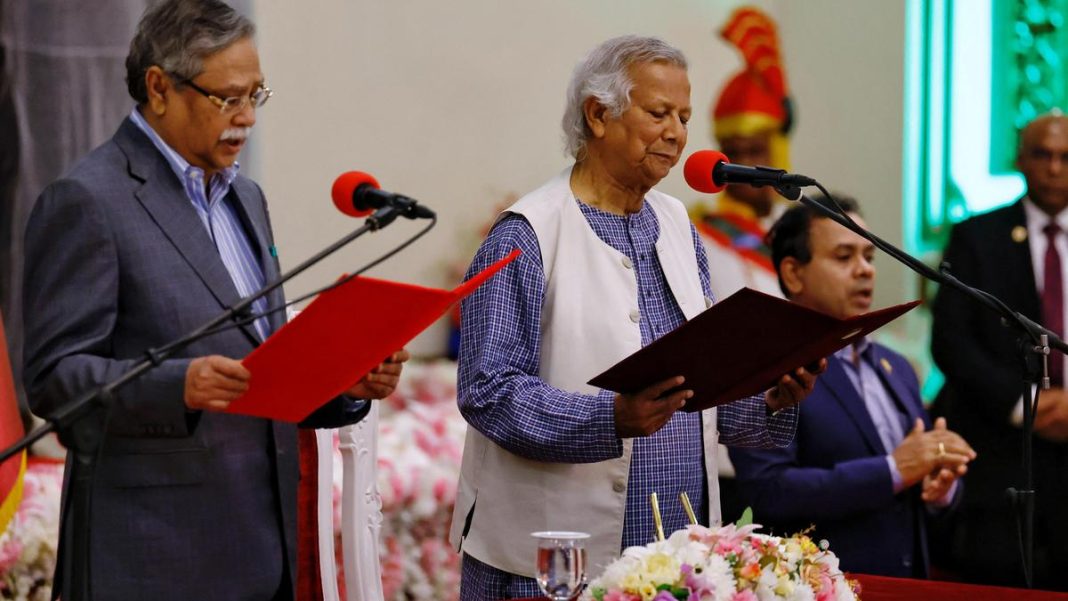
A significant political and legal storm is brewing in Bangladesh, drawing the attention of regional observers, including India. Nobel Peace Laureate Professor Muhammad Yunus, internationally acclaimed for pioneering microcredit and founding Grameen Bank, finds himself at the centre of fresh controversy following sharp criticism from Bangladesh President Mohammed Shahabuddin. The President recently accused Yunus of disregarding constitutional norms and operating without proper transparency, statements that underscore the deepening fissures between the country’s political establishment and the revered social entrepreneur.
President Shahabuddin’s Direct Allegations and Constitutional Questions
The recent remarks by President Shahabuddin during a program in Pabna have ignited considerable discussion. The President explicitly stated that Professor Yunus “did not follow the constitution” and “kept me in the dark” regarding the affairs of Grameen Bank. These are not trivial accusations; they strike at the heart of governance, accountability, and the rule of law within Bangladesh, issues that are always watched closely by its neighbour, India.
President Shahabuddin, who served as the chairman of the Anti-Corruption Commission (ACC) before assuming the presidency, recounted his past experiences. He asserted that while he was chairman, he sought information from Yunus regarding Grameen Bank, only to be met with evasion. “I repeatedly sent letters asking him to send the rules of Grameen Bank and the rules on how he was serving as its managing director, but he never responded to me,” Shahabuddin reportedly stated. This historical context provides depth to the President’s current displeasure, suggesting a long-standing pattern of alleged non-compliance. The President’s role, though largely ceremonial, carries significant constitutional weight as the head of state and guardian of the constitution. His public criticism of a figure like Yunus, therefore, transcends mere personal opinion and points to serious systemic concerns regarding adherence to national legal frameworks and institutional transparency.
The allegations come at a time when Yunus is already grappling with numerous legal challenges, including a recent conviction for labour law violations, which has sparked an international outcry for his vindication. From India’s perspective, the stability and adherence to constitutional practices in Bangladesh are paramount for regional peace and bilateral relations. Any perception of disregard for national laws by prominent figures can lead to instability, an outcome India has consistently sought to avoid in its neighbourhood.
Grameen Bank, Legal Scrutiny, and International Reverberations
Professor Muhammad Yunus’s journey with Grameen Bank is a compelling narrative of social innovation. Founded in 1983, the bank revolutionized poverty alleviation by providing small loans to the impoverished, primarily women, without requiring collateral. This model earned Yunus and Grameen Bank the Nobel Peace Prize in 2006, elevating his status to a global icon. However, his relationship with the Bangladeshi government has been contentious for over a decade, culminating in his removal as managing director of Grameen Bank in 2011, ostensibly over age limit violations.
The President’s current statement adds another layer to this complex saga, aligning with the government’s consistent stance that Yunus has been operating outside established legal and constitutional boundaries. The “kept me in the dark” accusation specifically implies a lack of transparency and an unwillingness to subject himself and his institution to due oversight, a fundamental expectation of any public or quasi-public entity.
“He did not follow the constitution, rather kept me in the dark,” President Shahabuddin reportedly said, conveying a clear message of displeasure and hinting at deeper issues of institutional accountability that Bangladesh is currently navigating. This quote encapsulates the core of the President’s grievance and highlights the perceived lack of cooperation from Yunus.
Beyond the labour law conviction, Yunus also faces accusations of tax evasion, further intensifying the legal pressure. These challenges are not merely legalistic; they carry significant implications for Bangladesh’s international image and its reputation for upholding the rule of law. For India, a stable and transparent Bangladesh, where institutions function according to constitutional mandates, is a vital strategic interest. The ongoing legal battles surrounding Yunus, therefore, are observed with keen interest, not just as an internal Bangladeshi affair but as a barometer of institutional robustness in a crucial neighbouring state.
Conclusion: A Call for Constitutional Adherence
The allegations by President Mohammed Shahabuddin against Professor Muhammad Yunus underscore a critical juncture in Bangladesh’s political and legal landscape. The President’s assertion of Yunus’s failure to adhere to constitutional norms and maintain transparency reinforces the government’s long-standing narrative. As the legal proceedings against Yunus continue, the focus remains sharply on the principle of accountability, irrespective of an individual’s global stature.
This situation serves as a potent reminder for all public figures and institutions about the paramount importance of operating within constitutional frameworks and maintaining transparency. From an Indian perspective, the adherence to rule of law and the strengthening of democratic institutions in Bangladesh are essential for regional stability and fostering robust bilateral relations. The outcome of these disputes will undoubtedly shape not only the future of Professor Yunus but also perceptions of governance and justice in Bangladesh for years to come.

