


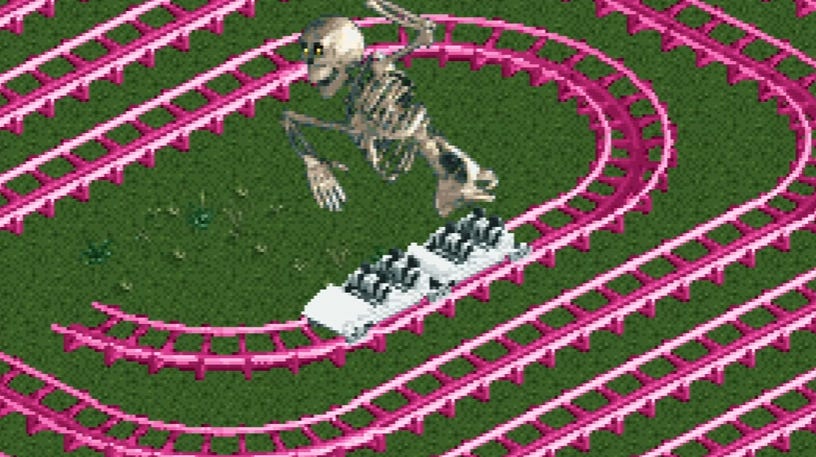
Even decades after its initial release, RollerCoaster Tycoon 2 continues to inspire players to push the boundaries of virtual park management and design. While many focus on maximizing profits or guest satisfaction, a distinct subset of players dedicates themselves to elaborate, often abstract, architectural feats. One such creation recently caught attention for its sheer scale and unusual aesthetic: a rollercoaster so immense and intricately designed, it strikingly resembles a computer motherboard.
The Art of the Abstract Ride
In the world of RollerCoaster Tycoon 2, particularly within its vibrant community often facilitated by projects like OpenRCT2, the concept of a “functional” ride can sometimes take a backseat to pure artistic expression. Players are equipped with an expansive toolkit, allowing for intricate track layouts, diverse ride types, and vast, customizable landscapes. This freedom enables them to transcend typical park design and engage in what can only be described as digital engineering marvels.
The “motherboard” rollercoaster exemplifies this trend perfectly. It isn’t built for speed, guest satisfaction, or even profitability. Its primary purpose is to exist as a monumental visual spectacle, a testament to intricate planning and sheer dedication. “For many of us, it’s less about the ‘ride’ experience and more about the satisfaction of bringing a complex concept to life within the game’s engine,” states a long-time OpenRCT2 community member. “It’s a form of digital art, where the canvas is a theme park map and the brushes are track pieces and scenery.” These creations often highlight the game’s underlying grid-based mechanics, transforming what could be perceived as limitations into opportunities for structured, complex patterns.
Deconstructing the “Motherboard” Design
What makes this particular rollercoaster so strikingly similar to a computer motherboard? The resemblance lies in its extraordinary layout and meticulous detailing. Imagine a vast, sprawling network of interconnected tracks, winding and branching like the copper traces on a circuit board. Various ride elements, such as lift hills, drops, and station platforms, are strategically placed to mimic the distinct components found on a motherboard – CPU sockets, RAM slots, capacitors, and expansion ports.
The creator likely employed different track types, colors, and possibly even carefully placed scenery elements to differentiate between the “data buses,” “power lines,” and various “chipsets.” The sheer length of the track is staggering, potentially spanning across an entire large map, creating a dizzying array of crisscrossing paths and intricate intersections that demand precision in their construction. It requires an understanding not just of RollerCoaster Tycoon 2‘s mechanics, but also a keen eye for abstract representation, translating real-world electronic architecture into a playable, albeit highly unconventional, rollercoaster experience.
Beyond the Game: A Creative Statement
This “motherboard” rollercoaster is more than just an impressive in-game build; it’s a profound statement about the enduring appeal of sandbox games and the boundless creativity of their communities. It blurs the lines between gaming, art, and even technical design. It showcases how a game designed for park management can become a powerful tool for artistic expression, allowing individuals to construct intricate, conceptual pieces that exist purely for their aesthetic and intellectual appeal.
Such creations serve as an inspiration, demonstrating that the only true limits in these virtual worlds are those of imagination. They highlight the longevity of classic titles and the innovative spirit of players who continue to find new ways to engage with and redefine their favorite games. The immense “motherboard” rollercoaster stands as a monument to digital ingenuity, inviting us to ponder what other unexpected wonders might emerge from the pixelated depths of creativity.

