


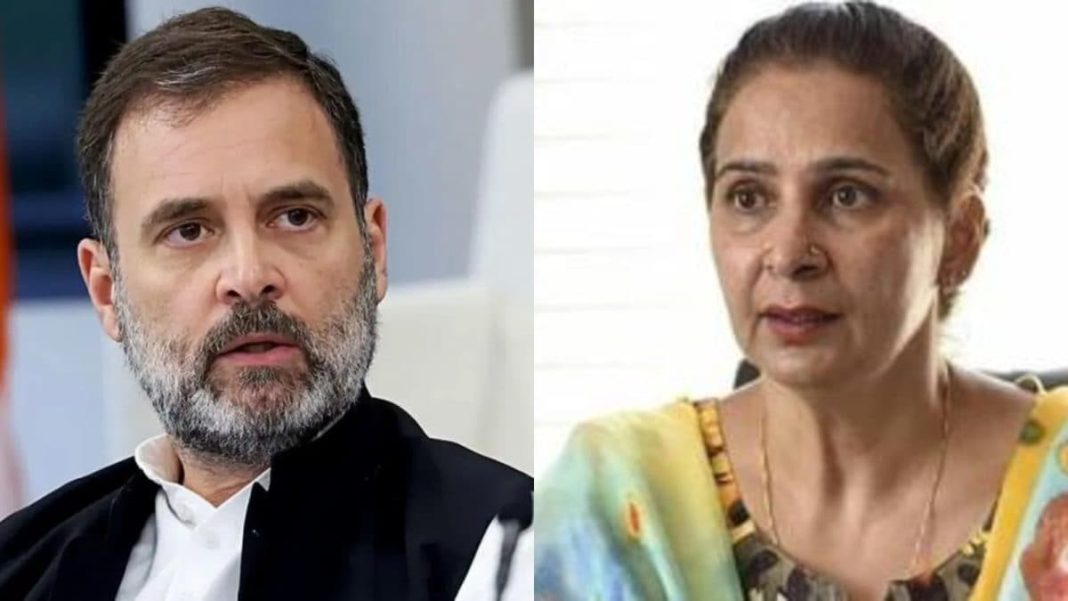
In a political development that has sent ripples across India’s vibrant and often tumultuous political landscape, Navjot Kaur Sidhu, former Chief Parliamentary Secretary of Punjab and wife of prominent Congress leader Navjot Singh Sidhu, has delivered a scathing critique of Rahul Gandhi while simultaneously extending significant praise to Prime Minister Narendra Modi. Her outspoken remarks, encapsulated by the pointed phrase, “You don’t deserve that chair,” directed at the former Congress president, have ignited considerable debate and speculation regarding internal party dynamics and potential political realignments.
Navjot Kaur Sidhu’s Blistering Critique of Rahul Gandhi
Navjot Kaur Sidhu, known for her candidness and direct communication style, did not mince words when expressing her disillusionment with Rahul Gandhi’s leadership. Her comments surfaced amidst ongoing discussions about the Congress party’s strategy, internal coherence, and its capacity to pose a formidable challenge to the incumbent BJP government. The assertion that Rahul Gandhi does not “deserve that chair” is a powerful and direct indictment, particularly coming from within the broader Congress ecosystem, given her husband’s long-standing association with the party.
Observers note that her critique likely stems from a perceived lack of decisive leadership, strategic vision, or connect with the grassroots, issues that have frequently plagued the Congress party in recent electoral cycles. While the specific context of her remarks might vary, the sentiment underlines a frustration felt by some within the party regarding its ability to project a strong, unified front. Such public statements from a figure with significant political experience and a close connection to a prominent state leader add weight to the internal rumblings often speculated about behind closed doors.
Praise for PM Modi: A Contrasting Narrative
In stark contrast to her criticism of Rahul Gandhi, Navjot Kaur Sidhu lauded Prime Minister Narendra Modi’s leadership, highlighting aspects of his governance and vision. This dual commentary creates a compelling narrative, positioning her remarks not merely as an internal party dissent but as a broader commentary on the differing styles of political leadership at the national level.
While the exact points of her praise were not fully detailed in initial reports, such commendation typically revolves around themes of strong governance, decisive policy-making, focus on development, and India’s enhanced standing on the global stage. Her acknowledgment of Modi’s perceived strengths is significant, as it comes from a background traditionally aligned against the BJP. It reflects a growing trend where political figures, even those from opposition ranks, occasionally express admiration for aspects of their opponents’ performance, often sparking intense debate about political objectivity versus loyalty.
The juxtaposition of criticism for one leader and praise for another from the opposing camp naturally fuels speculation about future political movements. Whether these comments are a personal expression of her views, a strategic move, or a reflection of shifting ground realities within Punjab politics, they undeniably contribute to the ongoing political discourse surrounding national leadership.
In comments that resonated widely, Navjot Kaur Sidhu reportedly stated, “For too long, leadership has been about rhetoric rather than results. When you look at the fundamental issues facing our nation, the decisive action and vision required are often absent in certain quarters. Frankly, if you cannot connect with the pulse of the nation, if you cannot offer a clear direction, then perhaps, one doesn’t truly deserve to occupy that chair. On the other hand, the demonstrable progress and clarity of purpose under Prime Minister Modi’s leadership are undeniable.”
Implications for Punjab and National Politics
Navjot Kaur Sidhu’s statements carry particular weight given her political background and her husband, Navjot Singh Sidhu’s, prominent role in Punjab politics, where he has often been seen as a dynamic yet controversial figure within the Congress party. Her remarks could potentially signal internal friction within the state unit of the Congress or reflect a broader sentiment among certain factions disillusioned with the national leadership.
Such public criticism from an insider can have several implications. It might embolden other dissenters within the Congress, creating further challenges for the party’s cohesion. Conversely, it could also be dismissed by loyalists as a personal opinion not reflective of the broader party sentiment. For the BJP, such endorsements, even indirect ones, from opposition figures are often highlighted as validation of their government’s performance and leadership.
The incident underscores the complexities of Indian politics, where individual voices, even those seemingly peripheral, can trigger significant national conversations. As the political landscape continually shifts, statements like those made by Navjot Kaur Sidhu serve as a barometer of the prevailing sentiments and potential undercurrents shaping the national discourse, compelling both parties and the public to critically examine leadership and governance.
Her bold articulation of views adds another layer to the ongoing political narrative, reinforcing the idea that India’s political arena remains a vibrant space for diverse opinions and robust debate on leadership efficacy.

