


The universe, in its boundless expanse, continues to yield secrets at an astonishing pace, thanks to humanity’s relentless pursuit of knowledge and increasingly sophisticated instruments. At the forefront of this cosmic quest stands the Vera C. Rubin Observatory in Chile, home to what is arguably the world’s most powerful digital camera. Currently undergoing its final commissioning phases, this colossal observatory has already begun to demonstrate its unparalleled capability, recently spotting one of the fastest-spinning giant asteroids ever observed, hinting at a torrent of discoveries yet to come.
For enthusiasts of astronomy in India and across the globe, the news underscores a new era of cosmic mapping. This isn’t just about finding distant objects; it’s about fundamentally reshaping our understanding of the solar system, galactic evolution, and the very fabric of the cosmos.
The Vera C. Rubin Observatory: A New Eye on the Universe
Perched atop Cerro Pachón in Chile, the Vera C. Rubin Observatory is more than just a telescope; it’s a revolutionary facility designed to conduct the Legacy Survey of Space and Time (LSST). Its heart is the Simonyi Survey Telescope, equipped with a groundbreaking 3.2-gigapixel camera – the largest digital camera ever built for astronomy. This incredible instrument can capture an area of the sky equivalent to 40 full moons in a single exposure, scanning the entire visible sky every few nights. Its primary mission is to create a dynamic, living map of the universe, observing billions of objects with unprecedented detail.
The sheer volume of data it will generate – approximately 20 terabytes per night – is staggering. This firehose of information will enable scientists to study everything from transient phenomena like supernovae and gamma-ray bursts to the distribution of dark matter and dark energy, and the hazardous paths of Near-Earth Objects (NEOs). For Indian researchers, gaining access to such comprehensive datasets promises to significantly enhance indigenous astronomical studies, providing crucial insights that complement India’s own growing space capabilities through ISRO and other scientific institutions.
Unveiling a Cosmic Spinner: The Asteroid Discovery
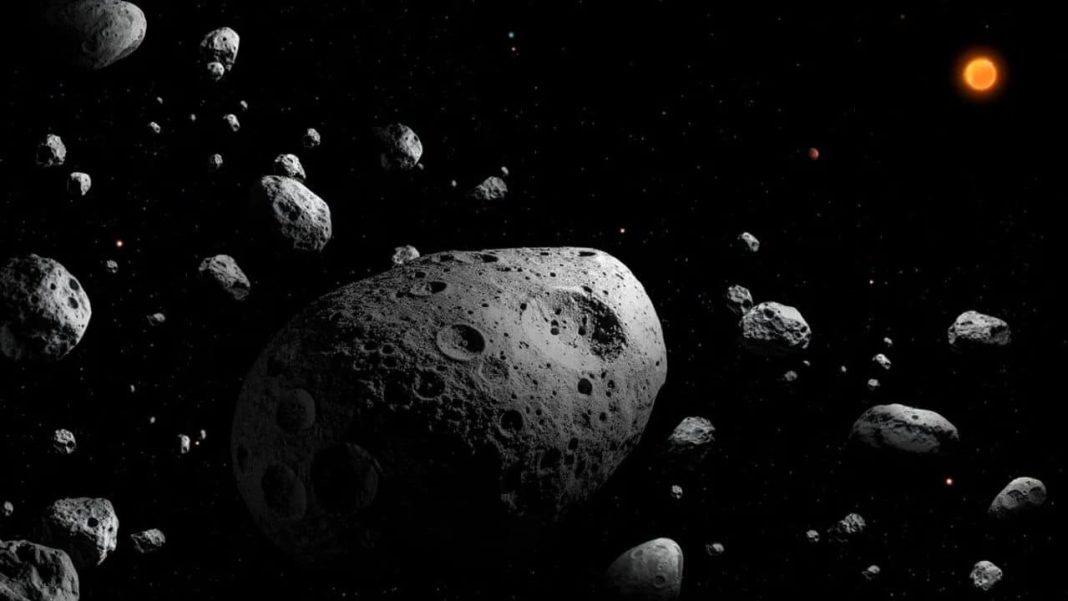
Even before its full operational phase begins, the Rubin Observatory’s formidable vision has already paid dividends. Early data collected during its commissioning and calibration tests have revealed a giant asteroid rotating at a speed that has left astronomers captivated. This particular celestial body, provisionally designated, spins on its axis once every few hours, placing it among the fastest rotating large asteroids known to science. Such extreme rotation poses fascinating questions about its composition and formation history. Objects spinning too fast can break apart, suggesting this asteroid must be remarkably cohesive or dense.
The detection of such an object highlights the observatory’s extraordinary ability to detect subtle changes and movements across vast stretches of the sky. Its wide field of view and rapid survey cadence are perfectly suited for identifying fast-moving objects like asteroids, comets, and other transient events that might otherwise go unnoticed. This particular discovery is not just a statistical anomaly; it provides vital clues about the dynamics of the asteroid belt and the processes that shaped our solar system.
Dr. Anjali Sharma, an astrophysicist based in Bengaluru, commented on the significance: “The Rubin Observatory’s early discoveries, like this incredibly fast-spinning asteroid, demonstrate its profound potential. For us in India, access to its data will open new avenues for research, allowing our astronomers to contribute to global efforts in understanding planetary defense and the evolution of minor bodies in our cosmic neighbourhood.” Her words resonate with the growing ambition within India’s scientific community to participate actively in leading-edge global astronomical endeavors.
A Future Brimming with Discovery
The discovery of the fast-spinning asteroid is merely a preamble to the scientific feast that the Vera C. Rubin Observatory is poised to deliver. Once fully operational, it will conduct a ten-year survey, continuously mapping the ever-changing universe. This constant vigilance will not only lead to the identification of millions of new celestial objects but also track their movements and evolutions, providing unprecedented insights into the dynamic nature of our cosmos.
From monitoring potential asteroid threats to charting the expansion of the universe and probing the mysteries of dark matter and dark energy, the observatory is set to generate data that will fuel astronomical research for decades. For India, a nation with a rich history of stargazing and a burgeoning scientific prowess, these developments are particularly exciting. They represent not just an opportunity to observe from afar, but to actively participate in the collective human quest to understand our place in the vast, awe-inspiring universe.
The universe continues to surprise us, and with instruments like the Vera C. Rubin Observatory leading the charge, we are better equipped than ever to listen to its ancient whispers and decipher its profound secrets.

