


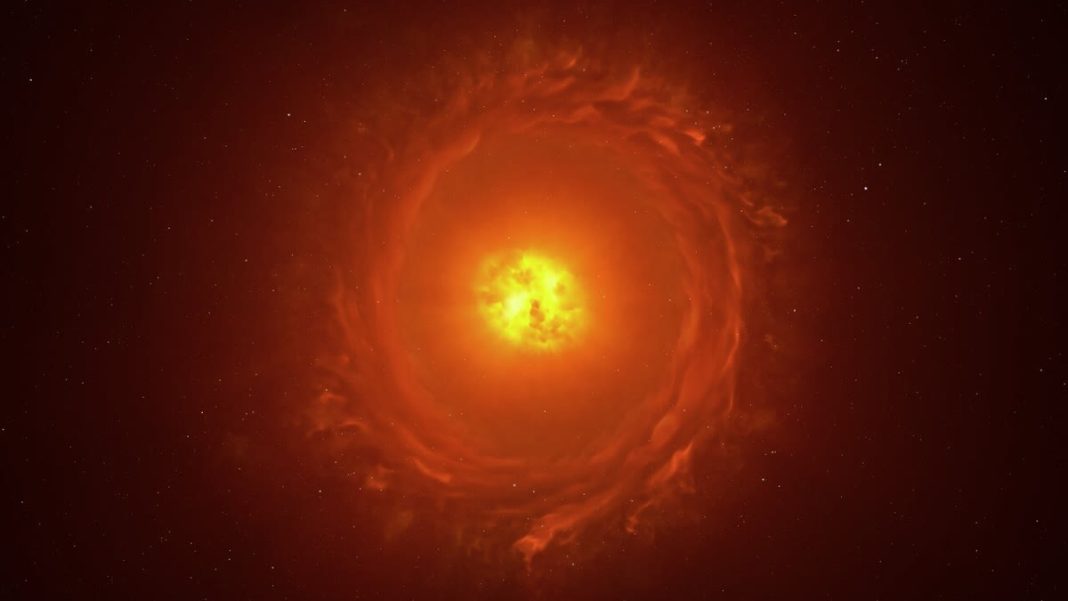
In the vast canvas of the cosmos, where stars are born, live, and dramatically perish, certain celestial bodies capture our imagination more than others. One such star, a true behemoth residing millions of light-years away, is WOH G64. This colossal red supergiant, nestled within the Large Magellanic Cloud, has long been a subject of fascination for astronomers. However, recent observations have revealed a startling transformation: WOH G64 appears to have undergone a significant colour shift, a cosmic beacon that may signal its imminent, cataclysmic demise as one of the universe’s most spectacular supernovae.
WOH G64: A Gargantuan in the Galaxy
Located approximately 163,000 light-years from Earth in the Large Magellanic Cloud, a satellite galaxy of our Milky Way, WOH G64 is not just large; it is truly gargantuan. Estimates place its radius at an astonishing 1,500 to 2,000 times that of our Sun, making it one of the largest known stars in the universe. If placed at the centre of our solar system, its sheer size would engulf the orbits of Jupiter and Saturn, extending well beyond them. With a luminosity hundreds of thousands of times greater than the Sun, WOH G64 radiates an immense amount of energy, dominating its cosmic neighbourhood.
For most of its observable life, WOH G64 has been classified as a red supergiant—a phase in the evolution of massive stars characterised by their immense size, cool surface temperatures, and reddish hue. These stars are in their final stages of hydrogen fusion in their core, having expanded dramatically as they begin to burn heavier elements. Their immense mass and rapid fuel consumption mean their lifespan is remarkably short in astronomical terms, often just a few million years compared to our Sun’s billions.
The Alarming Colour Shift and Stellar Evolution
What has captivated the scientific community recently is the observed change in WOH G64’s spectral signature and perceived colour. While precise details are still being analysed, the star appears to be shedding its characteristic red supergiant appearance, transitioning towards a hotter, bluer phase. This is not merely a cosmetic change; it’s a profound indicator of a star undergoing rapid and violent internal processes.
Astronomers theorise that a red supergiant switching from a cooler, red phase to a hotter, bluer one signifies that it is shedding its outer hydrogen envelope at an accelerated rate. This dramatic mass loss exposes the hotter, inner layers of the star, transforming it into what is known as a Wolf-Rayet star. This transitional phase is extremely short-lived, astronomically speaking, and is a strong precursor to a Type II supernova. The star’s core, now stripped of its protective outer layers, is rapidly approaching a critical mass and density where it can no longer support itself against its own gravity.
“The shift in WOH G64’s spectral characteristics is a compelling signal,” explains Dr. Kavita Sharma, a leading astrophysicist at the Indian Institute of Astrophysics. “It suggests the star is in an advanced, highly unstable state. We are likely witnessing the penultimate act of a cosmic drama, a process that will culminate in one of the most energetic events in the universe.”
The Specter of a Supernova and Its Cosmic Impact
When a star as massive as WOH G64 exhausts its nuclear fuel, its core collapses under immense gravity, triggering a catastrophic explosion known as a supernova. This event unleashes more energy in a few moments than the Sun will emit in its entire 10-billion-year lifespan. For observers on Earth, even at a distance of 163,000 light-years, a supernova from WOH G64 would be a spectacular sight, potentially visible in our night sky as a brilliant, new ‘star’ for weeks or even months.
Beyond the visual spectacle, such an event holds immense scientific value. Supernovae are the primary cosmic factories for most of the heavy elements in the universe, including those vital for life itself—like iron, oxygen, and carbon. Studying an imminent or ongoing supernova provides an unparalleled opportunity to understand stellar nucleosynthesis, the formation of neutron stars or black holes (the remnants left behind), and the dynamics of extreme astrophysical phenomena. While predicting the exact moment of explosion is impossible—it could be tomorrow, or thousands of years from now—the observed changes in WOH G64 intensify the anticipation.
WOH G64 serves as a potent reminder of the dynamic and violent processes that shape our universe. Its recent colour transformation is not merely a curiosity but a crucial observation, offering astronomers a rare glimpse into the dramatic final stages of a true stellar titan. As telescopes worldwide continue to gaze upon this distant, enigmatic star, the cosmic countdown has arguably begun, promising a future spectacle that will illuminate our understanding of the universe’s most powerful events.
—

