


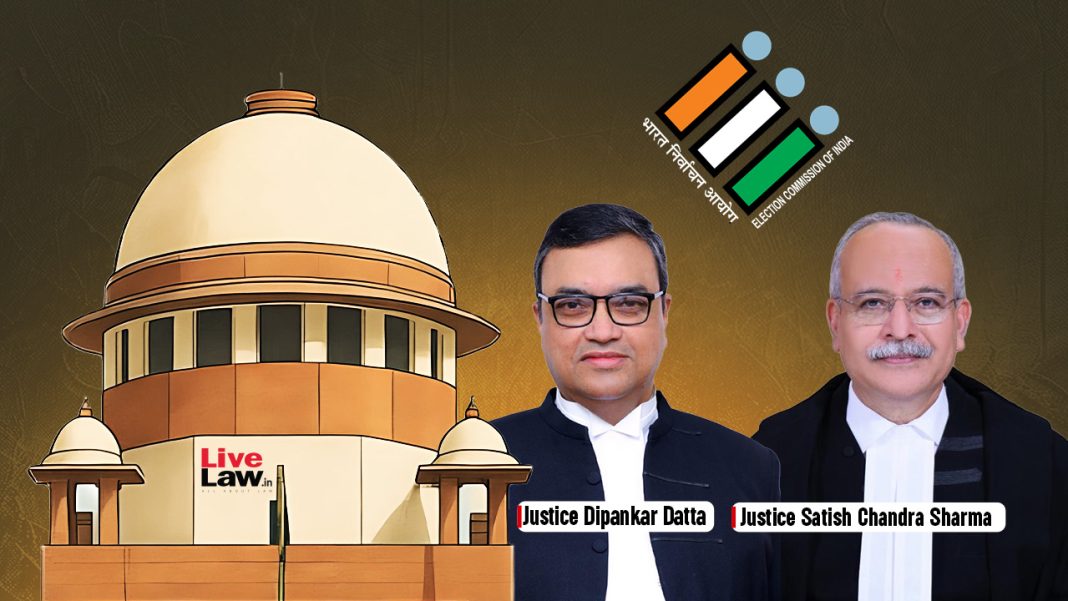
The hallowed halls of the Supreme Court of India recently reverberated with an observation that has once again cast a spotlight on the perennial issue of judicial appointments. In a pointed remark, the apex court expressed a desire for the appointment of judges to be as swift and efficient as that of Election Commissioners, drawing a stark contrast between two critical state functions. This commentary from the bench of Justices Sanjay Kishan Kaul and Sudhanshu Dhulia underscores the growing frustration within the judiciary over prolonged delays in filling vacancies, a bottleneck that significantly impedes the justice delivery system across the nation.
The Supreme Court’s Resonant Call
The observation came during a hearing concerning the government’s pace in approving names recommended by the Collegium for various High Courts. With a staggering backlog of over five crore cases pending across all courts in India, and High Courts grappling with nearly 33% of their sanctioned strength lying vacant, the judiciary’s exasperation is palpable. The Supreme Court highlighted that the government often takes considerable time to process judicial appointments, sometimes even returning recommendations, leading to a protracted back-and-forth between the Collegium and the Executive. This protracted process not only creates an immense burden on existing judges but also denies citizens timely access to justice, a fundamental right.
“We wish judges were appointed as speedily as election commissioners,” the bench remarked, a sentiment that cuts to the core of the institutional relationship between the judiciary and the executive. This statement is not merely a critique; it is a plea for a more streamlined, time-bound mechanism for a process that is vital for the health of India’s democratic framework. The delay in appointments directly contributes to the accumulation of cases, which in turn erodes public trust in the judicial system and exacerbates the problem of judicial pendency.
A Tale of Two Appointment Systems
The comparison drawn by the Supreme Court between judicial appointments and those of Election Commissioners is particularly instructive, highlighting divergent approaches and priorities. While judicial appointments, governed by the Collegium system and the Memorandum of Procedure (MoP), frequently face significant delays, the process for appointing Election Commissioners has recently demonstrated remarkable alacrity. The recent enactment and application of the Chief Election Commissioner and other Election Commissioners (Appointment, Conditions of Service and Term of Office) Bill, 2023, saw the swift constitution of a new selection committee and subsequent appointments, demonstrating that rapid action is possible when the political will is aligned.
The Collegium system, wherein the Supreme Court’s senior-most judges recommend names for judicial appointments, has often been a point of contention between the judiciary and the executive. While the Collegium aims to safeguard judicial independence, the government’s role in vetting and approving these recommendations, sometimes involving delays or even the return of names, creates friction. This dynamic stands in stark contrast to the executive-driven process for Election Commissioner appointments, especially following the recent legislative changes, where a committee comprising the Prime Minister, a Union Cabinet Minister, and the Leader of the Opposition now makes the selections.
Strengthening the Pillars of Justice and Democracy
The timely appointment of judges is not merely an administrative issue; it is a constitutional imperative that underpins the rule of law and the functioning of a vibrant democracy. A fully staffed and efficient judiciary is indispensable for upholding fundamental rights, interpreting laws, and ensuring checks and balances against potential executive overreach. When vacancies persist, the institutional capacity of the judiciary diminishes, leading to an overburdened system where justice delayed often becomes justice denied.
The Supreme Court’s observation serves as a crucial reminder that a robust justice system requires proactive and collaborative efforts from both the judiciary and the executive. While safeguarding the independence of the judiciary remains paramount, a consensus-driven approach to appointments, characterized by transparency, efficiency, and adherence to established timelines, is equally vital. The nation’s legal fraternity and citizens alike await tangible reforms that can bridge the gap between the urgency expressed by the judiciary and the practicalities of the appointment process, ensuring that the wheels of justice turn swiftly and without impediment.
The challenge lies in finding a harmonious pathway that respects the constitutional framework while also addressing the pressing need for a fully functional judiciary. Only then can the wish expressed by the Supreme Court transition from a mere observation to a lived reality, bolstering public faith in India’s democratic institutions.

