


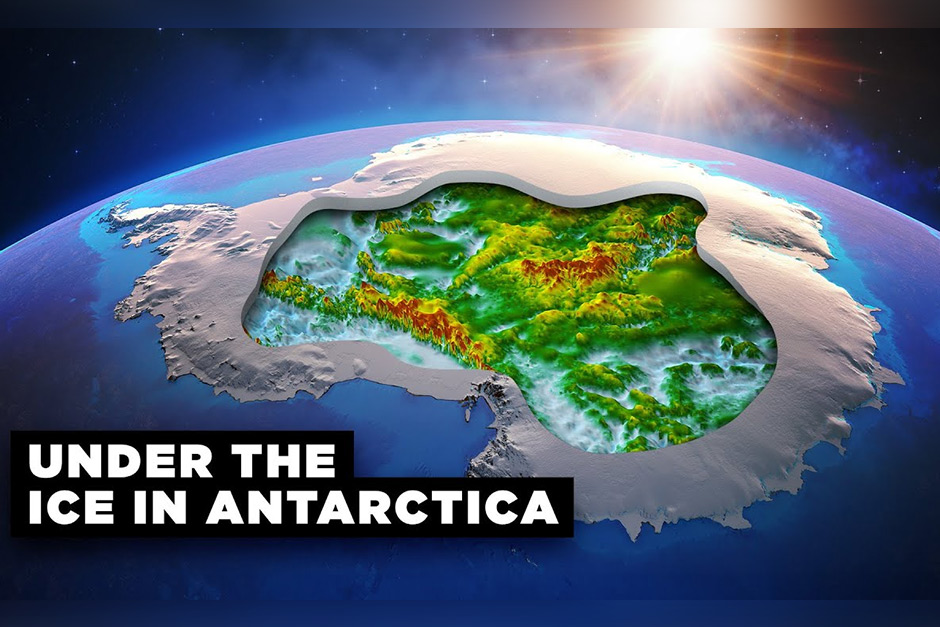
Antarctica. Just the name conjures images of an immense, frozen realm, a land of stark white stretching to the horizons. For centuries, this colossal continent has held its secrets close, its vast ice sheet acting as an impenetrable shield, hiding whatever lies beneath. But thanks to incredible scientific advancements and relentless curiosity, that shield is beginning to lift, revealing landscapes and mysteries more astonishing than we ever imagined.
We’re not just talking about a few hills; we’re talking about entire worlds, preserved and reshaped by millennia of ice. The revelations coming from beneath Antarctica are transforming our understanding of Earth’s geology, its history, and even the potential for life in extreme environments. It’s like finding an ancient map, but instead of charting oceans, it charts hidden continents.
Peering Beneath the Veil: How We’re Seeing More
Unlocking Antarctica’s underground narratives isn’t about digging; it’s about seeing with new eyes. Scientists are employing a suite of sophisticated technologies that are literally X-raying the continent. Ice-penetrating radar, mounted on planes and even satellites, sends signals through miles of ice, bouncing off the bedrock below to create detailed topographic maps. This isn’t just a blurry image; we’re getting resolutions that allow us to discern valleys, mountain ranges, and intricate drainage systems.
Seismic surveys, another crucial tool, use sound waves to map geological structures deep within the Earth’s crust, giving us clues about the ancient plate tectonics that shaped this continent before the ice took hold. Add to this the occasional deep-drilling expeditions that bring up actual samples from subglacial lakes, and you begin to understand the unprecedented level of detail we’re now privy to. It’s a technological marvel, allowing us to reconstruct environments that have been hidden from sunlight for millions of years.
Unearthing Ancient Landscapes and Alien Worlds
So, what exactly have these groundbreaking techniques revealed? Prepare to be amazed. We’re talking about sprawling mountain ranges rivaling the Alps, deep canyons larger than the Grand Canyon, and vast river systems carving channels beneath the ice. Perhaps most captivating are the hundreds of subglacial lakes, some as large as major inland seas, isolated from the surface world for eons. These aren’t just stagnant pools; they’re dynamic environments, potentially teeming with unique life forms that have evolved in complete darkness, feeding off chemosynthesis from rocks.
Imagine finding an entire forest fossilized in place, or remnants of ancient rivers that flowed when Antarctica was a lush, temperate land. These discoveries aren’t just abstract data points; they’re tangible glimpses into Earth’s deep past. As Dr. Anya Sharma, a glaciologist we spoke with, put it beautifully: “It’s like finding entire lost continents under our very feet, teeming with possibilities we never dared to imagine.”
Why These Hidden Worlds Matter to All of Us
These revelations from beneath the ice are far more than just fascinating curiosities. They are critical to understanding our planet’s future. The topography beneath the ice plays a crucial role in how fast ice sheets move, how stable they are, and ultimately, how much they contribute to global sea-level rise. Knowing whether a glacier is sitting on a steep, slippery bedrock valley or a bumpy, resistant plain can dramatically alter predictions for melting and ice loss.
Moreover, the ecosystems within subglacial lakes offer unparalleled opportunities to study extremophiles and understand the limits of life, potentially informing our search for life beyond Earth. And the ancient geological record preserved beneath the ice provides invaluable insights into Earth’s climatic history, helping us understand past warm periods and how the planet responded.
Antarctica, once a symbol of Earth’s frozen silence, is now speaking volumes. The stories emerging from beneath its ice are tales of ancient landscapes, unique biology, and crucial climate data. As our technological prowess grows, so too does our understanding of this enigmatic continent, reminding us that even in the most extreme corners of our world, there are always new wonders waiting to be revealed.

