


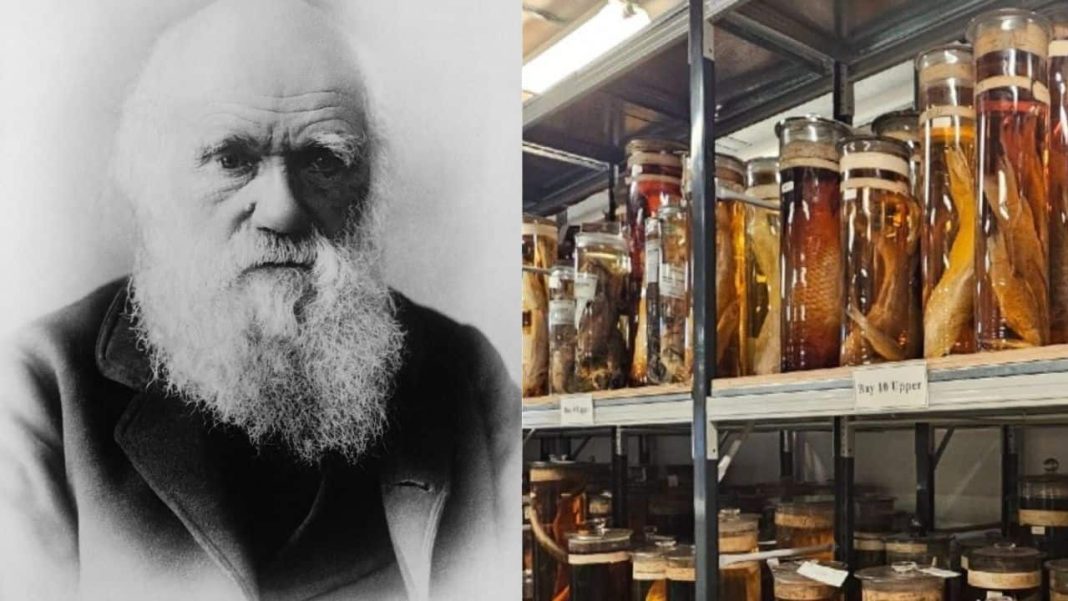
In the hallowed halls of the Natural History Museum in London, reside some of the most profound relics of scientific history: the specimens collected by Charles Darwin. These humble jars, sealed for nearly two centuries, hold the physical evidence that underpinned revolutionary theories about life on Earth. But what if one could peer into these time capsules without ever disturbing their fragile contents? This wasn’t a question for mere speculation when a team of international scientists recently aimed high-tech lasers at Darwin’s meticulously preserved creatures, promising to unlock secrets from the past. The findings offer an extraordinary glimpse into historical preservation methods and the hidden stories within these iconic jars.
Darwin’s Time Capsules: A Legacy Under Scrutiny
Charles Darwin’s voyage on HMS Beagle, from 1831 to 1836, was a pivotal journey that transformed our understanding of natural history. During this expedition, he meticulously collected thousands of specimens – barnacles, marine worms, and countless other species – which later served as crucial evidence for his groundbreaking theories of evolution by natural selection. These specimens, many of them preserved in sealed glass jars, are more than just scientific samples; they are tangible links to a bygone era of discovery and a testament to Darwin’s rigorous empirical approach.
For generations, these jars have remained largely untouched, their contents a mystery accessible only to curators with difficult choices to make regarding their conservation. Opening them risked contamination, damage to the delicate specimens, or alteration of the historical preservation fluid. The challenge for modern science has been to extract information from these invaluable artefacts without compromising their integrity. This is where cutting-edge technology intersects with historical preservation, offering new possibilities for exploration.
The Laser’s Gaze: Unveiling Secrets Non-Invasively
The innovative solution came in the form of Raman spectroscopy, a powerful, non-destructive analytical technique. Unlike methods that require physical samples, Raman spectroscopy uses a laser to illuminate a substance, causing its molecules to vibrate and scatter light in a unique pattern. This scattered light creates a “fingerprint” spectrum that reveals the chemical composition of the material. In simpler terms, scientists could aim a precise laser beam through the glass of Darwin’s jars, allowing them to identify the compounds within the preservation fluid and even glean information about the specimens themselves, all without ever breaking the seal.
This technique is particularly revolutionary for museum collections and heritage science. It allows researchers to analyse highly fragile or historically significant objects that cannot be handled or sampled directly. The application to Darwin’s jars represents a significant leap forward in understanding historical scientific practices and the long-term stability of biological specimens. It’s a testament to how modern scientific ingenuity can illuminate the past while safeguarding its treasures.
What the Lasers Revealed: Echoes from the 19th Century
The laser analysis provided fascinating insights into the preservation methods employed by Darwin and his contemporaries. Researchers confirmed that many of the specimens were preserved in ethanol, often diluted with water, a common practice of the time. However, the lasers also detected subtle chemical changes and degradation products that had accumulated over the past two centuries. This included identifying compounds that suggested interactions between the specimens, the fluid, and even the glass of the jars themselves.
“These specimens are not just scientific objects; they are irreplaceable time capsules that offer a direct link to the very foundations of evolutionary biology,” says a leading heritage scientist involved in the project. “Raman spectroscopy has allowed us an unprecedented, non-invasive look into the chemical narratives held within these jars, providing vital information for their ongoing conservation and a deeper understanding of Darwin’s scientific methodology.”
Furthermore, the study provided clues about the original conditions of preservation and how they might have changed over time due to factors like light exposure or temperature fluctuations. Understanding these historical degradation pathways is crucial for museum conservators who are tasked with ensuring these invaluable collections survive for future generations. The information gleaned from these laser probes can help guide optimal storage conditions and inform restorative practices.
This remarkable intersection of historical artefacts and cutting-edge technology underscores the enduring appeal of scientific discovery. By firing lasers at Darwin’s 200-year-old sealed jars, scientists have not only unveiled hidden chemical compositions but have also reaffirmed the boundless potential of interdisciplinary research to illuminate our past and inform our future. It’s a powerful reminder that even the oldest secrets can yield new insights when viewed through the lens of modern innovation, continuing Darwin’s legacy of meticulous observation and profound understanding.

