


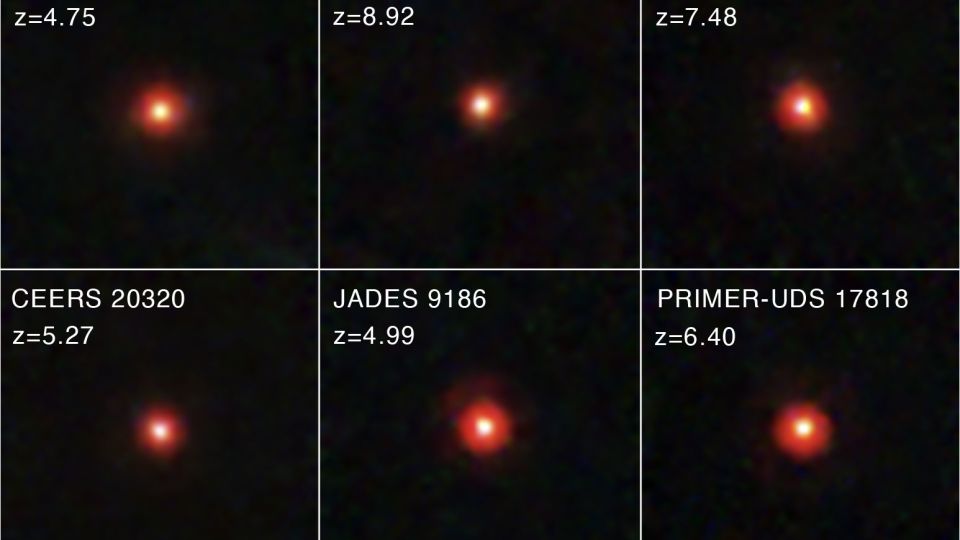
The James Webb Space Telescope continues to deliver mind-bending images of the cosmos, pushing the boundaries of what we thought possible to observe. From the majestic Pillars of Creation to the farthest reaches of the early universe, Webb’s vision is unparalleled. But amidst the breathtaking beauty and scientific revelations, a perplexing mystery has emerged – a scattering of tiny, incredibly bright red dots that have astronomers scratching their heads. These aren’t just quirky observations; they’re cosmic enigmas that defy our current understanding of the universe, and right now, astronomers have absolutely no idea what they are.
A Cosmic Anomaly Among the Wonders
Webb’s infrared capabilities allow us to peer back in time, observing galaxies as they were just hundreds of millions of years after the Big Bang. These ultra-deep field images are where the mysterious red dots are most prominent. Unlike the familiar spirals and ellipticals, or even the nascent, irregularly shaped galaxies we expected to find in the early universe, these dots are remarkably compact. They’re tiny, yet their incredible brightness in the infrared spectrum suggests they are either extremely energetic or far closer than their apparent size would imply – but neither scenario fits comfortably with existing models.
Astronomers have meticulously ruled out common explanations. They aren’t foreground stars, as their light signature is distinctly different, showing significant redshift. They don’t appear to be typical nascent galaxies, which would generally be larger, more diffuse, or exhibit different spectral characteristics. They’re too red, too bright for their apparent size, and don’t seem to possess the tell-tale signs of the super-massive black holes usually found at the heart of early galaxies. These dots are something altogether new, an unexpected signal from the deep cosmic past that refuses to conform to our expectations.
Theories Emerge, But Certainty Lacks
The scientific community, a blend of brilliant minds and healthy skepticism, is buzzing with potential explanations, yet no single theory has gained widespread traction. One hypothesis suggests they could be a previously unimagined class of ultra-compact, hyper-luminous galaxies, perhaps undergoing an exceptionally rapid and intense burst of star formation – but again, their extreme redness and small size make this challenging to reconcile. Another idea floats the possibility of “dark” galaxies, primarily composed of dark matter, with only a tiny, bright core of ordinary matter, though evidence for such structures is still theoretical.
Some even speculate about a new form of cosmic object entirely, something we haven’t yet conceived. The sheer novelty of these observations is what makes them so captivating. As Dr. Anya Sharma, an astrophysicist at the Leiden Observatory, put it, “Every time Webb sends new data, we expect to refine our understanding. But these red dots? They’re not just refining; they’re fundamentally challenging our textbooks. It’s like finding an entirely new color in a palette we thought we knew perfectly.” This feeling of wonder mixed with profound bewilderment is palpable throughout the astronomical community.
A Universe Still Full of Secrets
The mystery of the red dots underscores a vital truth about scientific exploration: every answer often leads to a dozen new questions. While we celebrate Webb’s ability to show us so much, these anomalies remind us that the universe is still vastly unexplored and far more complex than our current models can fully encompass. These dots are not a flaw in Webb’s data; they are an exciting invitation to push the boundaries of our knowledge, to reconsider fundamental assumptions about galaxy formation, the early universe, and even the nature of matter and energy.
For now, the little red dots remain an enigma, a captivating blank space in our cosmic understanding. But with Webb continuing its groundbreaking observations, and the world’s best scientific minds focused on this puzzle, it’s only a matter of time before these mysterious signals begin to yield their secrets, potentially rewriting chapters in our cosmic history books. The universe, it seems, always has a few surprises left in store.

