


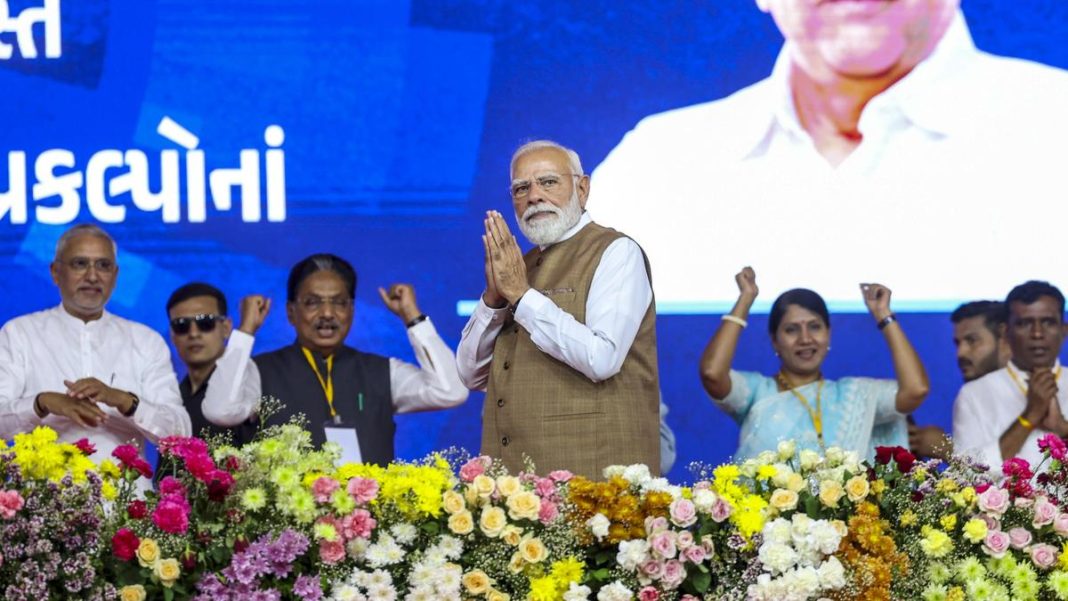
In a politically charged address amidst election campaigning, Prime Minister Narendra Modi escalated his rhetoric against the Congress party, accusing them of exploiting the unfolding West Asia conflict for electoral advantage. Speaking at a public rally, PM Modi sharply criticized the opposition, likening their alleged actions to those of “political vultures” seeking to spread panic and instability among the Indian populace for selfish gains. This strong condemnation highlights how global geopolitical events are increasingly becoming fodder for domestic political battles in India, particularly as the nation gears up for crucial elections.
PM Modi’s Scathing Indictment
Prime Minister Modi’s remarks came during an intense phase of the election campaign, where leaders often use platforms to differentiate themselves from rivals. His accusation centered on the premise that the Congress party was attempting to create alarm and fear regarding the West Asia conflict, thereby undermining national unity and trust in the government’s ability to navigate complex international challenges. The Prime Minister underscored the sensitive nature of the conflict, pointing to its potential for humanitarian crises and economic repercussions, and lambasted what he perceived as irresponsible political opportunism.
Highlighting the government’s approach, Modi asserted India’s consistent stance of advocating for peace and stability in the region, while also working to ensure the safety of Indian citizens abroad and mitigating any adverse economic impacts at home. He stressed that a responsible opposition should ideally support national efforts during such times, rather than sow discord. “When a global crisis like the West Asia conflict emerges, a responsible nation comes together,” Modi stated. “But some in our opposition, driven by their hunger for power, act like political vultures. They see suffering as an opportunity to spread panic and fear among our people, solely for their political gains.” This pointed remark underscored the depth of the political chasm between the ruling party and the opposition on matters of national and international significance.
Congress’s Concerns and the Opposition’s Narrative
The Congress party, for its part, has articulated concerns regarding the West Asia conflict primarily from a humanitarian perspective and its potential implications for India. Their narrative has often focused on the need for de-escalation, protection of civilians, and the broader impact on global peace and stability. Some Congress leaders have also questioned the government’s perceived silence or delayed response on certain aspects of the conflict, suggesting a need for a more proactive and vocal stance from New Delhi.
Opposition parties frequently scrutinize the government’s foreign policy decisions, especially when they intersect with domestic issues such as economic stability (e.g., oil prices, trade routes) or the welfare of the Indian diaspora. While the Congress has not explicitly stated that they are “spreading panic,” their criticisms often aim to highlight potential vulnerabilities or shortcomings in the government’s handling of international affairs. This divergence in approach naturally leads to political friction, with the ruling party interpreting such criticism as an attempt to undermine public confidence, especially during periods of global uncertainty.
Geopolitics as a Domestic Political Battleground
The politicization of the West Asia conflict by both the ruling party and the opposition underscores a growing trend in Indian politics: global events are increasingly being framed within a domestic electoral context. Issues like international relations, trade policies, and humanitarian crises, once largely discussed in foreign policy circles, are now potent tools for political mobilization and critique on the national stage. For the BJP, presenting itself as a strong, decisive government capable of navigating complex global challenges is key to its electoral narrative. Conversely, the Congress often seeks to position itself as the voice of caution and concern, ready to hold the government accountable for its actions and inactions on the world stage.
This dynamic ensures that debates surrounding the West Asia conflict are not just about foreign policy principles but also about projecting an image of leadership, competence, and national interest to the electorate. As India continues to play a significant role on the global stage, such political exchanges are likely to become more frequent, shaping not only the discourse around international events but also the trajectory of domestic political contests.
The Prime Minister’s sharp critique reflects a heightened political climate where even external crises are drawn into the domestic electoral fray. While the West Asia conflict continues to evolve, its ripples are clearly being felt in India’s political arena, with both sides striving to control the narrative and capitalize on public sentiment.

